


Saturday's movie platforms - Alice Bruxelle
Since it's gone almost unnoticed, it's time to shine the spotlight on the new Ryuichi Hiroki, available on Netflix. Romance rather than psychological thriller, Ride or Die takes us on an emotional journey through the Japanese countryside. Adapted from the manga Gunjōe, this Thelma and Louise Above all, trash reflects a certain malaise within Japanese civilization.
Would you kill for love? For any normal person, this is a question that requires at least a short period of reflection. Rei (Kiko Mizuhara), on the other hand, never hesitated when she plunged a piece of glass down the throat of the violent husband of the woman she loved. Ten years after leaving high school, Nanae (Honami Satô) asks Rei to liquidate the man who beats her day and night.
In this picture of contemporary Japan, the two of them begin a flight to nowhere, where feelings, irrationality and violence mingle. It is through the prism of two women in love that Ryuichi Hiroki offers us his vision. Bloody, almost graphic scenes follow on from sex scenes, and we become immersed in the lives of two women and all their ambiguities and contradictions.
Failed thriller, successful romance
The development of the two protagonists corresponds to two hackneyed, not to say clichéd, social carcasses: Rei, a middle-class woman who doesn't understand the principle of cooking if underlings do it for her, and Nanae, covered in bruises from head to toe, formerly beaten up by her father, then by her husband, and ready to prostitute herself to pay for her studies.
The linear narrative of road movie is interspersed with numerous flashbacks explaining the genesis of their friendship. These additions not only break the momentum with which the adventures unfold, but also reinforce the idea that the film is more of a romance than a psychological thriller, as advertised. The film's thriller genre misses the mark: linear narrative, predictable plot twists and little suspense. Despite these pitfalls, the romance is convincing, thanks in particular to the sometimes youthful, sometimes serious acting and the palpable chemistry of the two performers.
A look at women and sexuality
Ryuichi Hiroki is first and foremost a director whose favorite subject is women. Present in almost all his films, notably in the excellent Vibrator (2003), in which a psychologically troubled woman becomes infatuated with a truck driver, with whom she discovers her sexuality. Or The Egoists (2011), in which a stripper and an inveterate gambler attempt to wipe the slate clean and build a new life. Exposing his actors, the director constructs characters in search of their own sexuality, constantly skirting the limits of marginality within a well-framed Japanese society. Ride or Die is no exception to the director's logic.
Neither friends nor lovers, their relationship is intimate, but we have to wait until the film's second hour to see any tender gestures. Between distance and fusion, alternating wide shots on the outside and close-ups on the inside, the filmmaker plays with ambivalence, and the no man's land in which he places their relationship.
In addition to his focus on women and sexuality, Ryuichi Hiroki's uncluttered staging also features characters on the fringes of marginality. This is materialized by the consideration given to female homosexuality in the Japanese landscape. Even if Japan is a relatively open country when it comes to such issues, there remains a certain malaise within families, as evidenced by the character of Rei's ex-girlfriend, who cries at not being able to give her mother children, or Rei, who at the age of 29, remains in the deepest of closets for fear of offending «family piety». Without being totally marginalized, they skirt the edges of convention in this conservative climate accentuated by the ultra-violence of the men.
Not falling into a gratuitous lawsuit against them, the film is first and foremost a search for self-liberation that is achieved only through escape. Incidentally, the film itself has joined the very tight list of Japanese lesbian films that includes, among others Kakera: A Piece of Our Life (2009) or Manji (1964). Perhaps the land of the rising sun will see the rainbow a little brighter one day.
Write to the author: alice.bruxelle@leregardlibre.com
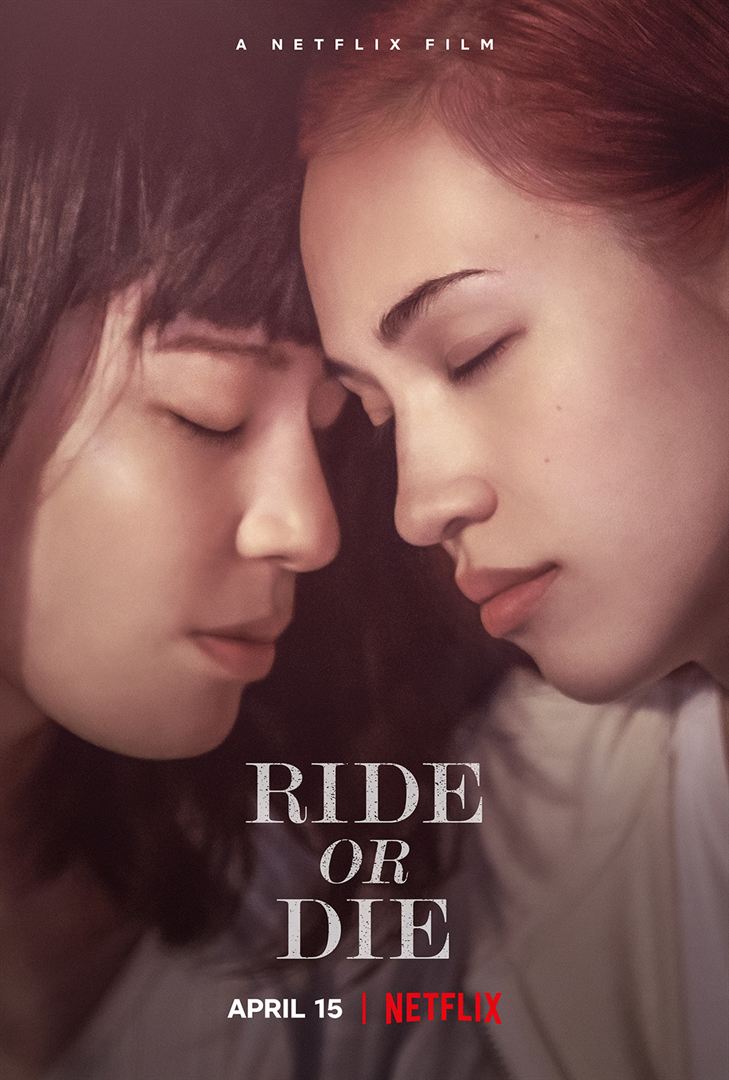
Photo credits: © Netflix
 French
  German
  English