



See Vesoul and relive
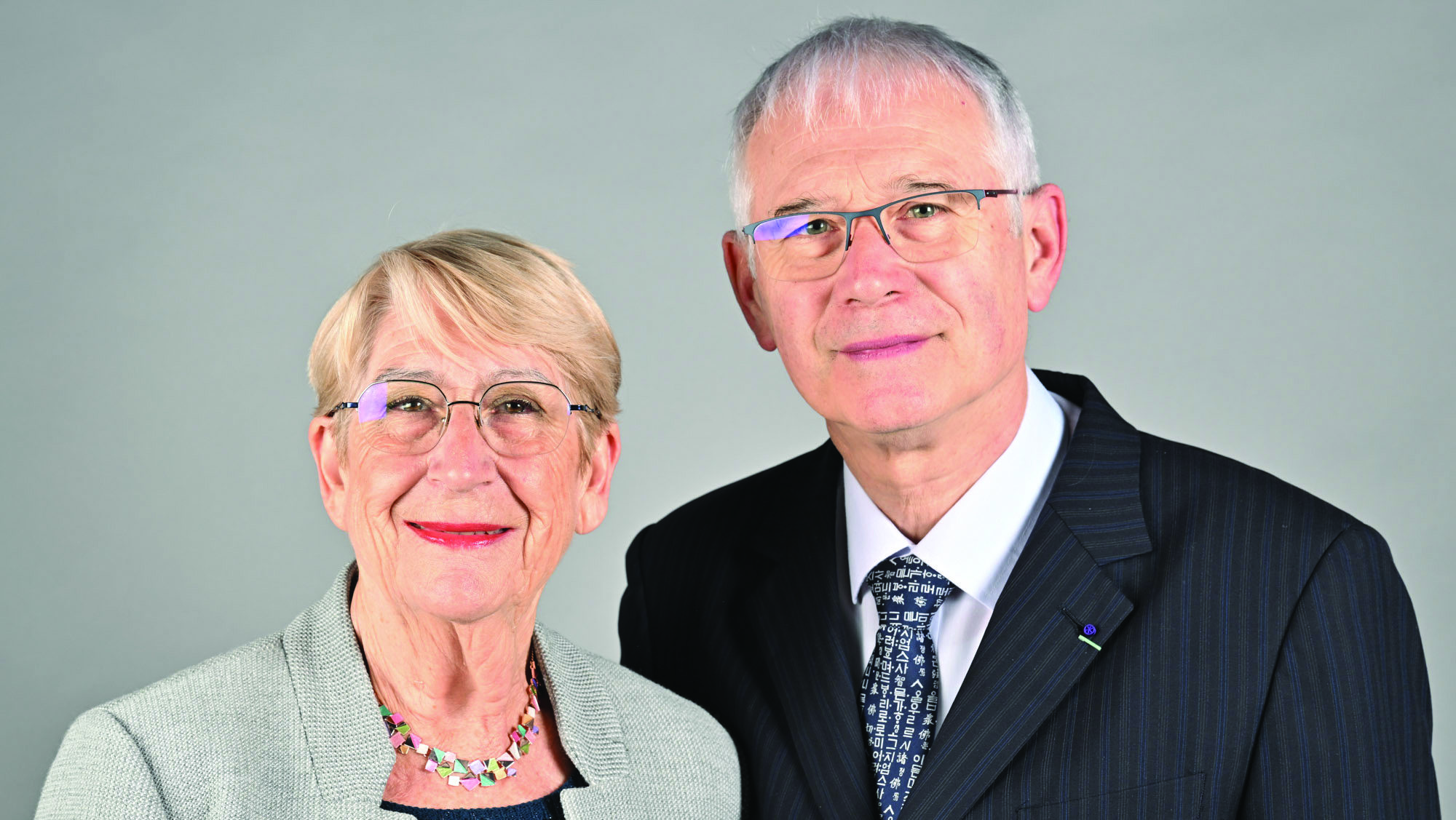
Martine and Jean-Marc Thérouanne. Photo: jfmaillot
In Vesoul, the Festival international des cinémas d'Asie, whose new edition kicks off on January 27, sells out every year. Meet Martine and Jean-Marc Thérouanne, the architects of a cultural miracle that is both demanding and popular.
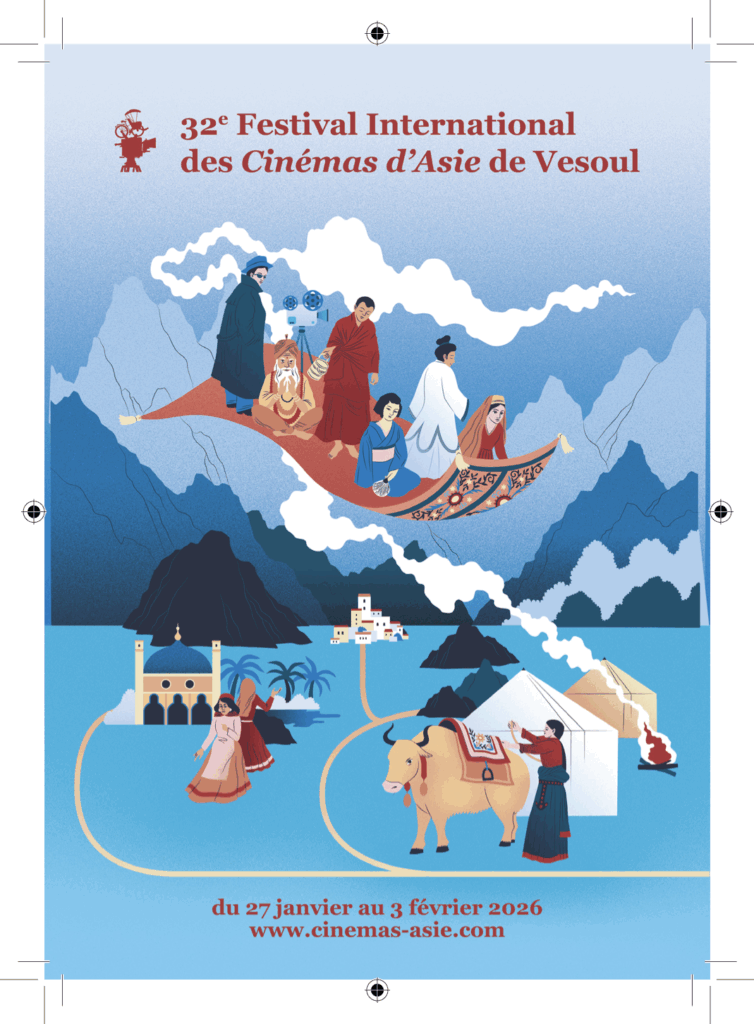
La 32th he Festival International des Cinémas d'Asie (FICA) de Vesoul will take place from January 27 to February 3, 2026. For eight days, the town will sparkle with a thousand lights. Emerging and established filmmakers will be there with gusto, but what's most incredible, in these times of cultural stagnation, is that theaters will be packed to the rafters at every screening, as they are every year.
The festival's audience is indeed a loyal one. They often come from far and wide, and chat cheerfully in the queues about the films they've just seen, or those they'll be seeing later in the day. Some spectators attend up to four screenings, and still find the strength and desire to participate in the afters, These events bring together international producers, celebrities and cosmopolitan and local visitors for cocktails, quizzes and wild dancing.
Read also | All our festival articles
The miracle is manifold. How is it possible to fill cinemas with auteur films from countries whose cinema is little known to the general public, such as Burma, Bhutan, Malaysia, the Philippines, Yemen and Kyrgyzstan? How do these works manage to enthral viewers with the condition of being thousands of kilometers away and far from their own culture, to evoke discriminations and biases of thought without falling into a moralistic or didactic discourse? Where on earth do Martine and Jean-Marc Thérouanne, the directors, find the strength to answer journalists at dawn and set the dance floor alight late at night?
An interview with these magicians of the seventhart, who for more than a week make the small town teased by a famous Brel song one of the most inspiring places on the planet.
Le Regard LibreHow did the festival adventure begin?
Jean-Marc Thérouanne: Since she was a teenager, Martine had been involved in cultural activities with the Association Haute-Saônoise pour la culture, which promoted auteur cinema. In 1989, she co-founded the Ciné-Club des Cinéphiles Vésuliens, first as general secretary, then as president.
1995 was the centenary year of cinema. The brothers Louis and Auguste Lumière were born in Besançon, Franche-Comté. Their father Antoine Lumière, a pioneer in photography, was born in Ormoy in Haute-Saône, a village near Vesoul, in the Franche-Comté region. It was only natural that we should be involved in the centenary celebrations. The members of the board got together to look for an event to mark the occasion. Someone suggested: «What about a festival? That's where Martine's personal history with Asia came in; she proposed »a festival of Asian cinema«.
As backpackers who'd traveled the length and breadth of geographical Asia, from the Near to the Far East, we conceived this event as a festival of Asian cinema, not Asian cinema, to show the plurality of these cinematographies. Films from all over Asia, not just the Far East.
What were the first difficulties you encountered?
Initially, financial support was very modest. The various people I met thought I was crazy: «How can there be an Asian film festival in Vesoul, when there's no Asian community, apart from a few Chinese restaurants and Turkish kebab shops?» Well, it worked, because of the gap that existed in people's minds between Asian cinema and their idea of Vesoul.
We used this discrepancy as a communication tool. I've always rebelled against preconceived ideas. I don't understand why many people think you're smarter in a big city than in a small one. Martine and I have had to fight this prejudice tooth and nail.
Given the modest size of the budget, we had to use it wisely, avoiding waste. We had to convince, convince again, convince again, to increase it step by step, step by step, in the fervor of success.
Financial support is always modest, given the budgets of film festivals of the scale we've achieved. 32,000 spectators at the 31th FICA Vesoul in February 2025.
How come you haven't given up?
We're Franco-Comtois. The motto of Franche-Comté is «Comtois, rends-toi! Nenni, ma foi», and as Bourgogne Franche-Comté, we've made our own the aphorism of the Duke of Burgundy, Charles the Bold: «There's no need to hope to undertake, nor to succeed to persevere». We are a people of courage, and we know that nothing can be taken for granted in this world. The lion is on the flag of Franche-Comté. It takes a lot of hard work to progress little by little, and never to be discouraged.
Did you immediately have the crazy idea that a festival, even one located in a small outlying town like Vesoul, could be a hit?
Vesoul is not eccentric – you can see that when you look at a map of Europe. It's more central than Paris. We're oriented towards Europe. Take the example of four major European film festivals: Locarno (Switzerland), Venice (Italy), Berlin (Germany) and Cannes (France). Vesoul is the same distance from Paris as Locarno (400 km), and Cannes the same distance as Venice (740 km). To get to Berlin, a one-hour flight is all that's needed between Mulhouse-Basel Euroairport (near Vesoul) and Berlin (950 km from Vesoul).
Vesoul is the prefecture of Haute-Saône, and the Communauté d'agglomération de Vesoul is the fifth largest in Franche-Comté. It's a medium-sized community, and, as the saying goes, «small is beautiful».
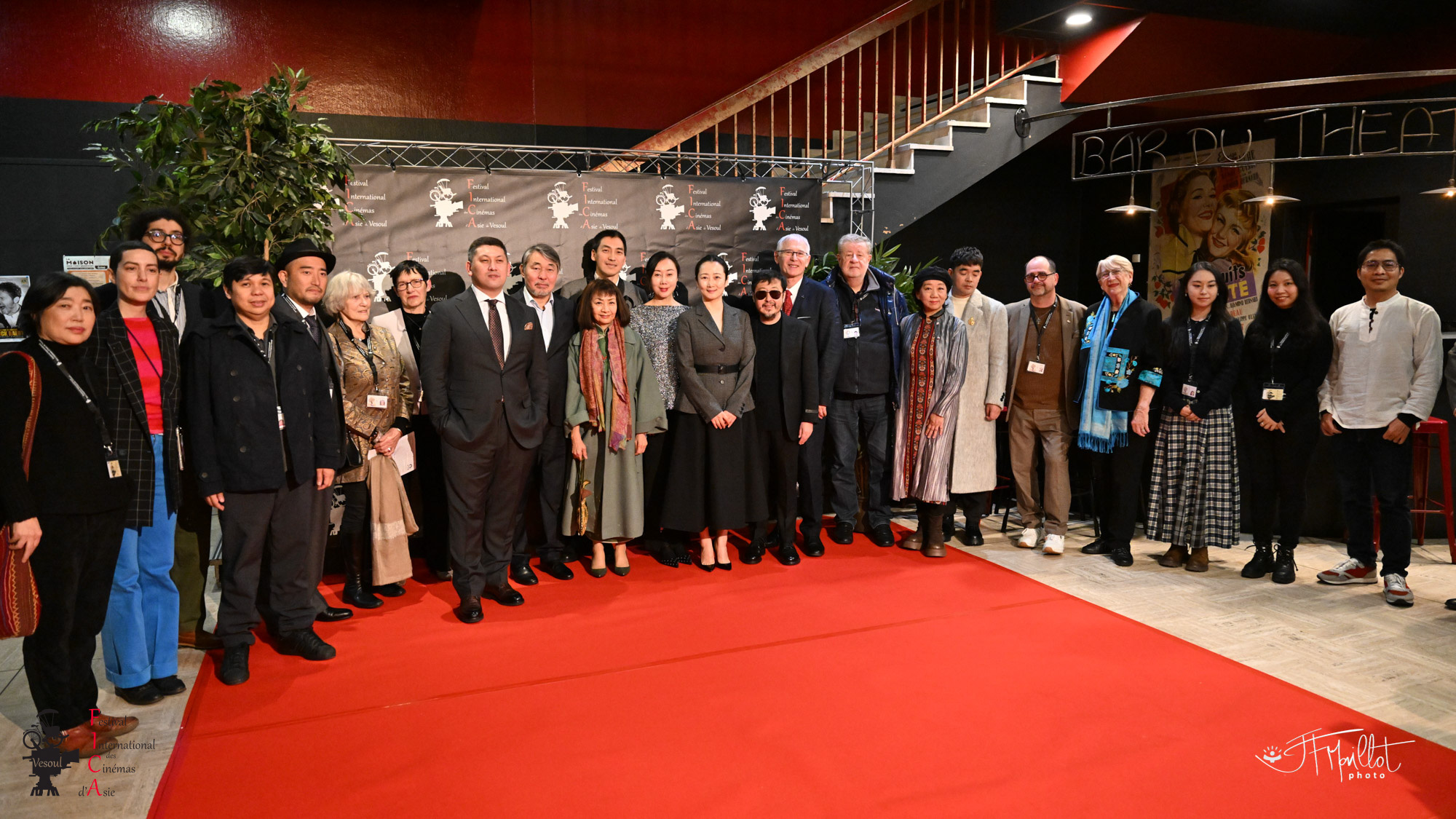
But to answer your question, no, my wife Martine and I didn't immediately have the crazy intuition that the Festival International des Cinémas d'Asie, by dint of hard work, would end up putting Vesoul on the world cinema map, that it would attract such great names as Jafar Panahi (Palme d'or Cannes), Kore Eda Hirokazu (Palme d'or Cannes), Jia Zhang-ke (Lion d'or Venice), Hou Hsiao-hsien (Lion d'or Venice), Tran Anh Hung (Lion d'or Venice), Brillante Mendoza (Prix de la mise en scène de Cannes)...
How did you know that audiences would be interested in films that are contemplative or tackle difficult personal or social issues, far removed from mainstream cinema: perilous border crossings, disturbing disappearances, sexual violence, the prison world, the living conditions of rural writers, feminicide, fatherhood in its various forms, disability, homophobia or infinite loneliness?
Martine and I were both cinema buffs from an early age. In Vesoul, Martine regularly went to the Vox cinema, now the Chez Jane restaurant, for the 8:00 p.m. art house screenings. As a child, I saw major works very early on. I vividly remember my first Asian film, The Naked Islandby Kaneto Shindo, seen at the age of 11, with my father, at the Tivoli cinema in Basse-Terre, Guadeloupe. This cinema was close to the sea, and I could hear its surf during the screening of this minimalist film about the daily lives of peasants living on a small, isolated, arid island where the sea is omnipresent.
There's a whole audience for auteur cinema, which is infinitely more interesting and entertaining than formatted cinema where everything is expected.
Festival-goers come in all shapes and sizes. In its nearly 32 years of existence, the Festival International des Cinémas d'Asie de Vesoul has built up a well-informed audience. Initially, festival-goers were mainly teachers and healthcare professionals, readers of Télérama, France Inter listeners. Thanks to a great deal of work in the field, which can only be described as pedagogical, social backgrounds have diversified. Today, the entire social spectrum is represented. The public has understood that «festival» means «party», and the party is for everyone.
Read also | When documentaries make do with reality
The town of Vesoul has 15,000 inhabitants, the Communauté d'Agglomération 32,000, the Haute-Saône 234,000, the Franche-Comté 1,184,000. So it's essential to work on the ground to mobilize festival-goers.
Of these, 60% come from Haute-Saône, 20% from neighboring departments (Doubs, Territoire de Belfort, Vosges, Côte d'Or, Haute-Marne, Jura), 20% from all over France and even Switzerland and Belgium.
The arrival of the 31stth FICA Vesoul last February, by China's greatest contemporary director, Jia Zhang-ke, and his muse, actress Zhao Tao, drew festival-goers from all over France: Nice, Marseille, Montpellier, Toulouse, Bordeaux, Nantes, Tours, Lille, Compiègne, Strasbourg...
Their presence as President of the Jury, and as the common thread running through their 14 feature-length films, acted like a magnet. In a festival, you always need a headliner as a driving force. Festival-goers come for the big names and discover the future talents. A festival is all about chemistry.
What criteria do you use to select the works you want your audience to discover?
The festival is prepared from one year to the next. Each edition includes an official selection of 90 to 100 films from the Near and Far East, as well as a few films by Western directors interested in Asia (Le Regard de l'Occidental sur l'Asie) or by Asian directors setting up their cameras in the West, with the aim of promoting intercultural dialogue.
For themed sections, tributes, and national, regional or inter-regional films, preparation can take two or even three years.
The «Young Audiences» section keeps us constantly on our toes. We have to find the right films for different age groups: 3-5, 6-8, 9-11 and middle-schoolers. The fact that my wife Martine was a literature teacher, then a librarian in secondary school, and I'm a librarian in junior high school, helps us a lot in our educational choices.
Martine and I are also the festival's artistic directors. We choose the films from among the 700 Asian films we see every year.
Read also | AI, the new betrayal of cinema
For the feature-length fiction competition, films must have been produced within the year, and be presented in their French premiere, or European premiere, or international premiere. The same applies to the short documentary competition.
The two competitive sections are finalized last, between late November and early December, as is the «Preview» section.
To find the films, we are in constant contact with the production companies for unreleased films, and with distributors for theatrically released films, provided they still have the rights. When this is no longer the case, which happens, we are obliged to resort to a treasure hunt to find the rightful owner.
Networking at the festivals we attend is essential. Evenings, aperitifs, dinners and breakfasts are made for this. It's from these encounters that projects are born. It's also about communication. You always have to be on the ball, otherwise you'll be forgotten very quickly. In setting up the FICA Vesoul every year for almost 32 years, I often think of Albert Camus' essay on the myth of Sisyphus! To go on and on up the rock to the top of the mountain – and since this is Asian cinema, it's the Himalayas!
Where is the festival heading?
Our event has grown steadily since its inception. The pandemic prevented us from holding the 27thth festival in February 2021. It took a lot of courage and hard work to get back to pre-Covid attendance levels. On the 26thth edition in February 2020, attendance reached a record 33,000 spectators. The 28th edition (20,000), followed by the 29th (26,000), followed by the 30th (29,000), and finally the 31st to return to this attendance level of 33,000 festival-goers.
In its 31 years of existence, the festival has presented 2,400 films, invited 1,000 filmmakers, awarded 300 prizes and attracted 800,000 spectators. We hope to keep it that way.
What dream would you still like to realize through the festival?
That the festival survives us. That doesn't depend on us, but on the institutions, if they are prepared to increase their subsidies by €100,000, in order to pay the director and general delegate who will come after us.
My wife and I have been working voluntarily for 32 years. We've demonstrated that it's possible to set up an international Asian film festival in a rural département. We've given a taste for culture, and cinema in particular, to a very large number of young people, as evidenced by the attraction of being a member of the Jury Jeune, made up of 90 members each year, or of being a member of the Jury Lycéen, made up of some thirty members at each edition of the festival. Some of them have joined the Festival team and hold important positions.
The festival's trump card is its soul. Writer Laurent Bayart, a keen observer of the event he has attended for many years, describes its essence perfectly in his book V'Asie in Vesoul! 25 years of FICA«This festival, where each spectator has a name, is a unique event and a precious annual rendezvous in «indoor/night» mode and in a (very) original version!»
What do you see as the mission of a film festival?
The mission of a film festival is to bring knowledge to as many people as possible, but also to encourage sharing, openness and tolerance.
What advice would you give to someone who would like to launch a cultural festival?
Working tirelessly seven days a week, twelve months a year.
Have you spotted a country whose cinema is emerging or particularly bold or dynamic?
Over the past 130 years, cinema has spread throughout the world. It would therefore be pretentious to claim that we have identified a country whose cinema is emerging. Our attention was drawn to cinematographies that had just been born under the leadership of filmmakers from the roof of the world. We're thinking in particular of the late Pema Tseden, founder of Tibetan cinema, or Bhutanese filmmakers Khyentse Norbu, Dechen Roder and Pawo Choyning. We paid tribute to Pema Tseden, 3 times Cyclo d'or at Vesoul in 2016 for Tharlo, in 2019 for Jinpa and in 2024 (posthumously) for The Snow Leopard, by organizing a retrospective of his complete works in 2020. This interest in emerging cinematographies has led us to plan a vast retrospective of cinemas from the roof of the world in 2026, with Bhutan taking pride of place.
There are also «fashions» at festivals all over the world. First it was Iranian cinema, then Filipino, then Bollywood, then recently Mongolian and then, for no objective reason, nothing from these countries. And yet, of course, the talent is still there!
Is there anything special about Asian cinema?
In my opinion, there's no such thing as a specific Asian cinema; in fact, there is no such thing as Asian cinema, there are Asian cinemas. Just as there is no such thing as European cinema, there are European cinemas. What do Iranian director Jafar Panahi and Chinese director Zhang Yimou have in common? What do Spanish director Pedro Almodovar and Swedish director Ingmar Bergman have in common? There are individuals who brilliantly use the art of filmmaking to express their vision of the world. I'm talking, of course, about auteur cinema.
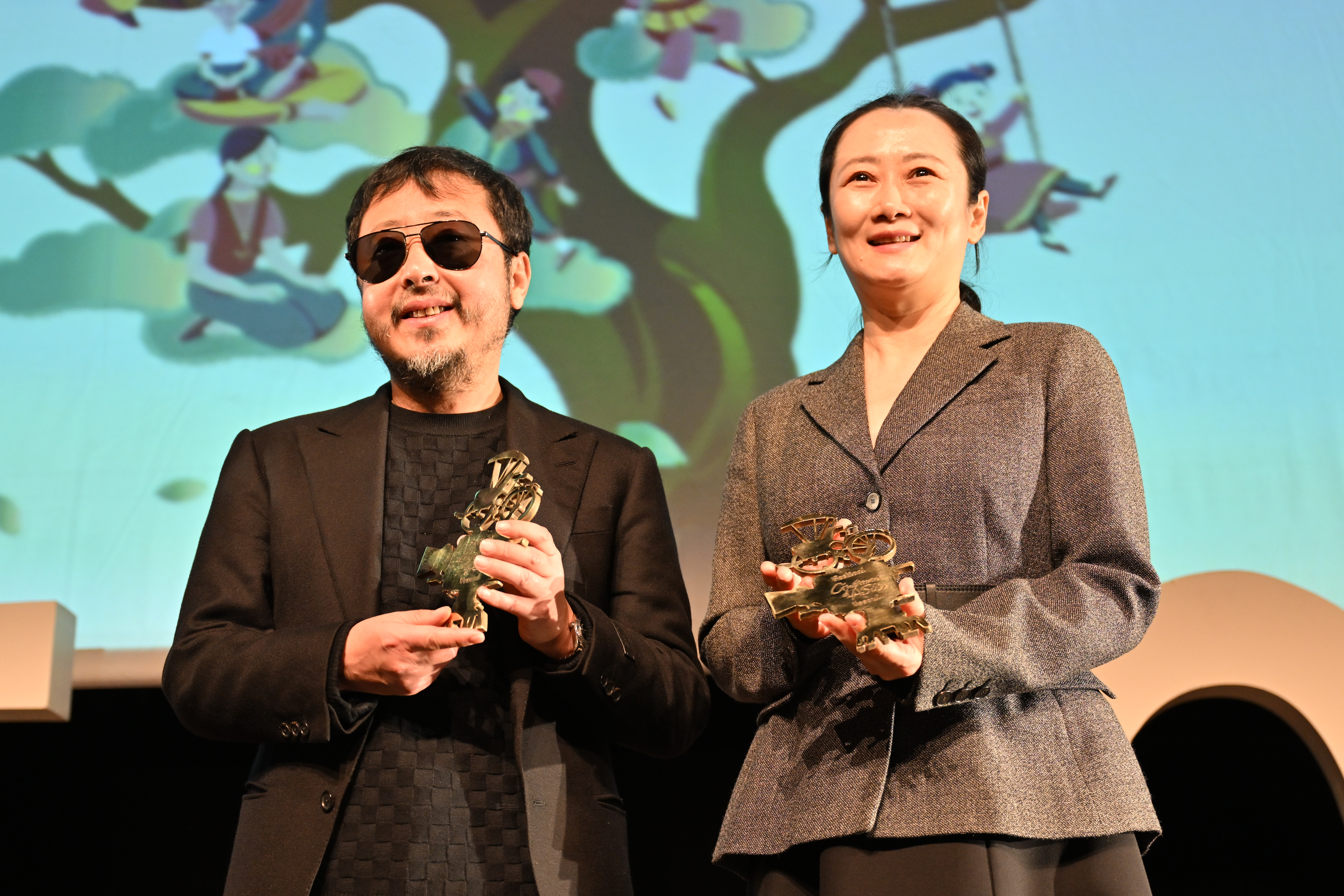
Do you think cinema is a particularly political art form?
Cinema is like Aesop's tongue. It all depends on how you use it. Dictatorial powers seek to use cinema as a propaganda tool. More subtly, in democratic states, filmmakers convey their vision of the world through their work. Some films are more the product of the zeitgeist, or imposed by the need to fight a particular historical battle. Like other art forms such as literature, painting, sculpture and architecture, cinema is the reflection of an era. In this sense, films are mirrors of society, reflecting the realities, challenges, values and beliefs of the times in which they were made.
What can the 7th art to improve the world?
We dare to hope that cinema, in a democratic society, can continue to nurture critical thinking. It can help us open up our imagination, preserve the memory of the past, and preserve the true values of sharing, caring and, quite simply, love. It can raise awareness of a number of political, economic and environmental issues... A film can have more impact than militant injunctions, and give us reason to hope.
Emphasis on the next edition
The 32 editorial lineth Festival International des Cinémas d'Asie de Vesoul, to be held from January 27 to February 3, 2026, will focus on films in competition from all over Asia (Iran, Kyrgyzstan, India, Sri Lanka, China, Korea, Indonesia, Palestine, Vietnam, Cambodia, Thailand...). They will be judged by seven juries (International, Netpac, Critique, Amis du Musée Guimet, Marc Haaz, Lycéen, Jeune).
Mysteries and opium balls« thematic section»
In the Western imagination, Asia seems full of mysteries. The Golden Triangle (Burma, Laos, Thailand) and the Golden Crescent (Afghanistan, Pakistan, Iran) grow the poppies from which opium is extracted. Festival-goers are invited to discover the mysteries of the Orient.
Cinemas from the roof of the world – Bhutan, Nepal, Himalaya Pravat (India), Sikkim, Tibet (China)
One of the festival's missions is to unearth and discover rare cinematographies. The festival has a reputation for seeking out new films and rare gems. Festival-goers will follow in the footsteps of Alexandra David-Néel, on the paths of the countries and regions of the roof of the world and the eternal snow.
A look at Arab cinema in the Middle East (Lebanon, Palestine, Syria, Iraq)
The martyred countries of the Middle East produce films of great strength, where black humor emerges as a remedy for the violence of history. Lebanon and Palestine, countries of the fertile crescent, are rich in cinematic talent. Syria and Iraq are witnessing the rebirth of a cinema that is rebuilding its national identity, with innovative themes that will fascinate festival-goers. The recent 78th Festival de Cannes 2025 awarded to Iraqi director Hasan Hadi for The President's Cake is the most visible sign of this.
Young Chinese talent
The astonishing vitality of young Chinese directors will enthral festival-goers with the virtuosity of their talents and the multiplicity of themes they tackle with great maturity.
Young Audiences – Japanimation
Animated and fiction films are on offer for youngsters aged 3 to 103. Festival-goers will dress up in the costumes of their favorite manga heroes for the Cosplay - karaoke evening on Saturday, January 31, 2026.
Laure Mi Hyun Croset is a novelist. She is the author of Beau Monde (Albin Michel, 2018) and Made in Korea (Okama, 2023).
You've just read an open-access interview. Debates, analysis, cultural news: subscribe to support us and get access to all our content!

You'll also like


 French
  German
  English
2 comments
Fascinating article on a festival I didn't know much about. I didn't even know where Vesoul was. I did know about the Corbusier chapel in Ronchamp. My paternal grandmother, whom I didn't know, was from Dijon. As a producer, I'd like to quote the aphorism of the Duke of Burgundy, Charles the Bold: «There's no need to hope to undertake, nor to succeed to persevere». Thank you for your commitment to knowledge and love of cinema.
A marvellous success for this FICA that I thought improbable and impossible, but passion, hard work and love have been rewarded by this large number of festival-goers and internationally recognized artists. What's more, the audience is friendly, educated and good-natured, and the region beautiful. Long live FICA, which I hope and believe everyone, local and otherwise, understands the financial efforts required to keep it going.
Leave a comment