



The warrior's lament

Le Regard Libre N° 49 - Ivan Garcia
The new creation by Frédéric Fisbach and Dieudonné Niangouna, And God didn't weigh much..., was presented at the Théâtre de Vidy between February 19 and 21, 2019. Composed of energetic rantings, the drama stages one man's sweeping indictment of a corrupt world.
On Wednesday, February 20, 2019, in the pavilion of the Théâtre de Vidy, the auditorium exudes a strange atmosphere. Shortly before the start of the show, spectators murmur their impatience at the return of Dieudonné Niangouna, who - last time - caused some controversy with his play entitled Nkenguégi, a complex work that lasted over three hours and saw the audience leave before half-time. This time, however, there were no rollerblades, no rafts, no costume parties and too many changes of scene.
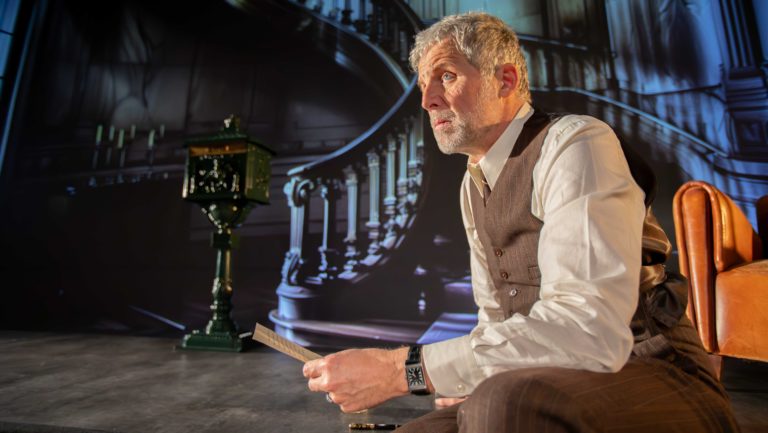
And God didn't weigh much... features a man, played by Frédéric Fisbach. The man, alone on stage, wears a jeans, a hooded jacket and a T-shirt; he says his name is Anton. He quickly describes his experiences, because he doesn't see himself as an ordinary protagonist. And with good reason: he comes from a suburb of Paris, and has been locked up for 23 years in various prisons around the world, from the CIA to a jihadist group to a rebel's cellar. This is the story of a vagabond, or rather a rebel, that Anton decides to tell us. maelstrom the protagonist wants to get it off his chest, to spit out his ugliness, stupidity and mediocrity to the world.
An anger in an unknown place
To tell the truth, the viewer doesn't really know where Anton is. He seems to be locked in a cell, spied on by a surveillance camera. Exposed to the spotlight, he rants, he reasons, he moans, and when he exceeds the limits imposed by his jailer, a shrill ultrasound sounds. Faced with his keeper's denial of freedom of thought and expression, Anton, in a powerful, chilling voice, sometimes howls, sometimes debates what makes him feel heavy in this universe: wars, world hunger, selfishness, corrupt politicians, and other burning issues of the day.
The protagonist's life story - as it relates to these themes - fluctuates, with various narrative devices used to explain events and encounters. We oscillate between analepsis, mise en abyme and reported speech. Trapped on a stage as tightly bound as a prison, the actor spins around in circles, engaging in cyclical reasoning.
Come to think of it, there's one character who stands out in this play. And it's not Anton, nor the leader of the jihadists, nor the man who's supposed to be keeping an eye on him, but a certain Saoul Atman, a guru and composer of electronic music; through a dialogue with himself, the protagonist explains how, in Seattle, he came to know this preceptor in one of the greatest clubs of the city.
As the story of this encounter begins, the atmosphere becomes electric. The light, previously white, is transformed into scarlet rays, the smoke machines go wild and the electronic music is in full swing. Saoul Atman reveals himself to be a dandy who, at night, mixes in the best of the best club of Seattle and, by day, slips away to his underground library to work on «The Work», the one that will subvert the world. While befriending Saoul, Anton is fascinated by this esoteric universe and decides to take part in the project.
Adapting a commissioned text
The piece was commissioned by Frédéric Fisbach from Dieudonné Niangouna. If you listen carefully, you'll recognize Niangouna's powerful, trenchant voice, his fiery verbiage, his acerbic criticism and his destroyed illusions. This reveals a daring decision: to have Fisbach perform a text, composed orally for the sake of it, by someone who didn't write it - and, at times, you can hear it. We might have preferred Niangouna - with his Congolese accent - and his one-liners. But Fisbach's masterful alternation of body language and spoken word convinces the audience of the sincerity of the subject and its reappropriation.
In fact, when we look at the original text, published by Editions Les Solitaires Intempestifs, we see that the director chose not to adapt Niangouna's text in its entirety, no doubt so as not to repeat the blunder of Nkenguégi, which lasted approximately three hours and thirty minutes. Niangouna has the logorrhea of a warrior. Eternally dissatisfied, never defeated, this man takes it upon himself to spit in the face of the world - sometimes even too much - which can guarantee him success as well as disappointment.
And God didn't weigh much... belongs to an undefined genre, somewhere between a statement of intent and a rebellious soliloquy. When they attend a performance, spectators are not faced with a classic play, nor with an established playwright. They are the only judges in the room. Fisbach and Niangouna deliver a heartfelt drama that allows catharsis of emotions, guilt and stress, yet they quickly fall into cliché and excess. We move from an era when «God didn't weigh much» to one of transcendent heaviness, from the consumer's lament to the warrior's lament.
Write to the author: ivan.garcia@leregardlibre.com
-
 Le Regard Libre - N° 49CHF10.00
 -
 Standard subscription (Switzerland)CHF100.00 / year
 -
Support subscriptionCHF200.00 / year

You'll also like

 French
  German
  English
Leave a comment