




«A.I. Artificial Intelligence», on the verge of tears
Cinema Wednesdays - Eugène Praz
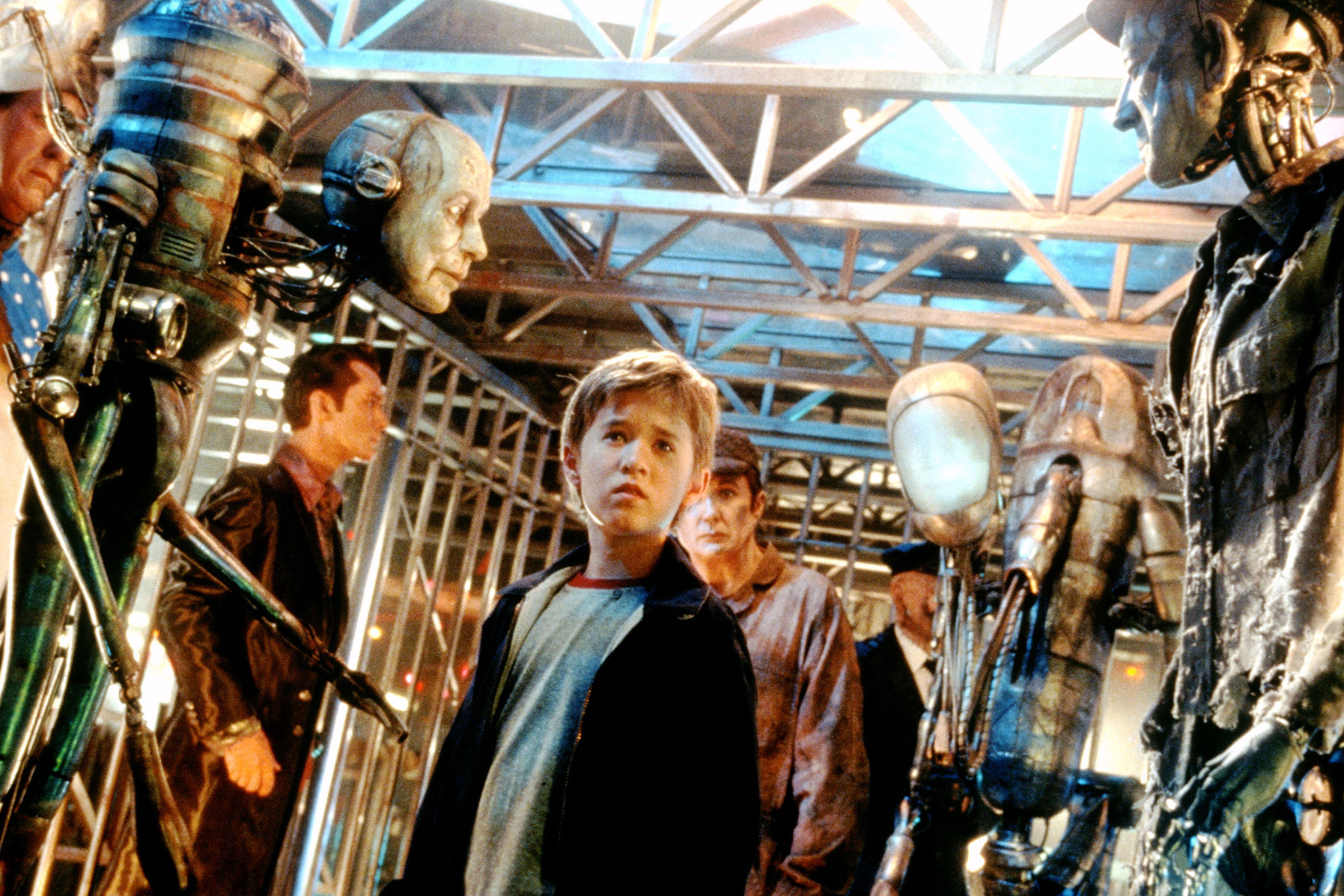
With A.I. Artificial Intelligence (2001) was Steven Spielberg's twentieth feature film. Inspired by the short story Supertoys Last All Summer Long by Brian W. Aldiss, represented a futuristic world, setting its plot in the 20th century.th century, and finally into the fifth millennium. In this world, robots, the Mechas, for human beings, who are called Orgas, These robots are capable of many tasks, including prostitution, but are incapable of feeling true love, devoid as they are of any feeling that isn't simulated. That's about to change when Professor Allen Hobby (William Hurt) and his team create a robot capable of love...
It's a film of great formal purity, faithful to the rigor of Stanley Kubrick, to whom it's dedicated and whose idea it came in the seventies, before he entrusted the project to Spielberg, for lack of sufficiently developed special effects at the time, not without Spielberg abandoning a softer, more emotionally expressive aesthetic, A.I. explores a number of metaphysical questions, in particular that of what underpins our humanity. But it is above all the story of a birth, that of David, a robot whose quest to become a real boy, and to be loved as such, leads him to the doorstep of artificial intelligence.
We could go back over the genesis of this film, which helps to make it unique and a fascinating story in its own right. But in reality, everything makes it unique, and as a result, misunderstood by a general public that may have been left skeptical or hungry, since the technical choices of the director who was and still is assimilated to the purest Hollywood cinema and its history are unusual, to say the least. His next science-fiction film, Minority Report, But the fact that the genre's codes are more closely adhered to doesn't make it a better film. On the contrary, and although John Williams’ music is just as moving in one as in the other, the originality of’A.I. is likely to reach even further, not to mention its profound storytelling, with its infinitely meticulous cinematic storytelling processes.
In addition, the A.I. elements of melancholy and pessimism already perceptible in Saving Private Ryan, which fortunately keep him away from a feel good movie regressive. Janusz Kamiński's photography and the technical prowess on display in this film propel it into a plastic dimension that has nothing to envy of today's productions. His designs, partly based on drawings by Kubrick himself, are sure to dazzle even those whose plot - inspired, albeit largely reinterpreted, by Adventures of Pinocchio, could leave anyone indifferent.
The choice of Haley Joel Osment as lead actor, a child actor revealed in the film Sixth Sense, may not be the most daring, since Spielberg doesn't take the risk of launching a total unknown until now. But the actor's unblinking gaze - his eyes are open throughout the film, as long as the camera captures his face - as well as his ingenuous smile and whimsical melancholy, make him the perfect choice for the role. the right child in the right place. Spielberg uses close-ups only in highly emotional dialogues, and various devices are used to keep emotions at bay, as they present a potential danger. David, the robot child who is the first of his kind because he is capable of love, chosen by the Swintons as a substitute for a dying son, who returns and causes David to be abandoned by his mother, will cause a family overwhelmed by a being whose love they do not understand to melt with emotion, but also to jump with fear, and finally to reject him.
However, there are hints that are less perceptible to the inattentive viewer, such as the shape of the car of Monica Swinton (Frances O'Connor), the «adoptive» mother of David and his brother Martin, a Jake Thomas whose talent for portraying an unsympathetic character is to be commended. The shape of this futuristic three-wheeled car is reminiscent of Pinocchio's whale, with its single horizontal headlight reminiscent of baleen, and a sound similar to the menacing song of a cetacean as the vehicle passes close to the camera.

To take it a step further, the film has many oceanic aspects, characterized by repetition, immensity and eternity. The film begins with the ocean, a narrator explaining that Amsterdam, New York and Venice no longer exist, submerged. In the last part, the oceans have frozen over. In between, an odyssey leads David, accompanied by the «love Mecha»Gigolo Joe (an impeccably acted Jude Law), to explore the world, at first the victim of a Flesh Fair, This is at the expense of the robots, who are executed with acid or cannon in a giant sacrificial ceremony, a clear reference to Spielberg's beloved Holocaust theme.
The child sacrifice was averted thanks to a crowd moved by the all-too-real cries of young David, even as the organizer of the festivities quoted Christ in a speech with Trumpian accents before its time: «Let he who is without sin cast the first stone.» Next, our two friends head for Rouge City, a city of debauchery and the dystopian center of a post-decadent world, whose entrances are in the shape of wide-open, luscious mouths... Stanley Kubrick had expressly asked Spielberg to include an excerpt from Suite op. 59 of Chevalier à la rose by Richard Strauss in a scene from’A.I., which can be heard briefly at the entrance to City Red, a discreet but ironic reference to a romanticism totally absent from the city's garish colors.
But that's not where this futuristic odyssey ends. City Red, Doctor Know, a computer program manifested in cartoonish Einsteinian holographic form, guides David and Joe across the seas to Manhattan, where the tops of the buildings rise above the ocean and David's creator, Professor Hobby, is at home. There, David discovers replicas of himself, reading, hanging or locked in boxes; what is left that would make him unique? His very quest, probably, which ends with the answer to a prayer he's been repeating for two thousand years: that the Blue Fairy will make him a real little boy.
The track entitled Stored memories of the film's soundtrack by John Williams unfolds a polyphony of voices singing a lament on a frozen planet, Earth, from which all human beings are now absent, but where David's ’amphibicopter«, caught in the ice, has preserved him, and through him the memory of human beings, which has remained a dead letter, but preciously preserved. And yet, the universe itself has the answer to David's questions, in a heartbreaking finale of eternal beauty, which we'll refrain from revealing here, and only the film, of course, is really capable of doing so.
Write to the author: eugene.praz@leregardlibre.com
Photo credits: © DreamWorks Films / Warner Bros
You'll also like


 French
  German
  English
Leave a comment