




«A l'école des philosophes», a magnificent philosophy of life
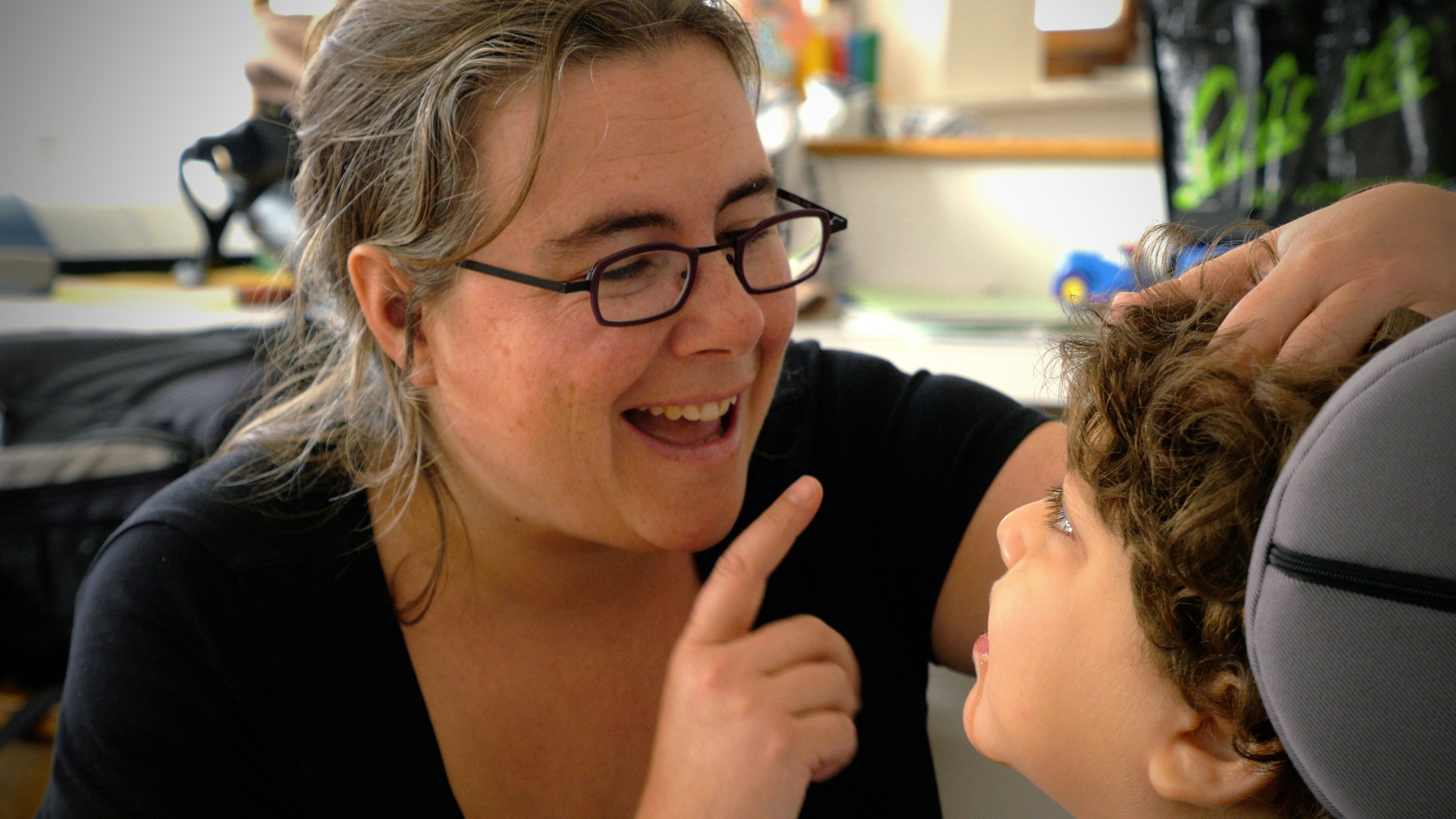
Adeline l'enseignate à l'écoute des parents. Image du film de Fernand Melgar " À l'école des Philosophes" © 2018 Le Dzè
Cinema Wednesdays - Lauriane Pipoz
In his latest documentary, Fernand Melgar takes a look at five children with disabilities. Accompanied by professionals, they experience their first day at school at Rue des philosophes. Their objective for the year: «to learn how to be a schoolboy», according to Adeline, the class teacher.
The camera opens on three special girls and two boys, accompanied by their parents. For a year and a half, they will be followed daily by Fernand Melgar, the Lausanne-based filmmaker familiar with committed documentaries. And so the magic slowly unfolds before our eyes: if the children seem chaotic on their first day at school, they slowly seem to tame themselves, under the constant attention and benevolence of their carers.
Progress as a guideline
Throughout the documentary, the viewer observes the «actors» evolve, guided by the comments of the teachers and therapists. This will be the film's common thread: the children seem to open up as they discover each other and learn to live in community. It has to be said that some were used to being the center of attention. Take Albiana, for example, whose exhausted mother confides that she had to leave her youngest daughter in Kosovo with her parents: her first daughter, suffering from Dawn's syndrome, was beating her up because she was no longer the sole focus of the family's attention. If, at the beginning of the film, the child seems uncontrollable and gives the educators a great deal of trouble, she gradually becomes more manageable, thanks to the extreme patience and optimism of the educators.
It's hard to talk about it without mentioning the poignant scene in which Albiana's mother emotionally reveals her daily life: the unruly little girl runs around screaming and rips off a few handkerchiefs. Her mother reprimands her energetically, but the teacher, with a smile and a tender look, tells her to use the handkerchief, as it was her daughter who gave it to her. In this way, she teaches us that things take on the meaning we want to give them.
The first ingredient: love
That's what this documentary is: a lesson in the miracles of love. In Melgar's words to Swissinfo,The first ingredient for «making any being progress».[1] We're talking here about the love of the professionals committed to their work at 100%, but also the love of the parents. The latter seem to have built their daily lives around their different child, and seem to do so willingly, despite all the difficulties. One example is the mother of little Chloé, who suffers from degenerative tochondriopathy and has a very short life expectancy. She declares that her marriage did not survive the diagnosis, because she could no longer bear to run around in her life for futile things: she wants to make the most of the time she has with her daughter. She makes this declaration by covering her with an affectionate look and calling her «ray of sunshine».
It's hard not to be deeply moved by the life lesson Fernand Melgar offers us through these wonderful people who have built their lives around these different children. They teach us just how much progress everyone is capable of if given the chance and the right environment. Among other lessons, they also show us how important optimism is, and how looking at difference can teach us more about life. So, to all those who claim that philosophy is boring, let's dare to reply that it doesn't just lurk on library shelves: it's all around us, if we dare to look at what others have to teach us, and it's magnificent.
Write to the author: laurianepipoz@gmail.com
Photo credit: © Outside The Box
[1]https://www.swissinfo.ch/fre/economie/-a-l-%C3%A9cole-des-philosophes–de-fernand-melgar_-je-ne-vois-plus-le-handicap–je-vois-des-enfants-avec-d-autres-qualit%C3%A9s-/43845828, accessed September 19, 2018.
You'll also like


 French
  German
  English
Leave a comment