



«Dear Future Children, see you at the next (un)settlement
Unpublished interview - Indra Crittin
Dossier on the Festival du film et forum international sur les droits humains (FIFDH) 2021: an issue for pre-order here
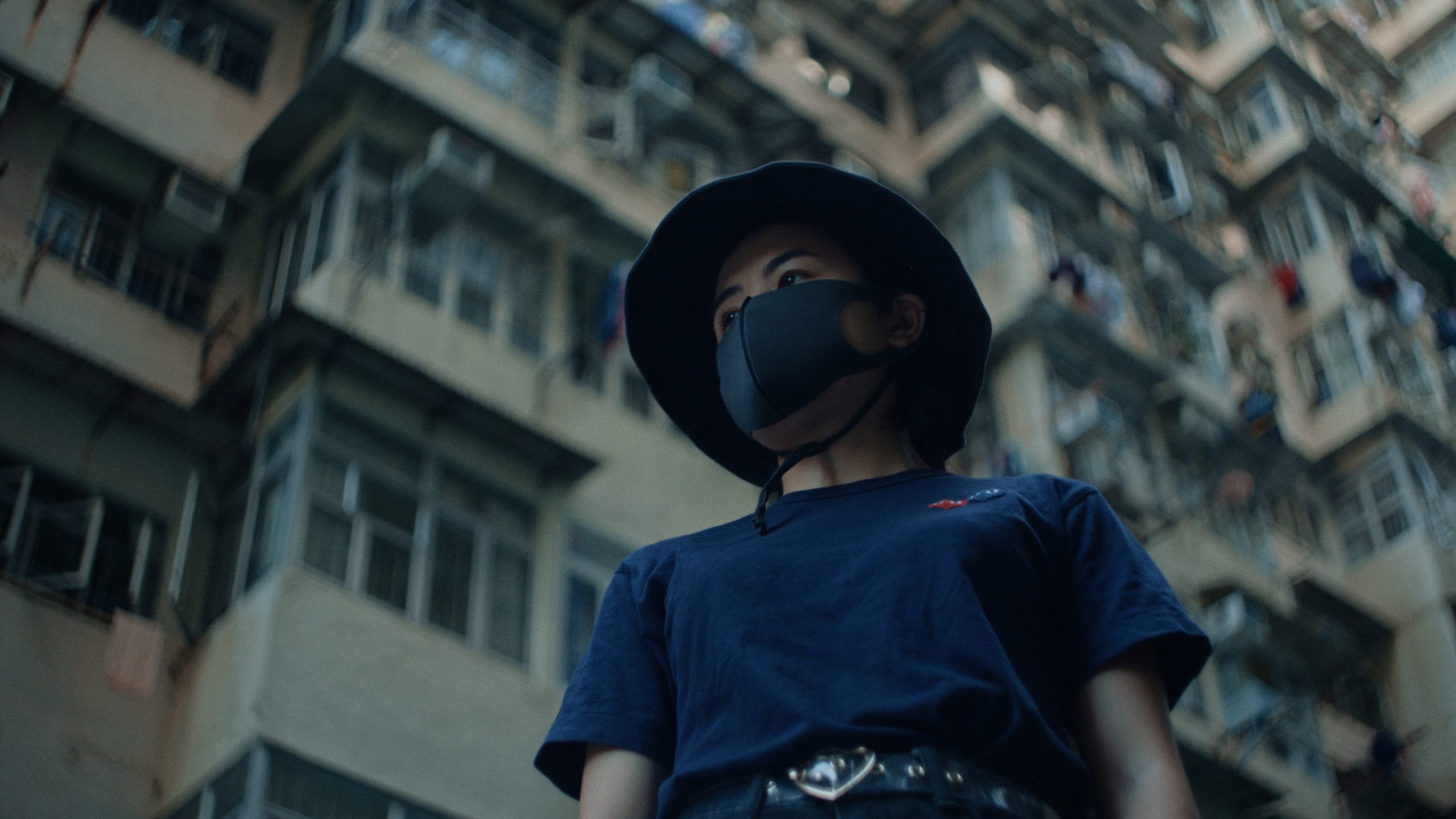
Armed with a camera and gas masks, the German duo of Franz Böhm and Friedemann Leis followed three young activists of today in their attempts to make a difference tomorrow. Their project, entitled Dear Future Children brings together three cultures, three causes, from Chilean protests against corruption to struggles for democracy and the environment in Hong Kong and Uganda respectively. Incidentally, one of the three protagonists, Hilda Flavia Nakabuye, gave a powerful speech at the 2019 C40 Mayors' World Summit, held in Copenhagen in 2019. In short, a documentary for people like you and me, and for those who haven't yet set foot in this world, as the film's title suggests. International premiere at the Festival du film et forum international sur les droits humains (FIFDH), Dear Future Children was a big hit, winning a second Prix du Public in his second festival selection. Interview with Franz Böhm, the youngest filmmaker in the FIFDH's «Creative Documentary» competitive section.
Le Regard Libre: Dear Future Children is your first feature film. However, it is not your first documentary..
Franz Böhm: Yes, this is my second documentary. Three years ago, I made a short documentary about young homeless people in Berlin and how they dealt with the big challenges in their lives. This project also explains how, in a country like Germany, people still live without a roof over their heads - especially when they're relatively young - and what the reasons are for this phenomenon. I lived on the streets with them for almost a month, which was very intense. However, for this feature film, I worked with the same cinematographer with whom I had collaborated on a previous short entitled Good Luck.
Is there a particular documentary or filmmaker that has inspired you?
American ambassador Samantha Power has been an inspiration to me when it comes to storytelling. She has also been a great influence on my work, showing how listening to individual stories can really change something, even on a larger scale. All the films that followed activists or people in extraordinary circumstances were, in a way, a source of inspiration for me.
Have you ever visited or lived in any of the three countries where you filmed?
No, this was the first time I'd been to each of these countries. So it was a total discovery.
How did the casting?
Getting in touch with the protagonists or compatible candidates was a lengthy process, which really took up our time. We used several means of communication to reach them. First of all, we contacted other activists in the countries concerned and asked them if they had any potential contacts we could approach. But we also worked very closely with local journalists and correspondents from several newspapers, who helped us enormously. We read every article there was on youth activism in the region. The reason? We wanted to make sure we spoke to enough people to get a feel for these movements. And we wanted to carefully select the people we were going to profile. As a result, we met many people in each country, then made a selection of those who might be the best protagonists for us.
Were you familiar with the socio-political situation in these countries?
As part of our preparation, our entire team researched the three countries and youth activism and resistance in general. We were informed by the advisors we had in each country. We also listened to numerous podcasts and panel discussions on these issues. Personally, I think I read all the publications on the conflict situation in Hong Kong. We just wanted to make sure we understood the situation. political landscape of the region. When we cover these events, it's important that we have a complete and detailed understanding of the situation.
Was it necessary for the protagonists to speak English?
Whether or not they spoke English was not a decisive factor in our selection process. During production, we also spoke with people who spoke no English at all. The decision-making process was defined by the test interviews conducted with the candidates. We accompanied them to several events, went with them to demonstrations, talked a lot with them about their past, their motivations, their reasons for protesting. All this to make sure we had someone who was representative of the local activist movement in each country. It was very interesting to carry out these tests to see how a potential candidate reacts in the presence of a camera. In particular, we wanted to find out if they were able to speak fluently in front of a camera, or if they became nervous. For us, it was important that a person really wanted to take part in our project. We stayed with them for about six weeks, so that's something you have to want. And then of course our good feeling. The question we had in mind during this process was, «Who was the most interesting?» We wanted to have three people under the age of thirty, because the three movements we covered were led by the leadership young people. So it made sense to have someone in that age bracket. And then, more or less by chance, we chose three English-speaking women. But neither language nor gender was a criterion in the first place.
What are the differences in the ways we protest?
These days, young activists around the world have a whole range of tools at their disposal to make their voices heard. It's quite impressive to see the means of expression that these individual activists use. Their choice of devices depends on past experience and the history of the country. In Hong Kong and Chile, for example, the activist movement has a long history, and several methods have already proved their worth. Indeed, in Hong Kong recently, it was clear that the use of silent devices would not be very effective, hence the use of tools to make oneself heard. Chilean activists have had similar experiences. So the choices these activists make today are based on years - sometimes decades - of resistance experience. Clearly, the Hong Kong movement was very modern, very well organized, and there were talented and skilled people involved in the protests. They also faced, in my opinion, a very robust opponent and very high risks. The landscape, the circumstances in which they had to work were - or are - very different from those in Uganda or Chile. The Hong Kong protest was defined by an absence of leader which was an obvious strength. Indeed, it was much more difficult to oppose it, because it was a democratic protest. It was defined by five key objectives, all of which were quite reasonable.

What about Uganda?
This is a typical example of a completely different story. The «Fridays for Future» movement, co-founded by our protagonist Hilda, is a grassroots SIR movement, based on the presence of identifiable personalities, because participants don't necessarily need to fear that someone wants to put them in jail. This is another job, which involves talking directly to people. It's about informing them about the effects of climate change and the actions the collective can take to combat it. It's much more communicative and less based on statements, I'd say. It's also about recruiting activists, making their cause heard, notably through TV shows and radio programs by giving speeches, something Pepper and the Hong Kong protagonists never had to do.
And then there are the Chilean protests.
These are very street-oriented and awareness-raising, which is also interesting, as they blend several causes into one big protest. I would also say that the methods employed in Chile are very democratic. The protest is divided into several organizational parts: there's what we call the front line, where our protagonist Rayen is. There's also the heart of the event and the social networks, which the protesters use intelligently to make their voices heard. They have the ability to mobilize large numbers of people, particularly in the Chilean capital Santiago, to take to the streets. What I've admired in Chile is that many artists are trying to support the protest in the best possible way. You can see this in street art, in graffiti, on social networks!
How did you manage to create this intimate portrait of the protagonists?
We worked closely with local filmmakers and activists, who gave us considerable support during the shoot. They sometimes accompanied us during the shoot, advising us on local conflicts and on the ground. In Uganda, for example, we also had production assistants who drove us around, which was very useful. Above all, this is an international project involving people from fifteen different countries and four continents. The local journalists, activists and filmmakers who supported us also had a major influence on our way of seeing things and on the way we wanted to report on these protests. The film as a whole is the result of extensive, intensive and detailed teamwork, of which we were the architects. We created an atmosphere in which everyone could unleash their full potential.
It helped you blend into the landscape.
I did work on the film as a European director. But we worked extremely closely with the people on location. We wanted to create this work together, and in the end we did. As Europeans, we didn't direct the project. We served the project in the same way as local activists and filmmakers did. We went there because we wanted to hear their stories - not to tell our own, nor to have our own vision of what activism needs. We were there above all to listen, which is also why we sent versions of the film edit in progress to all the local assistants and filmmakers we worked with. Of course, we also sent it to our protagonists, which was an important process.
What differences did you notice in the shooting, depending on the culture?
One thing that stuck in my mind was how grateful the people of Hong Kong were to the filmmakers and journalists. They always brought us free coffee or gave us food. What's more, each country had its own challenges. Obviously, filming in Uganda is completely different from filming in Hong Kong. And Chile also has its own laws. The whole production was defined by the fact that we were working with extremely limited resources and had to overcome many challenges, which was only possible thanks to the close collaboration, once again, forged with local filmmakers. And also because our entire team worked incredibly hard to bring this project to fruition.
Have you travelled to all three countries in a row?
No, we had to come back after each one, because of the equipment. It was pretty consistent though: we'd stay at home for a few weeks, then head to the next country. It's also worth mentioning that we shot in Hong Kong twice: we first shot there in August and September 2019, then returned in July 2020, during the introduction of the National Security Act, which was a stunning, dramatic and frankly sad experience.
Was it difficult to bring this independent film project to fruition?
Fortunately, we were able to collaborate with a university and the USA, who fully protected us from any hacking attempts - which they did. As far as death threats and hate mail are concerned, there were quite a few things that happened. For example, there were also blank bullets with my name on them, outside my door in London. There were obviously people trying to stop this project when it was only just getting off the ground. Ultimately, their aim was to create fear, but fear will never stop our team. Above all, it showed us why we were doing this. We weren't impressed by the situation, although we did gather valuable experience for the future, which we are now sharing with other filmmakers in similar situations. It's important to be united in such circumstances, to exchange knowledge about what we've been through. Once again, we had to face several attempts to put an end to our project. In Chile, for example, the police shot at us with rubber bullets, but again, it showed us why we were doing this. As a team, we were very well prepared, we had done extensive research beforehand and we had a lot of experience. briefings safety.
While the film is making its way to festivals, what are you working on?
As a team, we now have two objectives. On the one hand, we have the distribution of Dear Future Children. It will be released in German cinemas in June, which is great, and will be screened at a few other festivals. On the other hand, we're currently in the very early stages of developing a new feature film project: a fiction film, which will be based on a true story about a very courageous journalist. But that's all I can tell you at the moment, unfortunately. So I'm sure we'll be holding several special screenings of Dear Future Children in universities or similar institutions, to contribute to this great public debate on youth activism.
Write to the author: indra.crittin@leregardlibre.com

Vous aimerez aussi

 French
  German
  English
Laisser un commentaire