




«Glass»: a strange cocktail
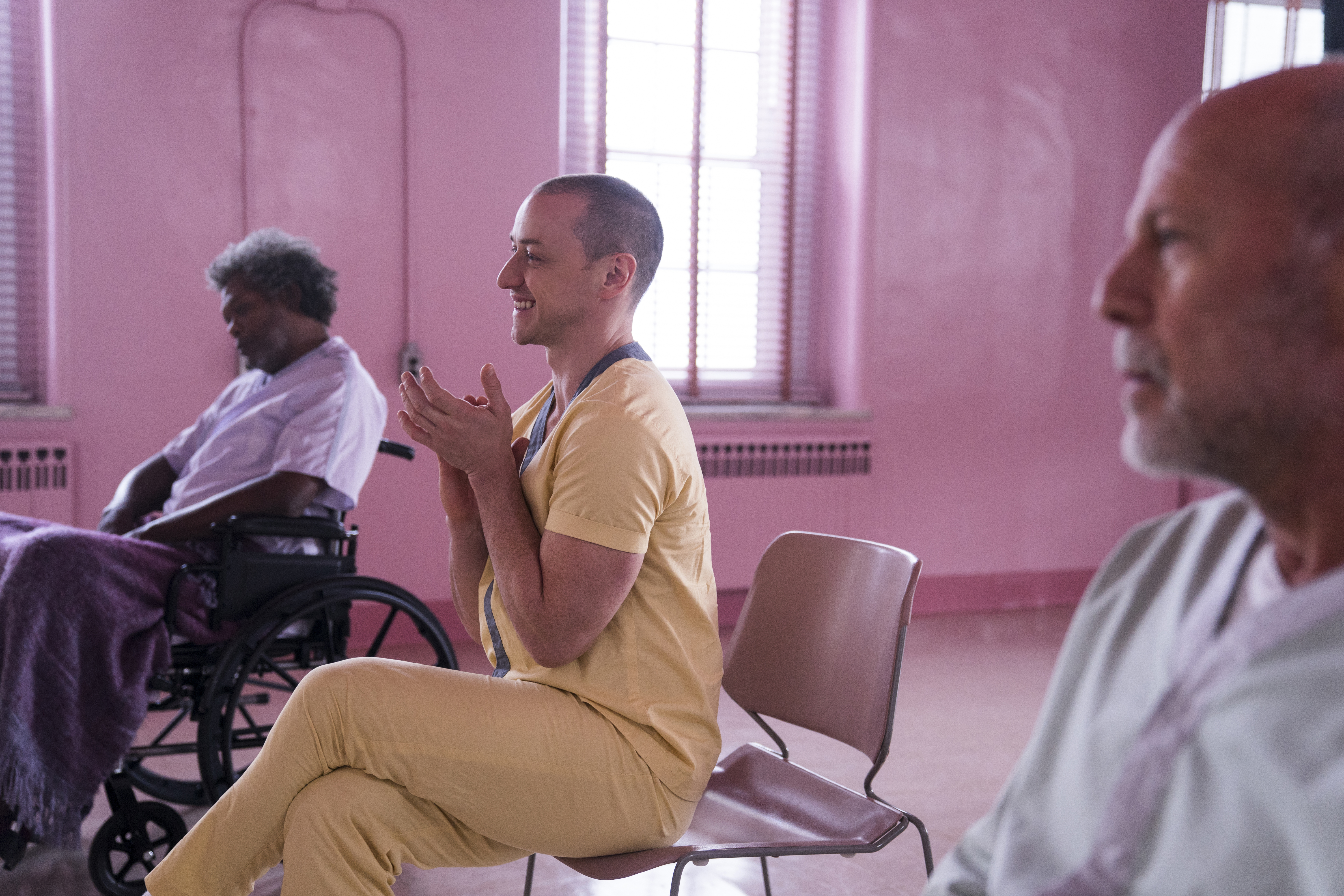
GLASS..L to R: Samuel L. Jackson, James McAvoy and Bruce Willis..Photo Credit: Jessica Kourkounis.
It's a surprising exercise for director M. Night Shyamalan: to offer the sequel to two films in a single feature, Unbreakable (2000) and Split (2017). No further words are needed to immediately make this strange genesis a real success. Glass a special cinematic object. As rare as it is intriguing. The filmmaker explained in the columns of Le Monde: Glass, «it's the sequel to two films, shot in two different studios almost twenty years apart, with two generations of characters and actors». While M. Night Shyamalan had never concealed his desire to give a sequel to Unbreakable, He had to wait almost twenty years for his long-awaited sequel.
Shyamalan Asylum
Heroes of’Unbreakable, David Dunn (Bruce Willis) is a raincoat-wearing vigilante who saves the world. Nicknamed The Supervisor with the help of his son Joseph (Spencer Treat Clark), David sets out to find five missing girls. The girls have been abducted by Kevin Wendell Crumb (James McAvoy), the man with the twenty-four personalities who has been spreading terror throughout the world. Split and, once again, attacks «the impure».». But that's without counting on David, who - obviously - finds Kevin's hideout, frees the hostages and then engages in an epic battle against «the beast» (ndlrThe Beast« is Kevin's twenty-fourth personality, giving him seemingly superhuman powers.).
But this testosterone-fueled battle between our two protagonists quickly turns into a real showdown. The two lascars are suddenly caught by the patrol and, without further ado, are committed to a psychiatric hospital where Elijah Price, alias «The Breaking Man» (Samuel L. Jackson), the great villain of’Unbreakable. Our trio's delusion: they think they're superheroes! At least, that's what Dr. Ellie Staple (Sarah Paulson) is trying to tell them, as she's on a mission to bring them back to their senses.
The Good, the Bad and the Ugly
What if it were true? What if that killjoy Dr. Staple was right? What if, after all, she wasn't a dream-breaker, but simply the person who would lead us (the viewer) back to our senses? It makes you wonder if the director isn't performing a tour de force of his own, as he did in Le Village (2004), where, without warning, what had previously been taken for granted vanished in a halo of yellow smoke.
But if the arrival of Dr. Staple questions the fictional pacts the viewer had previously sealed with M. Night Shyamalan and his non-Marvelian superhero universe, this doubt goes so far as to disturb the protagonists themselves. In a scene that's as amusing as it is unsettling, Dr. Staple tries to demonstrate to our three superheroes in a pink room, seated next to the others the rest of us that they are, in fact, nothing more than disturbed beings. The operation bears fruit. Interested, David begins to doubt. And if what he thought was the case wasn't, if he wasn't who he thought he was, then who is he? A problem of identity that goes so far as to undermine his own son's beliefs.
Fact or fiction?
Not so, however, for Elijah Price, aka «The Breaking Man». Unperturbed, the glass man doubts nothing and wants to show the world that he's no fool. In an explosive finale, M. Night Shyamalan pulls out all the stops. Overflowing with US references, Comics, and reflections on identity and forgiveness, Glass appears to be an ambitious, courageous construction, albeit with a somewhat convoluted scenario. Perhaps we're only seeing the glass half-full?
Write to the author: thierry.fivaz@leregardlibre.com
Photo credit: © Walt Disney Switzerland
[table id=43 /]
You'll also like


 French
  German
  English
Leave a comment