



Anja Kofmel's multidimensional point of view in «Chris the Swiss».»
Saturday movie platforms - Malika Brigadoi
Chris the Swiss, a biographical film and historical animated documentary directed by Anja Kofmel, traces the life of Swiss journalist Christian Würtenberg. In 1992, during the war in former Yugoslavia, he was found strangled in a field in Croatia. Chris' family never understood his desire to go so close to danger as a journalist. Ever since the news of his death broke, the director - and Chris's cousin - has been haunted by the mysteries surrounding his death. So she decided to investigate and reconstruct his story. In doing so, she hopes to explain not only why he went to the heart of the conflict, but also why he lost his life. Chris the Swiss has received more than a dozen awards, notably at festivals, including, in 2019, the Prix du cinéma suisse for best documentary film.
The film's strength lies in the vision it offers viewers. It skilfully blends four formal devices - animation, reportage, archive footage and eyewitness accounts. In this way, Chris the Swiss offers a multi-dimensional view of the situation, which in a way counterbalances the idealization of the main character. Indeed, one of the criticisms that could be levelled at the film is that of its impartiality. In addition to the debate surrounding the objectivity of a documentary - which can never be truly unbiased, since on the one hand, the director's point of view will be reflected in his work and, on the other, the cinema will take a stand and incite its audience to imitate it - the emotional closeness between Anja Kofmel and her subject may have prevented her from revealing the entirety of her cousin's personality. Chris's wrongdoings are systematically excused, while those of others are explicitly highlighted. The film gives the impression that Chris is only marginally involved in the conflict. Paradoxically, this mechanism makes him passive with regard to his own decisions and actions. Although the director has tried to be neutral, offering a multitude of voices to the narrative, the viewer still senses the hero the young woman imagined in her cousin.
A multi-faceted look
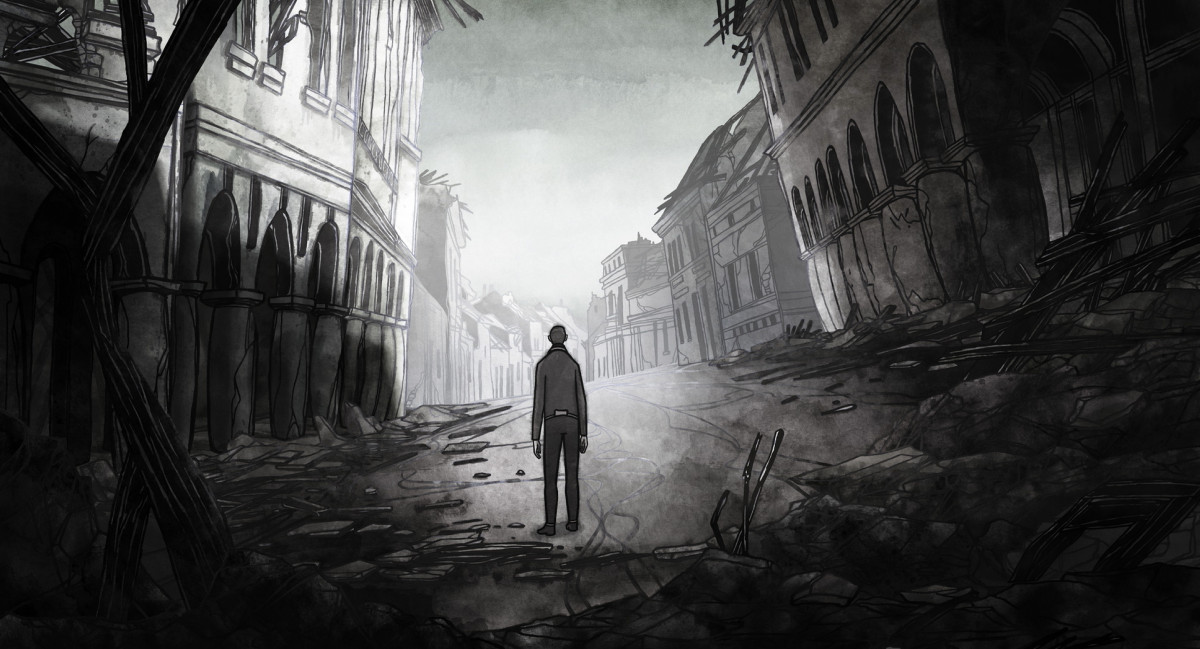
The animation represents the subjective vision of young Anja Kofmel. These scenes show how she perceives her cousin's past, but also evoke the fears she overcame and the nightmares that haunted her after his death. These animated sequences resemble a child's simplistic perception; for example, the dark drawings multiply shades of gray, recalling the absolute dichotomy that children imagine between good and evil. The caricatured dimension of the characters - and of the surrounding nature - is also in line with the imagined, phantasmagorical representation of the world through the eyes of a child. Ten-year-old Anja idealizes Chris, seeing him as a heroic adventurer. At the same time, Anja Kofmel produced a report on her investigative process. In it, she follows in her cousin's footsteps and revisits the key points of her journey. These reportage sequences serve as a kind of unifying thread, sealing the various formal devices together.

The portrait of Chris portrayed by the testimonies proves to be different. These sequences, which give voice to parents, other journalists and soldiers, present a multitude of viewpoints on one person - Chris - and one situation - the war. These scenes paint a complete and contradictory picture of the young man, who is sometimes accused of being a spy, a traitor and sometimes just a journalist. The director also uses archive footage, which plays a key role in the film, opening the door to the larger story. The film is not just about Chris' adventure, but also about the complex world around him. These sequences put Chris's story in context, without transforming it into a story of the past. Chris the Swiss into a war documentary.
The transitions between the multiple formal devices are smooth for the viewer, who doesn't feel transhipped from one reality to another. On the contrary, the film offers a complex vision of the situation, woven from a multitude of testimonies. The film's narrative is clear and easy to understand. It's not just on a narrative level that these transitions seem fine, but also from an aesthetic point of view, mainly when switching from a filmed image to an animated one and vice versa. The features of the former merge into the latter, transforming, for example, railroad tracks into telephone lines. Through archive images, the viewer follows the big story and plunges into the little one with testimonies, animated images and reportage. These two dimensions - the big story and the little story - remind us that war is fought on two sides, but that in each of them there are, above all, human beings.
While animation allows us to evoke symbolic images to deal with subjects such as war, documentary has the capacity to deliver a version of history, notably through archive images that force viewers to remember that this is the reality of the past. Chris the Swiss stands out for the way it looks at the small story - Chris's personality - but also at the big story, the war that took place in the Balkans at the end of the 20th century.th century. On the one hand, the film focuses on the conflict that led to the breakup of Yugoslavia, while on the other, it touches its audience through the story of the young journalist's journey. This duality is extremely well balanced by the director, as is the mix of genres and formal devices, which makes her animated documentary touching. Chris the Swiss can be viewed free of charge on the Swiss platform: Play Suisse.
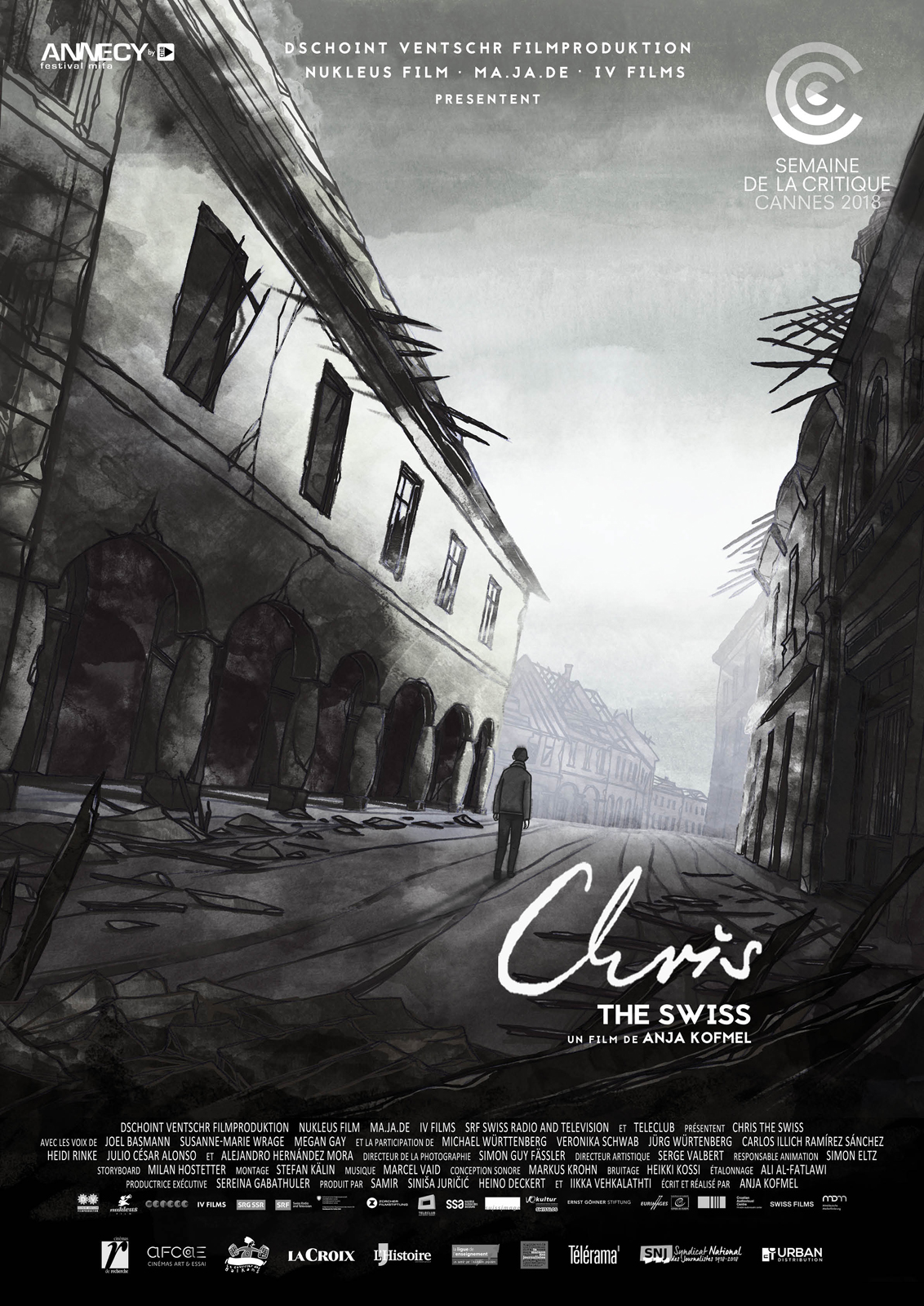
Photo credits: © Real Fiction and Urban Distribution
You'll also like

 French
  German
  English
Leave a comment