




«The Seminarians: Red and Black
Unpublished article - Alice Bruxelle
Communism and Christianity: an impossible alliance? If Pasolini had the audacity (and heresy?) to create a Jesus who was both Christian and revolutionary in The Gospel according to Saint Matthew (1964), Ivan Ostrochovský reminds us in Seminarians that the cohabitation between the Communist regime and the Church was far less peaceful. A look back at a historical episode in which atheistic materialism fought against the texts of the Christian faith.
«A dictatorship is when people are communists; already, they're cold, with gray hats, and zippered shoes,» said Hubert Bonisseur de La Bath in OSS 117: Rio no longer responds (2009). Devoid of zippers and grey hats, the secret police of the Communist dictatorship in Seminarians is to silence the Church.
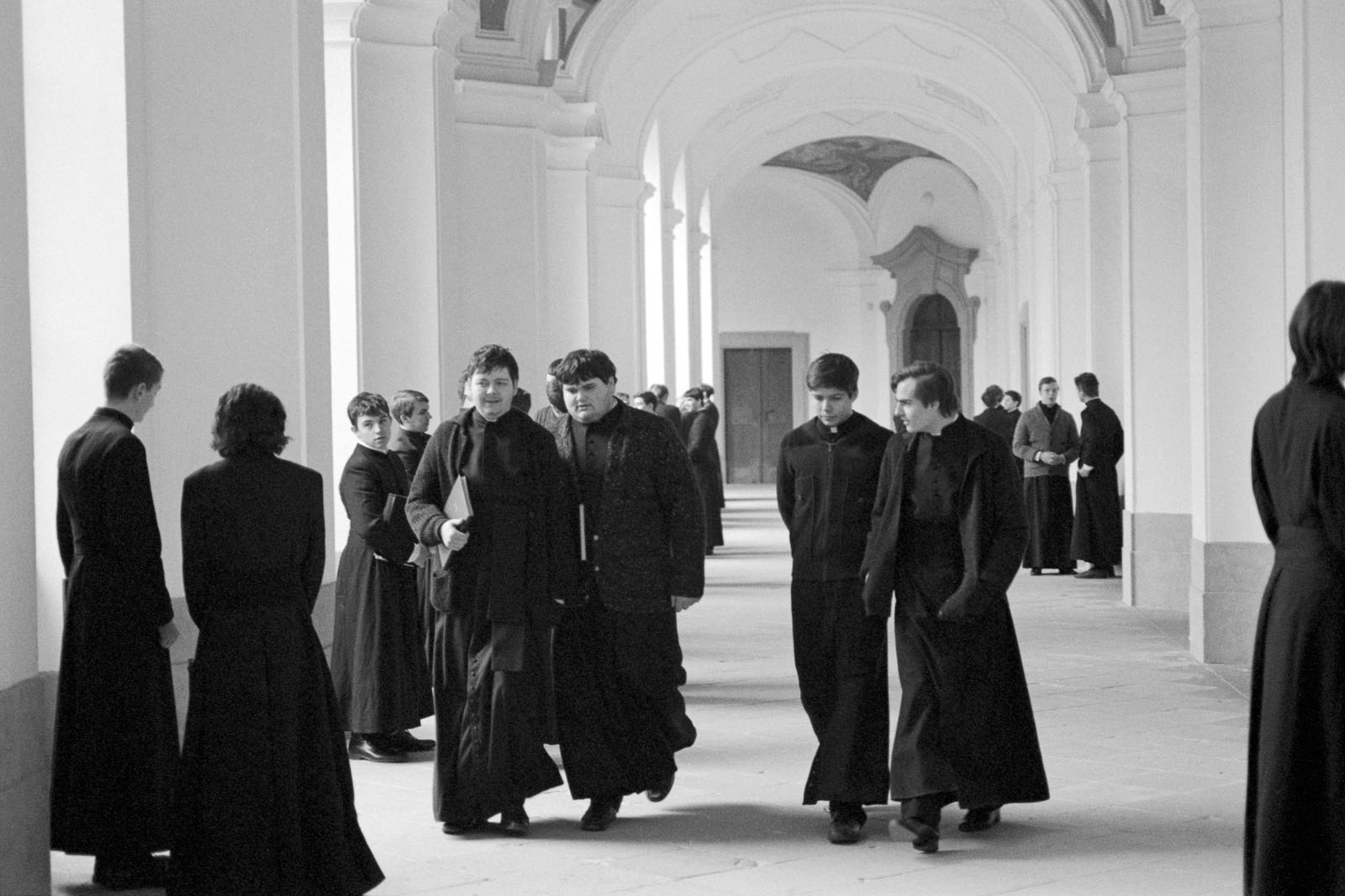
As the film is more aesthetic than historical, it doesn't bother with historical explanations. Ivan Ostrochovský takes us to Czechoslovakia in the early '80s, where the Communist regime, since taking power throughout the Eastern bloc after the Second World War, has sought to muzzle all dissident speech by imposing its ideological views on all spheres of society. As two young teenage students, Juraj (Samuel Skyva) and Michal (Samuel Polakovic), enter the seminary, they face a painful choice between freedom and silence.
Pursue your faith or bow to the regime? The film alternates between the two sides of this choice - resistance or collaboration - by filming the movement. Pacem in Terris - group of collaborationist priests within the Czechoslovak government - and the channels of Radio Free Europe listened to by a handful of resistant seminarians. More than just a tragic account of Eastern European history, Seminarians depicts ambivalent, human reactions to the sprawling monster of a totalitarian regime.
Total experience
Beyond the originality of its subject, this feature-length film also boasts a refined aesthetic. With its formalist Bresson-style mise-en-scène, characterized by the absence of any form of artifice, it's easy to sense that the director has chosen form over substance. The characters have difficulty becoming truly embodied and, as a result, the viewer finds it hard to become attached to them. In this respect, it's difficult to enter the film through a conventional channel - that of getting hooked on the narrative and the characters' adventures - not least because of the numerous ellipses making the narrative disjointed.
Seminarians is apprehended through aesthetic contemplation and the physiological feeling it provokes: a sense of unease and physical narrowness. The sensitive experience is conveyed by a 4:3 format, which makes the sequences narrow, almost immobile, and the rapid scenes featuring the seminarians lined up in their cassocks, devoid of context, verging more on the chillingly photographic than the filmic dimension, all enhanced by an absence of color.
Hannah Arendt wrote in The Origins of TotalitarianismIt is in the very nature of totalitarian regimes to claim unlimited power. Such power can only be assured if literally all men, without exception, are securely dominated in every aspect of their lives«. Like this quotation, every aspect of the film is dominated by a dark lead, making the totalitarian experience sensorially accessible. The only emotion that runs through all the characters is a mute stupor. All know that the Faculty of Theology has been infiltrated, and while some collaborate, others resist, but always in silence.
With no emotional or physical outbursts, and sparing use of dialogue despite the heaviness of the atmosphere, the bodies remain docile under domination. The perfectly sculpted black and white sucks out any hint of hope, making the atmosphere all the more strange and eerie. In this way, the film restores the attribute total of the totalitarian regime by insinuating itself into all its instances. The entire set-up becomes entangled in the immobility characteristic of terror, insofar as thought and movement are trained to remain within the frame.
Moral dilemma
British screenwriter Rebecca Lenkiewicz, who worked on the film, had already made religion a central issue in two of her other screenplays co-written with the directors: Ida (2013) by Pawel Pawlikowski and Disobedience by Sebastián Lelio (2017). The first tells the story of a young nun in 60s ultra-Catholic Poland who learns of her Jewish origins before taking her vows. What follows is a search for her identity outside the convent, in a secular discovery of carnal pleasure and jazz that will make her doubt her faith and the price to be paid for the sacrifices that await her. The second features two young women in love in a Jewish-Orthodox community. Here again, faith is shaken and challenged by an external event.
Without falling into a clichéd picture of a backward, traditionalist religion, these two feature-length films question freedom of choice, whether secular or religious, without taking sides. As Pawel Pawlikowski said of’IdaPoland has a special relationship with the Catholic religion, having suffered the occupation of Orthodox Russians and Protestant Prussians. It has become the bedrock of its national identity, at the risk of forgetting what is universal and transcendental in Christianity«.
In Seminarians, It's a story of freedom of religion, no longer a choice, but a struggle to rediscover the universality and transcendence of Christianity, the transcendence of pure faith. It's also a story of friendship that gradually unravels, one having chosen the path of resistance, the other whose courage is atrophied by fear. A struggle to regain spirituality and freedom, achieved through pain.
Write to the author: alice.bruxelle@leregardlibre.com

Photo credits: © Punkchart Films
You'll also like

 French
  German
  English
Leave a comment