




«Silvio et les autres», the art of forgery

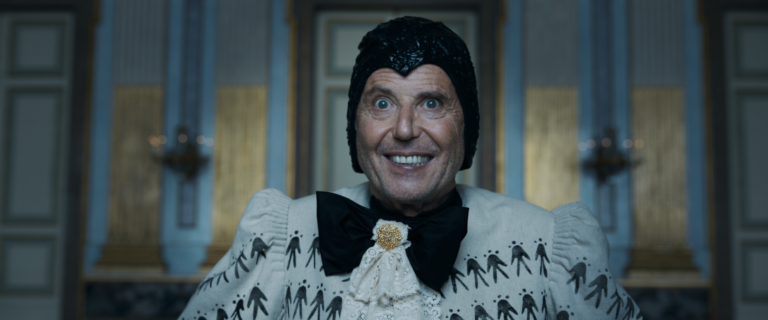
Set del film "Loro" di Paolo Sorrentino. Nella foto Toni Servillo e Giovanni Esposito. Foto di Gianni Fiorito Questa fotografia è solo per uso editoriale, il diritto d'autore è della società cinematografica e del fotografo assegnato dalla società di produzione del film e può essere riprodotto solo da pubblicazioni in concomitanza con la promozione del film. E’ obbligatoria la menzione dell’autore- fotografo: Gianni Fiorito.
Cinema Wednesdays - Thierry Fivaz
With Silvio and the others, Paolo Sorrentino delivers a rich and particularly disconcerting film. And like many of his films, it will probably take several viewings to fully appreciate and digest this strange object once again offered by the Italian director.
It's a difficult task to sum up Paolo Sorrentino's latest film in a few words. As is often the case with the Italian filmmaker, the film is made up of multiple tables, This is one of the reasons why multiple viewings may be necessary.
To put it simply, the film tells the story of a couple from Puglia who have only one desire: to make contact with Him. Him, is, of course, Silvio Berlusconi (played by a magnificent Toni Servillo). A Berlusconi who has just been defeated in the 2006 elections and, somewhat idle, is trying to win back his wife Veronica (Elena Sofia Ricci) while enjoying a good time in charming company. A paradoxical and contradictory situation.
But, as the original title suggests (ed: Loro, or «them» in Italian), the film focuses mainly on the courtiers of the Cavaliere - who doesn't appear until the fortieth minute. Courtiers struggling to make themselves look good to the flamboyant Silvio. As for the ambitious couple, their idea is simple: rent a villa next door to Berlusconi's, fill it with young women and wait for the predator to appear.
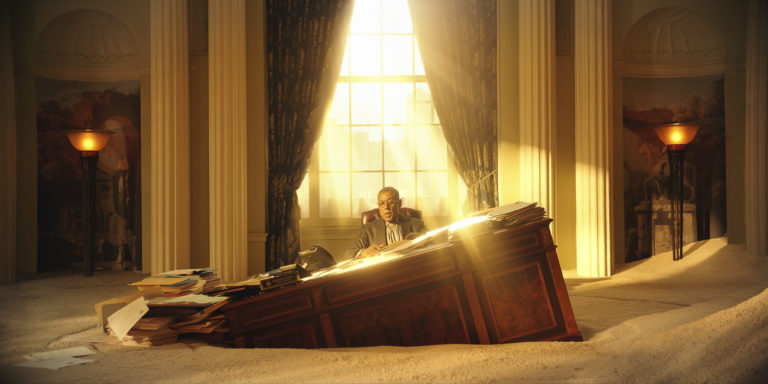
As usual, the image is particularly polished (almost excessively so at times). Punctuated by numerous still shots, the film offers some masterfully beautiful scenes, such as the Deposition of Christ in the final scene. And if the use of long travellings and less twirling, the touch is there. There's no mistaking it: this is Sorrentino.
Silvio's lamb
Planted in the middle of the garden of a luxurious estate (Berlusconi's, by the way), a young sheep cautiously moves forward. The animal seems attracted by something. Arriving on the house's huge terrace, it seems to hesitate, then finally enters the living room. In front of her: a huge TV screen showing a typically Italian program. Captivated by this televisione spazzatura (ed. note: telescopic garbage can), the sheep opens its eyes wide, then, without warning, collapses dead.
This intriguing opening scene sets the tone. As he had already done in La grande Bellezza, in which a friend of Jep's made a giraffe disappear, Sorrentino once again plays with the representation of the animal. Obviously, the scene here can take on a weighty allegorical dimension - shorn like sheep, Italians are bored to death in front of the television. created by the same man who shears them, to the point of death - this computer-generated ewe is equally striking. It sounds wrong. To the point of blurring and even ridiculing the message it conveys. It makes you wonder if the allegory isn't just a pipe dream after all. A fabrication, as is the famous sheep. But what does the enigmatic Sorrentino mean by this? Is he serious? Or does the ambiguity of the message simply stem from the fact that filming with a real sheep was so impractical?
Therein lies the subtlety of Sorrentino's cinema. In addition to dealing with Italian themes (Le conseguenze dell'amore, Il Divo, La grande Bellezza), the filmmaker's films must also be seen in an Italian light. And this goes beyond the polished aesthetic, the countless references to Fellini or the country's historical and artistic treasures. Above all, it's a state of mind, a particular kind of humor. It's a humor that's at once serious and detached, and one in which you're never quite sure whether what's being said is serious or not - and which, it seems, many French-speaking critics struggle to understand.
This is how Silvio and the others. Perpetually oscillating between real and the fake, Sorrentino's film is a representation of a fantasized reality, the childish and the serious, the beautiful and the kitsch, the noble and the vulgar. Non-documentary, Sorrentino's film is the representation of a fantasized reality. In which, dressed as Berlusconi, Toni Servillo looks like a clown. He, too, oscillates between the ridiculous and the touching, the superficial and the authentic. Nothing is true, yet everything rings so true.
Those expecting a portrayal with a vengeance will be disappointed, as this is not what Sorrentino proposes. Here, the exercise is more subtle. The director paints a portrait of a man who fears boredom, denies death, and whose incredible vitality makes him try, against all odds, to live as if he were still thirty. The ridiculousness of the situation lies in the fact that this man is in his seventies. That this lover of young women could be their grandfather. That his optimism is in fact denial. And it makes you wonder how such a character came to occupy such a position.
That's the whole point; Sorrentino provides a rough answer. In one scene, a Berlusconi randomly picks a phone number from the phone book, dials the number and then sets himself the goal of selling an apartment - which doesn't exist - to the person who had the misfortune of picking up the phone. And then, suddenly, the artist enters the scene. The beast awakens. The salesman is at work. A salesman of what? A dream salesman, of course. Such is the Berlusconi of Silvio and the others, a funny character. But is it so far from reality?
Write to the author: thierry.fivaz@leregardlibre.com
Photo credit: © Pathé Films
You'll also like

 French
  German
  English
Leave a comment