


Japan, in the near future. All the dogs in the city of Megasaki are suffering from dog flu and truffle fever, diseases apparently contagious to humans. Mayor Kobayashi decides to isolate - literally - these dogs on an abandoned island where all the city's waste is dumped. As a token, the mayor sends his own dog, Spots, to the island. Within six months, the island is populated by all the city's dogs, all mysteriously afflicted with this dangerous fever. Here, their days are spent fighting over a garbage bag and reminiscing about their domesticated past, until the day a little pilot lands on the island in search of his four-legged best friend.
Bears and dolls
For his ninth feature and second animated film, American director and producer Wes Anderson has spared no expense. While some of the director's favorite actors (Bill Murray, Edward Norton, Harvey Keitel) dub the characters, the cast also includes Tilda Swinton and F. Murray Abraham - whom we also admired in The Grand Budapest Hotel (2014) - or Scarlett Johansson and Yoko Ono.
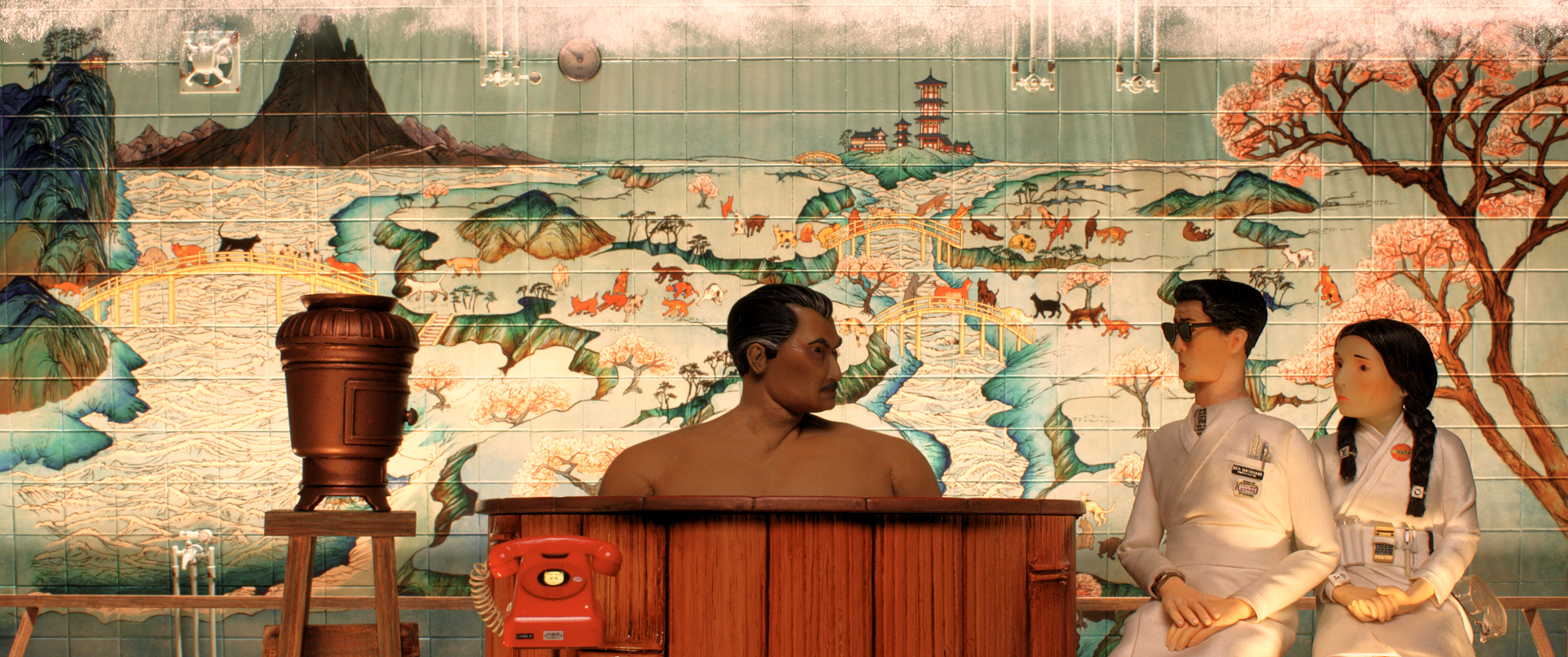
But above all, what first strikes the viewer is without doubt the quality of the images. The production of this animated film in stop motion took two years and required the skills of numerous craftsmen who created around 1,000 canine and human dolls of various sizes. The Silver Bear received at the 2018 Berlinale for Best Director therefore comes as no surprise.
Journey into a rich and disconcerting visual universe
While the film opens with cats, whose representations inhabit - and dress up - the town of Megasaki, it's actually five dogs, with distinct personalities, that we follow on the island where they're confined. Rex, Chief, King, Duke and Boss - names with alpha resonance - help young Atari in his search for his dog. Between founding myths and gossipy rumors, our protagonists wander between the ruins of nuclear power plants and the remains of abandoned cities, in a story characterized by its rhythm (also supported by the incessant sound of drums).
Wes Anderson, in fact, has accustomed us to a narrative divided into titled chapters - The Royal Tenenbaums (2001), The Grand Budapest Hotel (2014) - and sometimes speckled with explanatory flashbacks; here he again demonstrates a pronounced taste for surprise and astonishment that punctuate the narrative. We salute the originality of the script, which nevertheless retains the classic theme of the hero setting off on an adventure in search of meaning. The American director's meticulous framing, with its play of shadows tinged with yellow and orange, makes for a rich (too rich?) visual experience.
Indeed, some shots are highly aesthetic, even artistic, in their assembly of shapes and colors. The attention to detail and optical complexity is a leap from Anderson's first, already meticulous animated production, Fantastic Mister Fox (2009) based on the story by Roald Dahl. Small gems: the Japanese prints that infiltrate the sequences, as well as the use of animation for filmed or televised images, offering us a mix of techniques, a cornerstone of Wes Anderson's visual universe - let's remember the animated sequences in Aquatic life in 2004.
Lost in translation
The puppets of Isle of Dogs are distinguished by their expressiveness; the dogs have talking eyes that allow us to distinguish a wide range of emotions on their faces - quite a feat for clay figurines. Emotions are the flaw in this otherwise remarkable film. In an effort to be technically precise, the director seems to have neglected the viewer's emotions. It's worth pointing out that, while the character is fortunately not a simpleton, he doesn't touch the viewer, who nonetheless laughs several times at the friendly comments made by the pack of dogs.
By the way, it's the dogs we understand in this film, not the humans. A note at the beginning of the film explains that the barking has been translated into English, but that the human language exchanges - in Japanese - only reach us through simultaneous translators or translation devices. So, while some of the dialogue is lost, it doesn't interfere with the understanding of the scene.
Wes Anderson, already in The Grand Budapest Hotel, In this way, a ripped-off ear or shellfish deboyed alive do not shock, but do take away the innocence and naivety of his films, which are above all aimed at an adult audience. The film is packed with references ranging from Japanese cinematography to ancient myths and tales, including a Teriyaki-style David and Goliath.
Finally, Isle of Dogs stands as a complete work of art in visual terms - you almost want to touch the material sublimated on the screen - in musical terms - Alexandre Desplat's remarkable work is to be recalled - and in terms of content, delivering an original story and an unparalleled cinematic experience.
You've just read an open-access review. Debates, analysis, cultural news: subscribe to support us and get access to all our content!
 French
  German
  English