
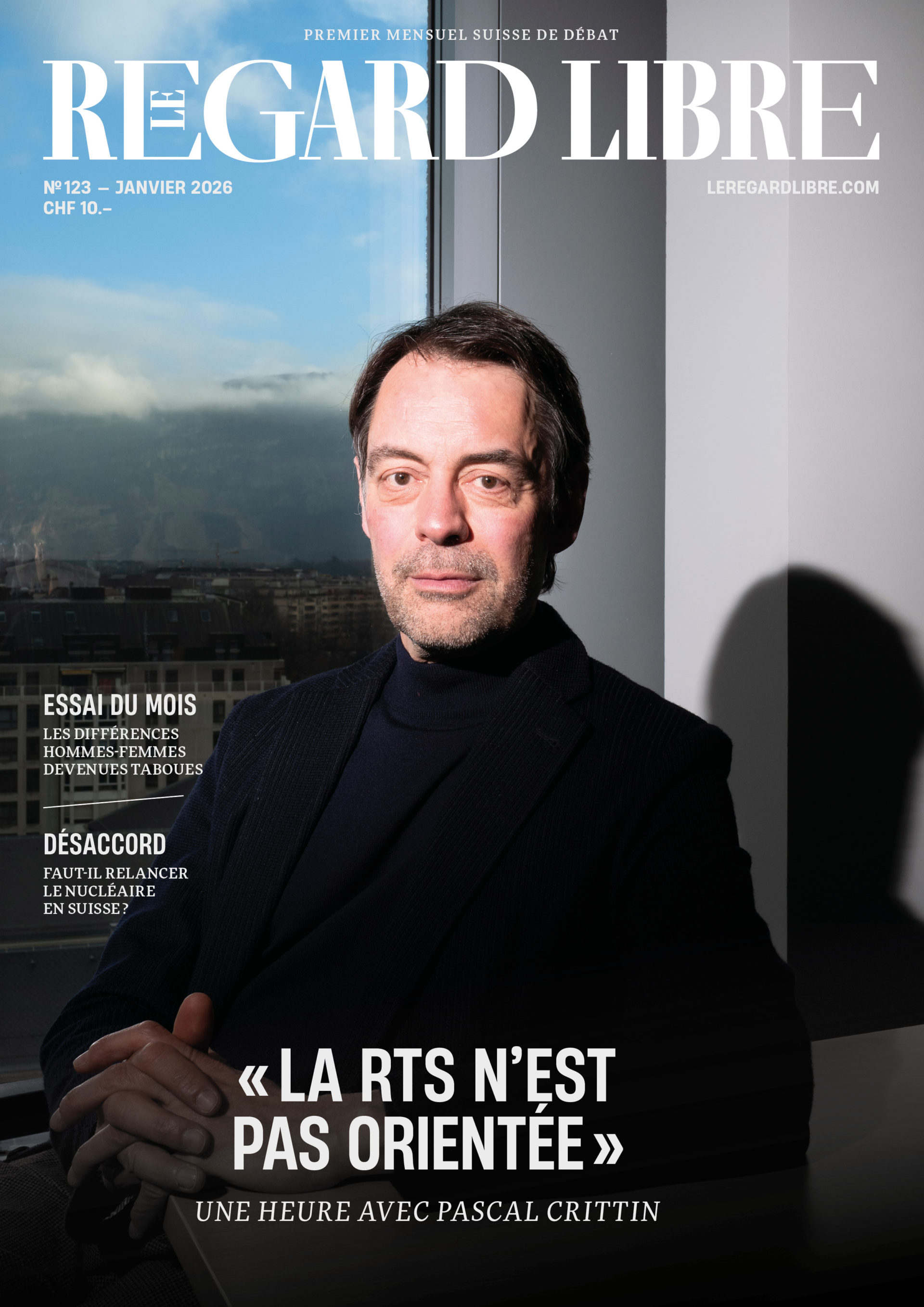

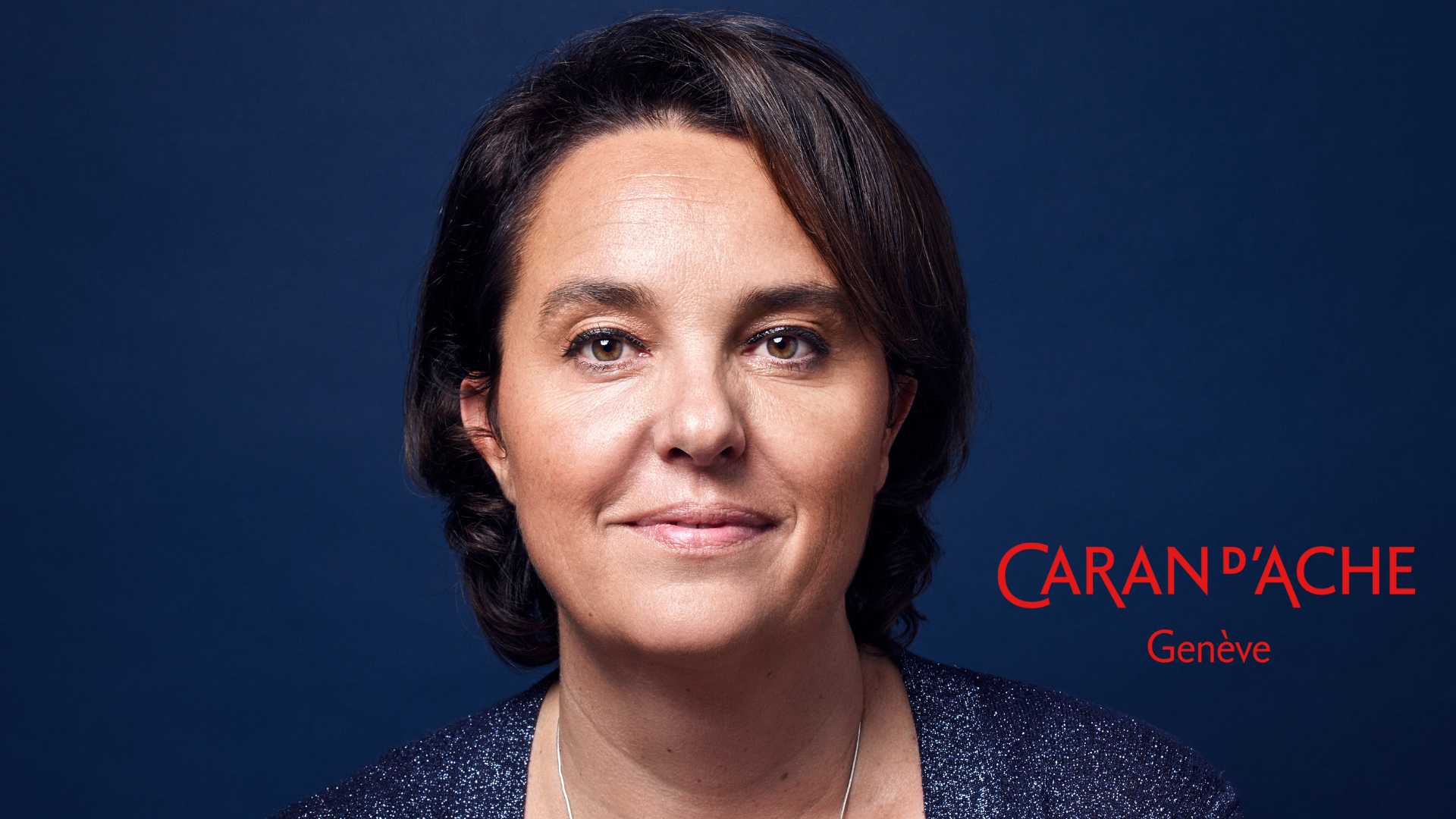
Founded in Geneva in 1915, Caran d'Ache - Russian for «pencil» - is part of the country's cultural heritage. Carole Hubscher, Chairman of the Board of Directors and the face of the fourth generation at the helm of the company, shares some of her manufacturing secrets with us.
Home to Caran d'Ache since the early 1970s, Thônex has become something of a pencil capital. Upon arriving at the site, the traveler sees a giant metal feather decorating a streetcar stop. Further on, a red pencil stands proudly at the entrance to the company's main building. It's behind these walls, and not in some faraway land, that the pencils and pens that make such a lasting impression on local children are manufactured. And those who have remained so. Once through the door, we witness a skilful blend of industrial and manual work. A perfect summary of the challenges facing the company, which must write its future between history and modernity.
Le Regard Libre: When I think of Caran d'Ache, the first thing that comes to mind is my childhood, and your window displays in railway stations. Is this imagination widespread?
Carole Hubscher: The window displays in railway stations featuring Caran d'Ache automata - teddy bears, hedgehogs and other figurines - are a fascinating subject and resonate in the hearts of the Swiss. Unfortunately, due to construction work, the window display at Berne station is about to disappear for a while. Internally, those who feel that this means of reaching the public has become somewhat outdated over time are almost always those who weren't lucky enough to have this madeleine de Proust as a child.
As an adult, is this nostalgic child still a Caran d'Ache customer?
We don't know if our most loyal customers are also those who pass our windows in train stations or used our pencils as children. Caran d'Ache is often perceived as a love brand. For some young adults, this link with childhood could also be a brake: some artists at art school associate Caran d'Ache with their childhood, and want to try out other products too. However, when they use our artist ranges, they almost always end up realizing that the quality of our products is irreplaceable.
Do these positive memories help you convince people to come and work for you?
I often talk about the Caran d'Ache family. We must never forget that we are a human-sized company, with around 300 employees. We all know each other and the general atmosphere is very good. Also because the people who work here feel that what they do makes sense. When someone says they work for our factory, people generally react sympathetically. Because everyone has a history with the brand. In a way, Caran d'Ache belongs to all the Swiss.
Does this link also exist in German-speaking Switzerland?
All over the country, people identify with our products. However, this bond is a little weaker on the other side of the Sarine. In addition to the language barrier, the influence of Germany and its pencils is not negligible.
You are the fourth generation to head the company. How do you see the succession?
The next generation is still young. But we regularly organize meetings at the factory, during which an employee explains his or her trade and know-how. Our aim is for the next generation to get to know them better and understand what we're all about. Being a family business is an opportunity, but also a responsibility that can be frightening. So we're here to reassure them that they're free to pursue the studies and careers they want. But Caran d'Ache is also an option for them.
You yourself, before taking over the reins, wanted to see something different.
After graduating from hotel management school, I wanted to gain experience abroad. So I spent some time working for the Caran d'Ache distributor in the United States. After that, I wanted to discover other realities. My family encouraged me in this choice, without putting any particular pressure on me. I was able to work for Swatch Group, which is also a strong brand. Then I was active in the branding, with various companies who wanted to strengthen or modernize their brand.
Was this work also necessary for Caran d'Ache when you returned in 2012?
No, the company's brand image was consistent with its day-to-day reality. Revolutionizing everything would have been pointless, because the company was running smoothly.
Knowing how to manage your story without missing an evolution is no easy task.
Juggling tradition and innovation is a constant challenge. The Internet has enabled us to strengthen our contacts with artists. They enable us to stay agile and anticipate trends. We also work with them before launching a new product. They use our articles and advise us on how to improve them, which is extremely valuable. We also try to cultivate an innovative corporate culture internally. For example, each new employee can fill in a «report of surprise» after his or her first few weeks on the job. With fresh eyes, you can sometimes see things that need changing that others no longer see.
But isn't the risk of obsolescence a general challenge for a writing products company in the digital age?
Digital technology could be seen as one of our «competitors». But rather indirectly. Drawing and writing remain the tools for expressing creativity today. When an architect draws his first designs, he won't do it on a computer. That would be a completely different experience. Caran d'Ache offers the possibility of personal creativity. Computers and digital tools, on the other hand, are more about productivity. I don't know anyone who doesn't have a pen or pencil on their desk. We all have one to quickly write a note or leave a trace of something that's on our minds.
Is this really the case with young people? If elementary school go digital in the classroom, the relationship with writing disappears.
Trials have been made in this direction, yes, but they have been inconclusive. Learning to write is important for a child's development. Some studies show that young people who take notes by hand retain much better than those who type directly on the computer. Writing by hand is slower, so you have to limit yourself to the essentials and prioritize things. As a result, listening is much more thoughtful. Nevertheless, it's true that when you look at old documents, you can see that handwriting is evolving: the letters aren't as well formed as they used to be. Today, people generally write faster.

Can this transformation in writing be observed all over the world?
In Asia, handwriting is still very fine and elegant. People still write a lot by hand on a daily basis. This also applies to the younger generation, who are still numerous in the stores that carry our products there. In the United States, the new generations have a more childlike handwriting style. In Europe, children still learn to write in cursive at school.
Digital also allows you to speak directly to your audience, without going through intermediaries like stationers. How has this revolutionized your business?
Caran d'Ache was the first company in the industry to launch e-commerce. The fact that we could have direct contact with our community of customers was great for us. We remain a modest SME, with means that are different from those of the big groups who can afford endless pages of newspaper advertising. That's not the case for us. With digital technology, you get more precise feedback from your audience. Before, it was always indirect, through distributors or stationers. The same goes for advertising campaigns. You didn't really have a direct exchange with customers, and little opportunity to take their feedback into account. Now, the many online comments give us a better understanding of why certain products work so well, and what still needs to be improved for others.
You are no doubt often criticized for the price of your products.
Because our pencils and pens are made in Switzerland, they come at a certain price - the price of quality. Our prices remain competitive with those of our competitors who are in the same position. premium. On the other hand, many products in our sector are now manufactured in China. The price level of this kind of merchandise is hard to compete with. But we're targeting a different audience, one with high expectations in terms of quality and durability. That's our promise, and it forces us to be uncompromising, even if it means sometimes delaying the release of a new product or abandoning it if it's not up to scratch. Ultimately, in the long run, quality costs the customer infinitely less, because the product lasts longer.
Back in 1928, Arnold Schweitzer, Caran d'Ache's historic figure, received a letter from a customer who assured him that he had managed to write 87,367 words with just one of your pencils.
Schweitzer was a true genius of marketing before his time. To publicize the company, he ordered boats in the shape of metal pencils, or a car with a pencil on the roof. During work near the Geneva train station, he managed to get large pencils suspended from the cranes. Arnold Schweitzer's successors worked more on industrial performance and internationalization of the brand. Each has made his own contribution.
Is Caran d'Ache positioned in the same way in Switzerland as it is abroad?
Yes, we have a global strategy, with some nuances depending on the country, of course. When it comes to prices, there are variations between Switzerland and other countries. Our products are a little cheaper in Switzerland, because we distribute them directly and VAT is lower there. In a country with less purchasing power, our products are perceived as more affordable. premium. Let's take an example: when you send your products to the United States, they have to be shipped and cleared through customs. All these steps have a cost, which is ultimately passed on to consumers.
Do you sense the return of protectionism?
Not very much at the moment. After Covid, we felt the main tensions in transport and energy costs, which meant that our prices had to be revalued.
Are your pencils subject to customs duties?
Yes, but at different levels depending on the market. In India, for example, if you don't produce locally, you're taxed enormously. This global dynamic worries me, because it makes trade more difficult. Especially for a small exporting country like ours, it's dangerous.
If your products are made in Switzerland, some of the raw materials come from elsewhere. This is particularly true of the wood used in our pencils, which is Californian cedar. Why this choice?
The different types of wood found in Switzerland have many more knots, and are more compact and hard, making them difficult to sharpen or work. California cedar, on the other hand, is perfect for making high-quality pencils. The nature of a wood depends on many factors. Whether it's wind, temperature and many others, California cedar is unbeatable.
This is not a new issue. During the Second World War, Caran d'Ache had to fall back on local wood because of delivery problems. It was a failure...
Even if it's difficult, we're not giving up. We're working with the Biel School of Wood to try and reproduce the qualities of Californian wood in Switzerland. Our country is a great source of wood, so ideally we'd like to use more of it, as long as it doesn't jeopardize the quality of our products.
Deputy director of the Institut libéral and essayist, Nicolas Jutzet is an editor at Regard Libre.
 French
  German
  English