




«Doubt is the magic of the historical thriller».»
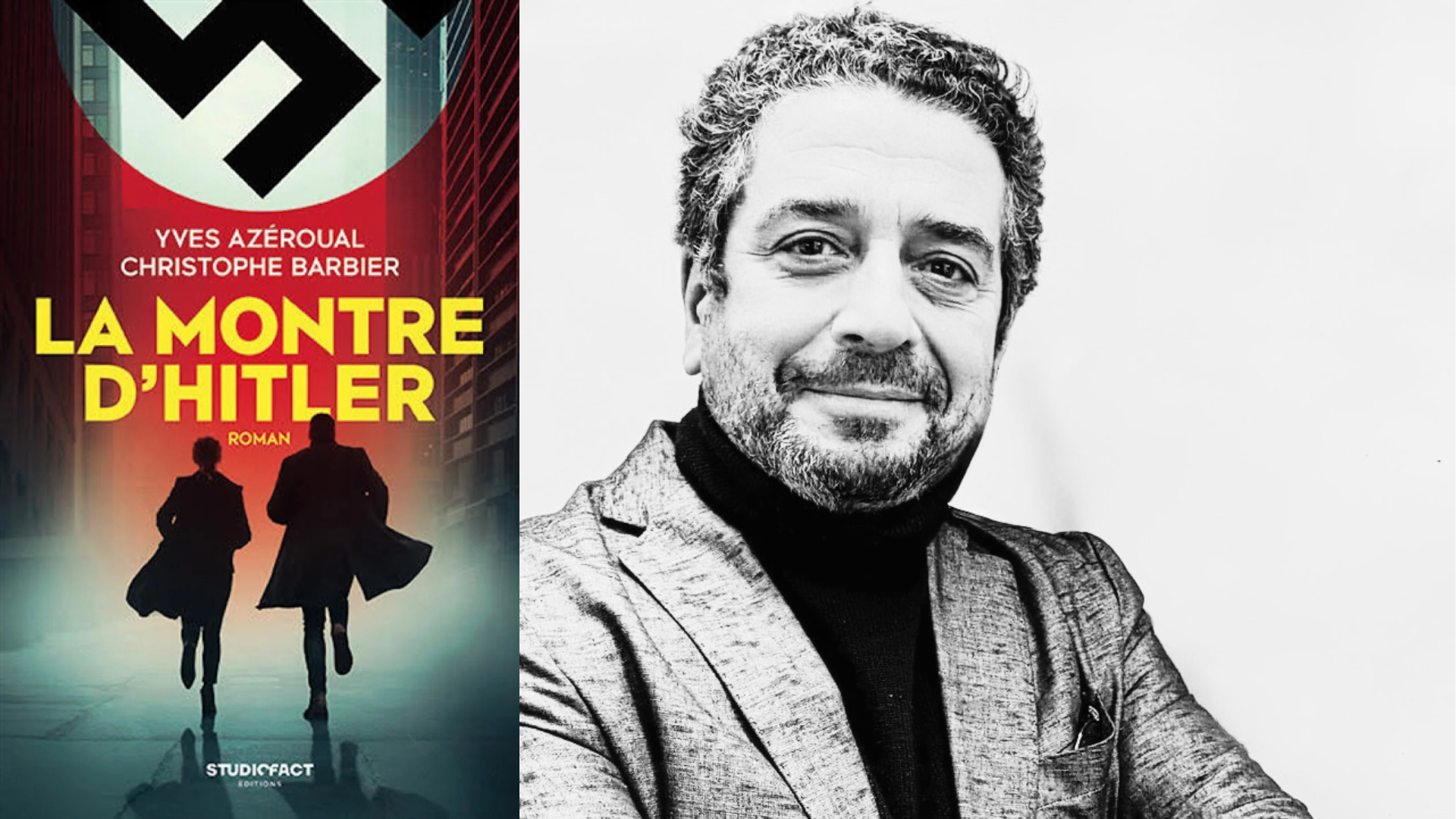
In Hitler's Watch («La Montre d’Hitler»), Yves Azéroual and Christophe Barbier combine thriller and reflection on transmission, around a watch that once belonged to the Führer, to probe how an era haunts the living.
The choice of thriller is not insignificant. It transforms history into an investigation, and places the reader in an ambiguous position: reading a plot while remaining aware of what it conjures up. The novel thus assumes a paradox: dealing with a serious subject through a deliberately readable form. This simplicity questions the way in which a society transmits its past: should memory be solemnized or made shareable? It was around this tension that we interviewed one of the two authors of Hitler's Watch («La Montre d’Hitler»), published in October by Studiofact.
Le Regard Libre: You've opted for a format akin to an adventure novel to retrace one of the darkest periods in history. Did this allow you to take a step back and ask fundamental questions about the duty to remember, and the weight of guilt over the generations?
Yves Azéroual: Novels, and thrillers in particular, offer a unique freedom: to take a historical fact and weave it into a captivating fiction. As Roger Vailland said, «a novel begins with a throw of the dice». For us, the trigger was a significant episode in 1945: a soldier of the 2nd DB, while storming the Berghof, Hitler's residence, with his squad, seized the Führer's watch, a birthday present from Nazi dignitaries. This theft becomes the starting point for an intrigue that blends history with suspense.
However, I'm wary of the expression «duty to remember». Like Simone Veil, I believe that the real duty is not to commemorate, but to teach and pass on. Thrillers, with their ability to conjure up the past while entertaining, can serve precisely this purpose: to awaken consciences without lapsing into moralism.
How do you write with two hands? Is there a precise organization to follow so as not to get lost or, on the contrary, to give free rein to your specificities?
Writing together is first and foremost an exercise in balancing our sensibilities and expertise. Christophe Barbier, with his experience as a journalist and his sharp eye for current affairs, brought an immediate and incisive dimension to the story. For my part, I concentrated on the details that anchored the plot in tangible reality, such as the 2nd DB soldier seizing Hitler's watch in 1945. But it's precisely this complementarity that gave the book its richness. The historical thriller demands both precision and pace, and our two points of view, one focused on history, the other on current events, created this narrative tension.
Our method? Neither too rigid nor totally improvised. We started with a common outline, then each of us wrote passages according to our strengths. After that, we went back and forth, rereading, adjusting and, above all, discussing to standardize the tone without erasing our specificities. For example, Christophe often refocused the story on contemporary issues, while I insisted on the resonances of the past.
When reading your book, one often wonders how much of it is fact and how much is fiction...
It was a conscious decision: we wanted the reader, on every page, to ask: «What if it were true?» Not to deceive them, but to draw them into a universe where fiction is so deeply rooted in history that it becomes plausible. Our method was based on three pillars.
First, rigorous documentation: we searched archives, eyewitness accounts and historical studies to anchor every detail – locations, objects, dialogues – in verifiable truth.
Then, real «hooks»: we slipped in little-known but authentic historical elements (such as the existence of this watch, or little-known Nazi protocols) to give the story a documented resonance.
Finally, «responsible» fiction: every invented element, whether a character or a subplot, was designed to fit naturally into the historical context, without distorting it. The aim? That the reader, even if he knows he's reading fiction, feels at every moment that «it could have happened».
Doubt is the magic of the historical thriller. If the reader closes the book wondering where the truth ends, we've succeeded: the boundary between fact and fiction becomes an invitation to reflect, much more than a simple enigma to be solved.
In this book, we often talk about the burden of transmission: how to be the descendant of a Nazi, and how to write one's own history while at the same time fulfilling one's duty to remember the victims. Why does this question of filiation and guilt resurface so insistently today?
We are living in a period when the last generations to have experienced war are disappearing. Their descendants are left with a duty to remember that often becomes a burden on their identity. Debates about family responsibility, reparations, or even DNA tests revealing unsuspected ancestry, show that the question haunts our societies.
In the age of social networking and online genealogies, buried family truths are just a click away. The novel's young heroes, Mia and Hans, with their contrasting backgrounds – one the granddaughter of an Allied soldier, the other the grandson of an ex-Nazi officer – symbolize this generation that must build its identity in the shadow of history, whether glorious or monstrous.
In Europe, too, the belated trials of Nazi criminals, the restitution of looted works of art and the controversy surrounding commemorative monuments are reminders that the past never stays buried. It returns, in the form of family secrets, passed-on traumas, or quests for truth like that of Hans, torn between the shame of his lineage and the need to understand.
The book's style is rather accessible. Did you want to unleash this period?
Hitler's Watch («La Montre d’Hitler») is neither a history textbook nor a moralizing treatise, it's a historical thriller, designed to captivate like a spy novel or thriller film. We've chosen to adopt the codes of the genre: breathless pace, twists and turns, and a plot that moves forward with every page, as our readers tell us.
Christophe and wanted to bring history to life. By integrating elements such as Mossad, emissaries from the Islamic Republic of Iran, archives from the German Democratic Republic (GDR) and the Carpentras cemetery affair, we wanted to show that the past is not a dusty subject, but a playground for the imagination. These real elements, mixed with fiction, create an augmented reality effect: the reader discovers little-known parts of history without even realizing it.
By avoiding a ponderous or academic tone, we hoped to appeal to younger readers, those who might be put off by an overly solemn narrative. The idea? To make them want to discover history through fiction, to ask questions about the past while being carried away by a thrilling plot. To show that serious subjects can be tackled without sacrificing the pleasure of reading. After all, the best way to pass on a story is to make people want to turn the page.
You've just read an unpublished open-access article. Debates, analyses, cultural news: subscribe to support us and access all our content.
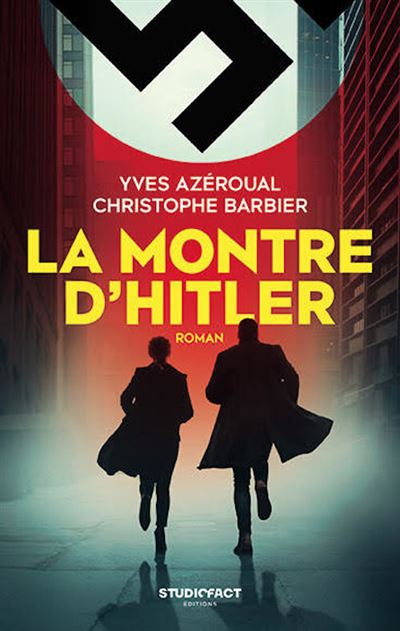
Yves Azéroual and Christophe Barbier
Hitler's Watch
Studiofact
October 2025
336 pages

You'll also like



 French
  German
  English
Leave a comment