




Le théâtre du grincheux

Le Regard Libre N° 51 - Ivan Garcia
In a small Austrian village, Bruscon, a state actor, moves in with his family at an inn to prepare for the performance of a play that has made him famous. Between theatrical rehearsals and long, cynical, disillusioned monologues, Bruscon speaks to the grump in all of us.
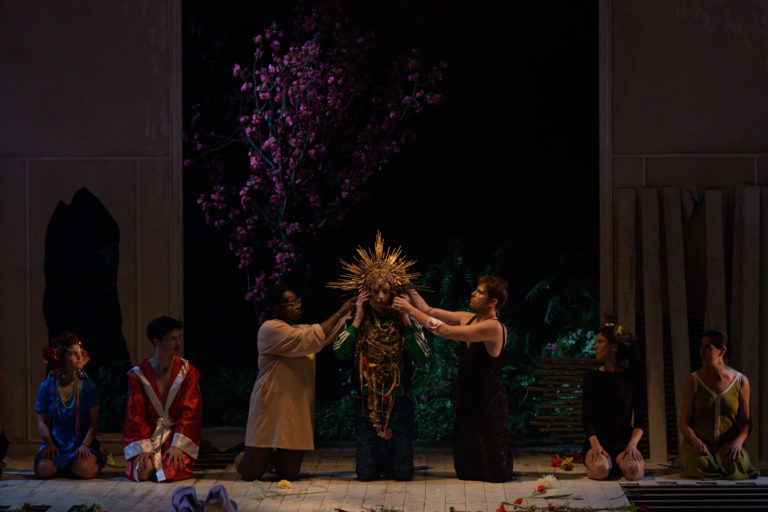
Before the show begins, an innkeeper, dressed in a chef's hat and skin vest, sleeps on a stool. As promised by the announcer, a curtain-raiser, inspired by Jacques le fataliste and his master, lets in two clowns, looking like punks and wearing t-shirts «Sex Pistols». After a bit of gallivanting, our two clown-punks, like good philosophers, launch into a long dissertation on fate with the innkeeper: «everything good or bad that happens is written up there.»
If everything is already written, what's the point of fighting the inevitable? Instead, let's be clowns! And there you have it, the main theme of the fable that will soon unfold before our very eyes. In the meantime, the innkeeper, as a quiet force, stands tall and firm in the face of the howling chaos embodied by the jesters. After a slight struggle, the three characters exit the stage, and the curtain rises, opening on The theater maker.
A protagonist who «hates it»...»
The fable can be summed up quite simply: Bruscon and his family settle in the small village of Utzbach, in rural Austria. At the inn, the state actor keeps telling the innkeeper that, for his famous play «The Wheel of History» to be a success, the light at the fire exit must be turned off, and that the fire chief had better not object. With this proviso sine qua non in the lead, the audience follows Bruscon in his long soliloquies on art, theater, intellectual misery and family relationships.
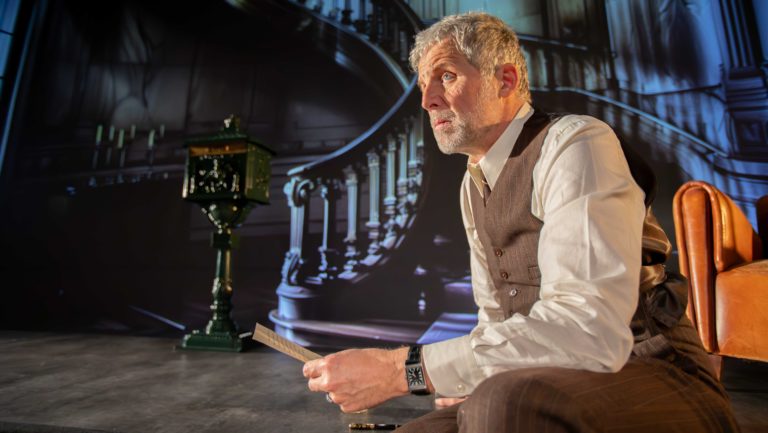
Father Bruscon has all the earmarks of a decrepit old artist; gray hair and untrimmed beard, long black coat, tall and dry, in poor health, he makes life unbearable for those close to him. No one really knows why he has come to live in Utzbach. However, given his unenviable character, we can only assume that the «big city» can no longer stand this slightly too psychorigid actor. Bruscon, as some young people would say, «hates it»: he digresses, alone, ranting, giving orders either to his children, Sarah and Ferruccio, or to the innkeeper who, willy-nilly but always stoic, puts up with his host. This is true even when, on several occasions, Bruscon, scandalized by what he considers to be attacks on «his Art», bursts out with «All Nazis!», «This Austria, all National Socialists!» and other historical gibberish.
On stage, as if to underline his authority, Bruscon controls the movements of the other characters. First, the innkeeper, who has to move the actor's table four times to different corners of the stage. Then there's his son, Benjamin, a «failed comedian» according to his father, who, with a broken arm, has to train himself to «pull the curtain back properly». With his arm in plaster, Ferruccio struggles, sometimes unsuccessfully, to pull the curtain from right to left and vice versa, at the behest of his father who, quite happy to humiliate him, takes pleasure in prolonging the ordeal for the one-armed boy.
Some of Bruscon's attitudes and gestures - longing glances, inappropriate caresses, holding his daughter in his lap, etc. - towards his daughter, Sarah, tend to reveal a special relationship with incestuous undertones between these two characters. In fact, he often shows concern for his daughter alone, taking care «not to spoil her talent» and «that she doesn't get contaminated by the other losers», especially her mother, who - poor thing - isn't very bright.
«Utzbach like Butzsbach»
Speaking of Madame Bruscon, let's talk about her! She's (almost) the most self-effacing character in the play, absent until about two-thirds of the way through the performance, at «bouillon à l'omelette» time. As soon as she arrives, she looks ill and coughs frequently, which prevents her from responding to her husband's invective. Yet, intriguingly, Madame Bruscon has the privilege of having the «last word», as she closes the performance by stepping over Bruscon's body, stricken with a kind of heart attack. We could see this as a kind of revenge on the part of this character or, as we'll show shortly, a reminder of a kind of fatality emphasized by the performance, through the figure of the wheel.
The most self-effacing character in the entire play is not Madame Bruscon, but the chief of the Utzbach village fire department. Although he is often mentioned, he never physically appears on stage, but is relayed by the innkeeper, who acts as liaison between him and Bruscon. So, while his role as decision-maker - will he give Bruscon permission to turn off the emergency exit light for his performance or not? - gives him a predominant role in the play's plot, the audience's expectations end up being somewhat disappointed by the author, Thomas Bernhard. While the audience is prepared for a few pitfalls thrown in the way of old Bruscon by the fire chief, nothing happens... The authorization to extinguish the fire comes through the innkeeper's mouth without any difficulty; the emergency exit light is not really a problem; in fact, it's merely a contingent sign which, in any case, won't prevent fate from happening: the wheel of fortune turns.
What's more, the protagonist ends up in the village of Utzbach, which he detests above all else. On several occasions, he underlines this dichotomy between the countryside Utzbach and the town Butzbach, using the phrase «Utzbach as Butzbach». More than just an expression, this covers a whole network of dualities that oppose - from Bruscon's point of view - Utzbach to Butzbach. Firstly, on the question of success and anonymity, while in Utzbach Bruscon and his family were illustrious unknowns, in Butzbach they enjoyed their status as «state actors». Secondly, gastronomy invites itself to the critical table: while in the countryside, pigs are raised to make sausages and «bouillon à l'omelette» is eaten, Bruscon soliloquizes on his nostalgia for the refined dishes of the city and his distaste for «bouillon à l'omelette».
The «wheel of history»
Nothing leaves the spectator more curious than this famous play which, in the world of fable, should be performed, on the village stage, by the Bruscon family. Entitled «The Wheel of History», we could see it as a simple two ex machina or a narrative motif to weave the plot. If you think about it, this detail probably holds the key to reading the performance. Let's find out what «the wheel of history» is about. Bruscon whispers a few words to the innkeeper, mentioning Stalin, Hitler, Churchill and even Napoleon. To tell the truth, we don't know much about it, except perhaps that Ferruccio embodies his characters best when he has a broken arm, and that it takes the form of a gigantic polyphonic fresco where most of the great historical figures meet. Under cover of invisibility, this «wheel of history» symbolizes the invisible hand that guides men towards tragedy.
Paradoxically, at the end of the show, «The Wheel of History» invades the auditorium like a symbol. As Bruscon and his family enter the stage, a fire breaks out in the presbytery, emptying the auditorium of its audience. The theater, deserted, devastated like a field of ruins after the spectators have fled, breaks the heart of poor Bruscon, who, in despair, grief and spite, collapses and - probably - dies. Victim of his fate, the protagonist ends up crushed by the wheel he himself set in motion, evoking the fact that tragedies systematically repeat themselves.
With The theater maker, Thomas Bernhard, in a tirade by the grumpy old man Bruscon, expresses his profound skepticism - or lucidity, you be the judge - about the art of theater, exclaiming that: «The writer is a lie, the performers are lies and the audience are lies too, and the whole thing is a unique absurdity, not to mention a perversity that's already thousands of years old. The theater is a perversity several thousand years old that humanity loves, and loves it so much because it loves its lies so much, and nowhere else in this humanity is the lie greater and more fascinating than in the theater.» So, dear readers, perhaps we're getting to the heart of a fascinating enigma: why do we humans take such pleasure in lying? go see du mensonge at the theater and, what's more, to be part of this great lie?
Write to the author: ivan.garcia@leregardlibre.com
Photo credit: © Philippe Pache
-
 Le Regard Libre - N° 51CHF10.00
 -
 Standard subscription (Switzerland)CHF100.00 / year
 -
Support subscriptionCHF200.00 / year
The theater maker / Based on the text by Thomas Bernhard / Directed by Jean-Luc Borgeat / Compagnie du Milan Noir / Pulloff Théâtres (Lausanne) / April 30 - May 19, 2019

You'll also like

 French
  German
  English
Leave a comment