




Let's unite against Islamism
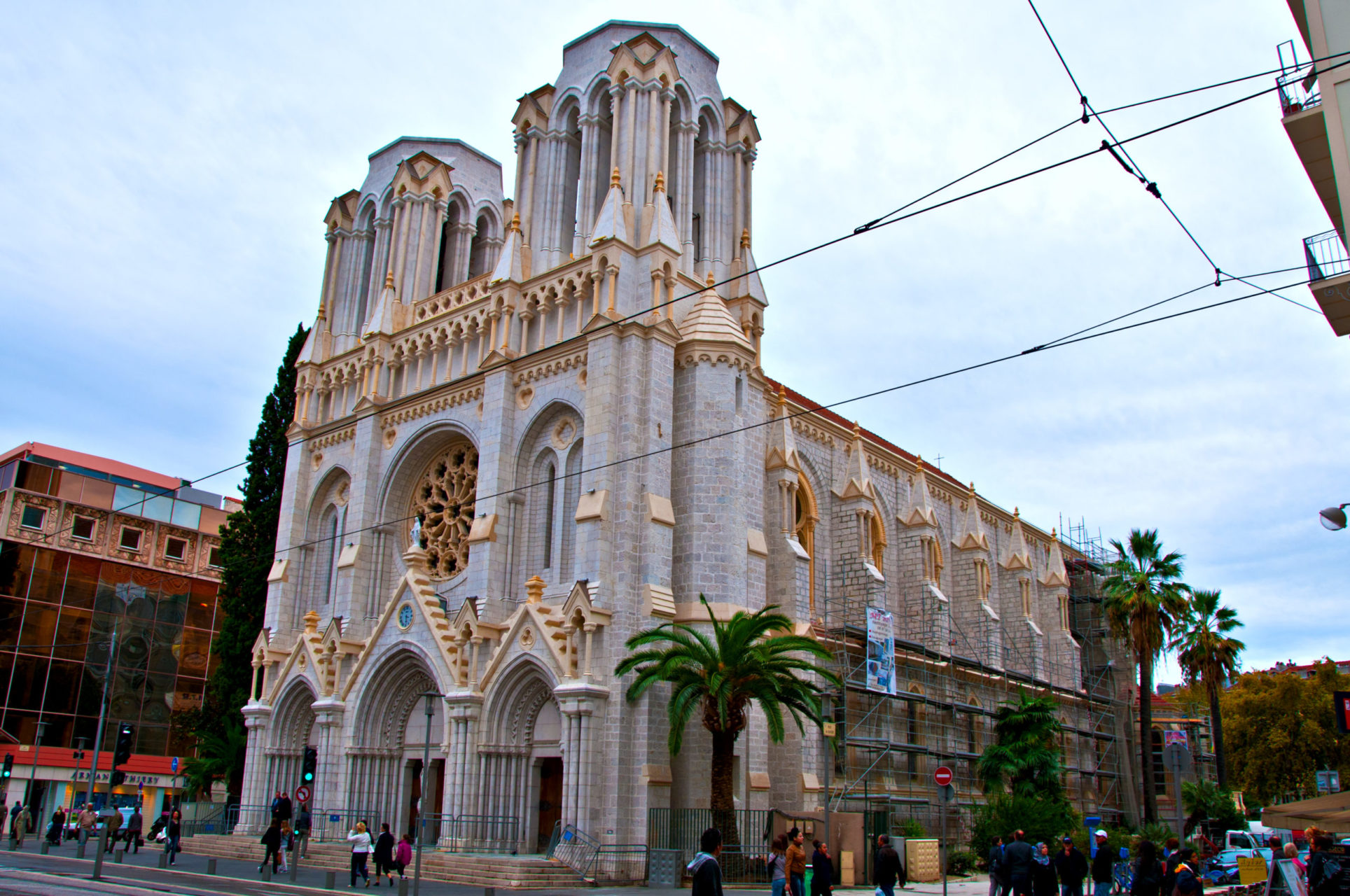
Notre-Dame Basilica, Nice. Wikimedia CC 2.0
In its violent expression, Islamism struck again in France on Thursday, October 29. After the attack that claimed the life of a teacher in Conflans-Sainte-Honorine on October 16, a terrorist stabbed three people to death in the basilica in Nice. To combat this scourge, it is important to recognize and situate Islamism, a revanchist ideology that is above all political. It must be dissociated from Muslims.
Islamism is less serious than capitalism, less serious than imperialism, less serious than the plight of refugees, less serious than cancer, less serious than feminicide, less serious than road deaths, less serious than unemployment, less serious than inequality, less serious than discrimination, less serious than the climate crisis, less serious than the disappearance of ecosystems, less serious than angry youth, less serious than racism, less serious than Islamophobia, less serious than the extreme right, less serious than a «certain secularism». There are always more serious issues than Islamism. Terrorism, of course. Islamist terrorism? Malaise...
Discomfort because the term «Islamism» is not immediately associated with what it actually is. It is a totalitarian political project based on religion, a civilizational revanchism nourished by victim paranoia. A small part of the left has found extenuating circumstances, even virtues, for it. We're talking here about political Islamism. Whether at the end of the 1970s in Iran or from the 1980s in the Maghreb, a fringe of the decolonial left, for whom the main enemy was imperialism and its counterpart neo-colonialism, Islamism, embodied at the time by political parties or central figures such as Ayatollah Khomeini, represented a promise of identity reconquest. It was seen as the culmination of independence, through which peoples reappropriated their identity stolen by colonialism.
Read also | Algeria's hirak and us: the end of innocence
In Algeria in the early 1990s, the Islamists had only one enemy: those intellectuals and journalists known as «democrats» or «francophones», disdainfully referred to as the «party of France». The attack on Tahar Djaout in 1993, at the start of the civil war, was aimed at pluralism and freedom of expression. The attacks on Charlie Hebdo and Professor Samuel Paty on October 16 in Conflans-Sainte-Honorine are all driven by the same ideological springs. In this respect, the current situation in France in the face of Islamist terrorism bears a striking resemblance to the situation in Algeria thirty years ago. By blackmailing Islamophobia, the Islamists are trying to lock Muslims into a defensive posture. They present themselves as the only valid Muslim voice, which they are not.
The pitfall that must be avoided at all costs is linking Islamism and Muslims, even if Islamism does its business in Islam. Let's not forget that most of the world's victims of Islamist terrorism are Muslims. People of good faith don't confuse the two, but they're not naive either. On the other hand, it's much harder to get people to recognize the harmfulness of Islamist ideology. A remnant of Third Worldism still sees Islamism - the political, identity-based kind - as a lesser evil than «state racism», in other words, a reaction to this supposed state racism. This vision is a recipe for disaster. For it forgets to come back to the essentials, namely that Islamism is part of the clash of civilizations against the West. The West, Europe at least, does not want this. Since the decolonizations, and even since the end of the Second World War, Europe has been turned towards others, welcoming them - which doesn't prevent racism, an evil tendency present in every society, and against which schools relentlessly and rightly educate us.
The difficulty that certain media, mostly on the left, have in using the term «Islamism» is also due to the fact that it forces them to establish a hierarchy of values. To define oneself, to set limits when part of progressivism sees a future only in multiculturalism and its societal translation, intersectionality. For example, the ’international of rights« does not distinguish between sexual orientation and religion, which is absurd and impoverishing from a spiritual and philosophical point of view. Yet if there's one area that Islamism - the political, not the terrorist - intends to invest, it's intersectionality. And since this ideology has to rely on, or rather against, something in order to exist, it has found its scapegoat: the »white patriarchy«. The latter unites various »minorities« against it. Anti-colonialism is the big business of Islamist agit-prop, which uses minorities while making fun of them, describing »Muslims« as people who suffer »humiliation« and »injustice«. Not true: Muslims are not humiliated in the West. They may be victims of racism, but they are not humiliated as Muslims.
Read also | Alain Soral, far-right and that's it?
These are grave times in France. In the long term, Muslims are in the greatest peril. How long will it be before they are targeted by revanchists, not even white supremacists? If France has stood firm - with the exception of two terrorist attacks that left people injured near mosques - and if its resilience has been praised, it is also, and above all, because it is secular and not communitarian. The French as a whole don't resent Muslims, because they don't give a damn about religions. But (political) Islamists don't see it that way. They would like to see the status of a religious minority legally recognized, which, let's be sure, the vast majority of Muslims do not aspire to, as secularism suits them perfectly. That's why it's important to isolate Islamism politically, peacefully but resolutely, by saying: I'm not going to do it.
Switzerland thinks it is immune to what is happening to its neighbor, linking the French situation to its colonial past, which is partly true. But it is also familiar with Islamist «experiments» such as the Swiss Islamic Central Council, for whom the ’Islamophobia« of official Switzerland, i.e. its concern to set limits to a conquering and intolerant ideology, fed the radicalism of certain Muslims. The usual accusatory inversion. In Switzerland, you need to know that in France, a large number of people of North African origin, with a Muslim faith or culture, suffer in silence, often out of fear, or on the contrary fight, politically, against this ideology, and that they are for the most part left-wing and completely progressive. Many have memories of the civil war in Algeria and have no desire to relive it in France today. Religion must no longer be a political playground for anyone. Left and right must unite against Islamism. Muslims are not the problem, they are not a problem. Federal Germany once fought extreme left-wing terrorism, not social democracy, and with the latter's full support. The analogy is worth what it's worth, but it's not without relevance.
Antoine Menusier is a journalist. Editor-in-chief of the Bondy Blog from 2009 to 2011 and a former senior reporter at Time and L'Hebdo, he is the author of Livre des indésirés - A history of Arabs in France (Editions du Cerf, 2019). Today, he writes for the Swiss media outlet Watson and contributes to the French magazines Marianne and L'Express.
You've just read an open-access forum. Debates, analyses, cultural news: subscribe to support us and get access to all our content!

You'll also like

 French
  German
  English
1 comment
Cela me pose problème de faire croire qu'il y a une hiérarchisation des questions ou des luttes. Et je trouve dommage de casser du sucre sur ceux qui n'osent pas utiliser le mot "islamisme" plutôt que de se concentrer justement sur cette idéologie politique inquiétante...
Néanmoins, je trouve ce débat passionnant et ne sait pas encore de quel côté me mettre. Même si j'ai l'impression d'être du côté de celles et ceux que vous critiquez, je ne me reconnais pas dans votre analyse... ce qui m'interroge.
Intéressée à recevoir plus d'infos sur la question sur mon adresse du Regard Libre.
Diana-Alice Ramsauer
Leave a comment