




Khaled Drareni, convicted Algerian journalist: his brother testifies
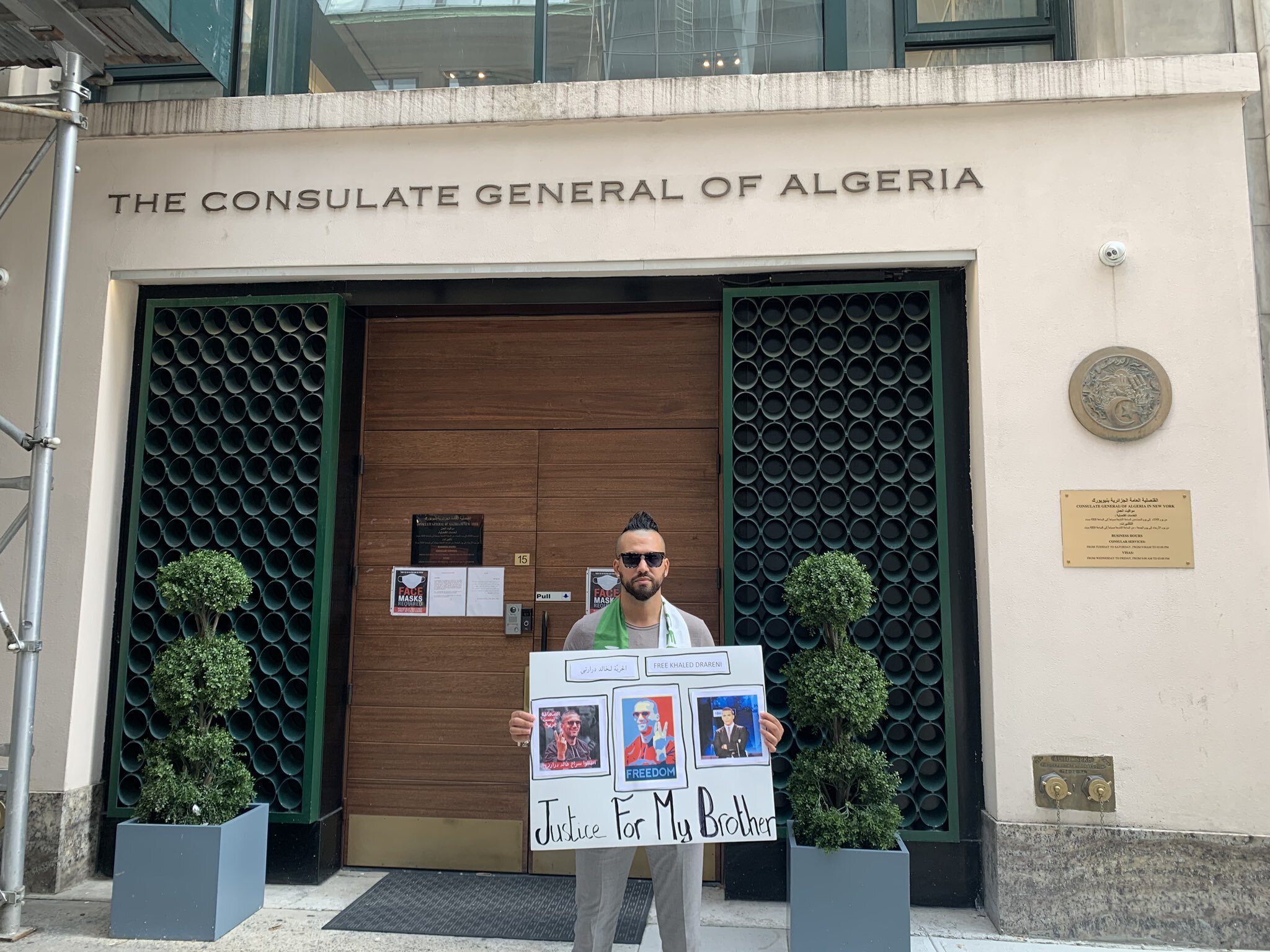
«The government wants to scare the hirak activists, but this will produce the opposite effect.» From New York, where he is based, Chekib Drareni, the reporter's younger brother, an activist in Algeria's peaceful uprising, explains his actions to secure the reporter's release, and tells us more about his journey since childhood.
Over the months, journalist and activist Khaled Drareni has become the emblematic figure of the Algerian hirak, the peaceful popular uprising launched on February 22, 2019 in opposition to a fifth term for ex-president Abdelaziz Bouteflika. Sentenced on August 10 to three years in prison for «undermining national unity», heaviest penalty pronounced since the beginning of the movement, he is now one of its heroic figures. The journalist was prosecuted for, among other things, «inciting an unarmed gathering.» We contacted by telephone his brother, Chekib Drareni, thirty-six, who has been living in New York for some time. He runs an art gallery there, having previously worked as a cabin attendant for an airline operating in the Middle East. From the United States, he is working hard to obtain the release of his older brother. Here he gives his testimony.
«My brother celebrated his fortieth birthday in prison on May 10. He is incarcerated in the Kolea prison, about thirty kilometers from Algiers, in the direction of Tipaza. Khaled was imprisoned on March 27 in El Harrach, a district of Algiers, but one or two days later he was transferred to Kolea prison, to keep him away from the capital, the spearhead of the anti-regime protests.
Khaled is innocent. We have appealed the verdict. We, his many supporters, are calling for his release. I have launched a petition to this effect on the change.org website. Some people on social networks tell me that my place is in Algeria, with the collective acting in favor of my brother. But I think I can be just as useful, if not more so, where I am, in the United States. On August 15, I organized a sit-in in front of the Algerian consulate in New York. Admittedly, there were only a dozen of us, but it's a start and the fact that Khaled's family, through me, were present on that occasion is something important. We intend to organize a sit-in in front of the Algerian embassy in Washington in the near future. The important thing is to give an international dimension to this case, which is synonymous with injustice. There has been a article in the New York Times, two others in Houston and Las Vegas newspapers. We have the support of several countries, I won't tell you which, but on August 15, Canadian Prime Minister Justin Trudeau, alerted by my brother's support in Canada, passed on his message. file at the Ministry of Foreign Affairs.
My family is from Algiers. My parents and we, their children, are passionate about politics. My father is a veteran of the war of independence and my uncle, Mohamed Drareni, died a martyr there in the late 50s. From childhood, Khaled's main interest was journalism. He dreamed of presenting the news on TV. Although he was passionate about politics, he didn't want to become a politician. He studied law for a year, then four years of Political Science at the University of Algiers.
He worked for Echourouk TV, where he presented the 7pm news. In 2017, he founded Casbah Tribune, a French- and Arabic-language media outlet. At the time of his arrest, while covering the hirak from the outset, he was a member of Reporters Without Borders and Algeria correspondent for the French TV channel TV5Monde. It was during an interview conducted by my brother that Emmanuel Macron, then a candidate for the French presidency, said in 2017 that the colonization of Algeria was a crime against humanity. Khaled campaigns for freedom of expression and the rule of law in Algeria.
The case of my brother's unjust conviction bears witness to the regime's nervousness. This judgment - three years in prison - is supposed to send a message to Algerian youth, to a whole new generation yearning for profound change. By heavily sentencing my brother, the government wants to scare the hirak activists, but I'm sure it will produce the opposite effect.»
Interrupted by the Covid-19 pandemic, has the Algerian hirak movement run out of steam? While it has succeeded in withdrawing Bouteflika's candidacy for his own succession, it has not succeeded in toppling «power» - a perhaps illusory objective, given the protean nature of this word, which can mean one thing and another, depending on the category of opponents to the regime. Likewise, the movement seems to be riddled with serious contradictions, notably concerning the question of morals. While the Belarusians may well achieve major democratic breakthroughs in the space of a few days, the Algerians seem to be stalling somewhat, even if a constitutional reform - which can only be encouraging - is on the way. Nonetheless, the powers that be, as they say in Algeria, are not reassured. is multiplying the number of criminal judgments against hirak activists. The aim is to break up the movement. Will he succeed? Supporters of prisoner Khaled Drareni would like to think not. His brother, Chekib, does not rule out taking steps to have the «unjust and contrary to human rights» nature of his sentence recognized.
Antoine Menusier is a journalist. Editor-in-chief of Bondy Blog from 2009 to 2011 and a former senior reporter at Time and L'Hebdo, he is the author of Livre des indésirés - A history of Arabs in France (Editions du Cerf, 2019). Today, he writes for the Swiss media outlet Watson and contributes to the French magazines Marianne and L'Express.
-
 Youth passFrom: CHF2.50 / month
 -
Digital subscriptionFrom: CHF5.00 / month with a 30-day free trial and a CHF2.50 sign-up fee
-
 Standard subscriptionFrom: CHF10.00 / month with a 30-day free trial and a CHF2.50 sign-up fee

You'll also like
 French
  German
  English
Leave a comment