



«Unicórnio», a unique film
Fribourg International Film Festival - Jonas Follonier
«Are you sad?
- No, I'm alone.»
In 1818, some two thousand Swiss people, including eight hundred from Fribourg, crossed the ocean to found Nova Friburgo, a major city now in the state of Rio de Janeiro. Two hundred years later, the Fribourg International Film Festival (FIFF) has decided to include Brazil among its countries of honor. This country has an important cinema, and the first film we saw for our coverage of the festival is one of them: Unicórnio.
This was one of the first films the selection committee screened, and according to the presenter at the screening, the jury was immediately captivated by the poetic and original nature of this feature film. Le Regard Libre shares the FIFF team's enthusiasm for this nominee in the international feature film category. Although it may be too niche to appeal to a broad audience, Unicórnio captivated by its aesthetics and symbolism.
A Slow Pace That's Changing
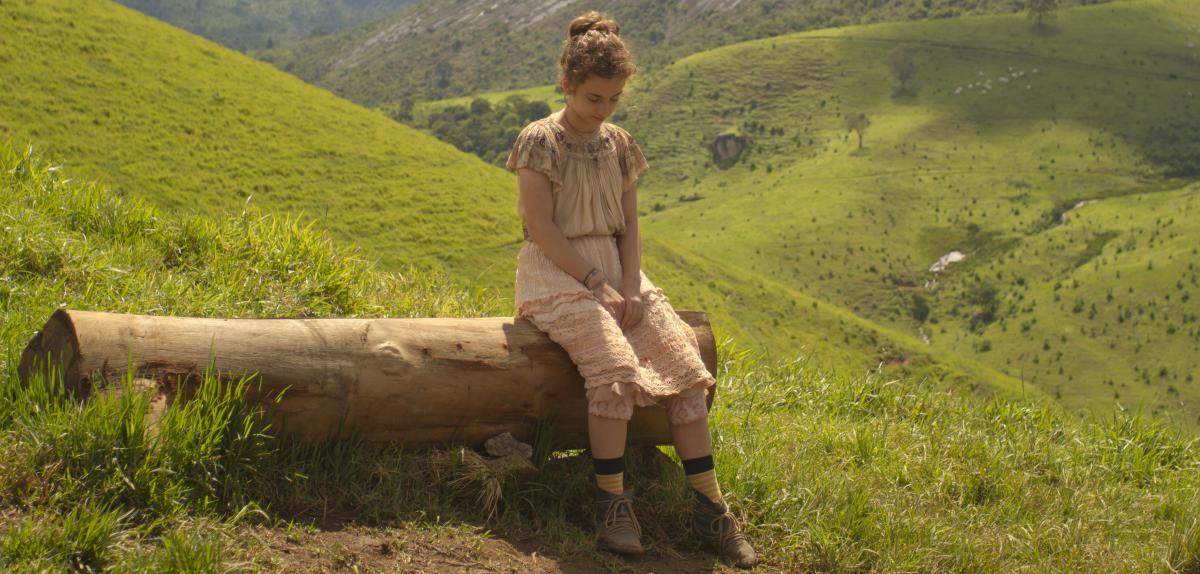
A young girl is lying on her back in the countryside. She opens a beautiful, large pomegranate and then plays with the seeds. Then, ants appear in close-up under the girl’s curious gaze. The film’s color palette, in the literal sense, is established right from the start: for the scenes set in the countryside, it’s a vivid, almost unreal green, along with yellow and brown, contrasting with scenes set in a dingy white room, where the young girl talks with her father. In fact, it is their voices that we hear in the very first minute, with heavy reverb effects.
In the setting of these rural scenes, the girl is thirteen years old. She lives with her mother in a place isolated from everything and awaits her father’s return. The setting seems straight out of a fairy tale—and indeed it is, since the film is based on two short stories written by the Brazilian poet Hilda Hilst. The film’s aesthetic is characterized by an extremely slow camera that does not hesitate to hold a shot focused on a character, a room, or even an object for several minutes.
A profound silence—also linked to this slow pace—and contemplative music are counterbalanced by jarring sounds that mark the transition to scenes of conversation between the girl and her father and to key moments, such as when the unicorn appears.
The unicorn: What does it symbolize?
But what on earth could this unicorn—which the young girl discovers in the forest and goes to visit—possibly mean? This question gnaws at us as rational viewers, but fortunately, it was the very first one asked of the director after the screening. We won’t reveal his answer here, so that the audience can form its own opinion, since the film will be screened again in Fribourg from Tuesday through Thursday.
One thing is certain: this kind of cinema draws, through unique techniques, on realities that are far more intimate than those depicted in comedies and dramas mainstream. When the hustle and bustle gives way to calm, it’s a special moment that we get to experience.
«I think God is mean.".
– No, of course not. There's the sun, the sea, …
»– That's not all."
Write to the author: [email protected]
Photo credit: © Unicórnio

You'll also like


 French
  German
  English
1 comment
[…] See also: «Unicorn, a One-of-a-Kind Film» […]
Leave a comment