



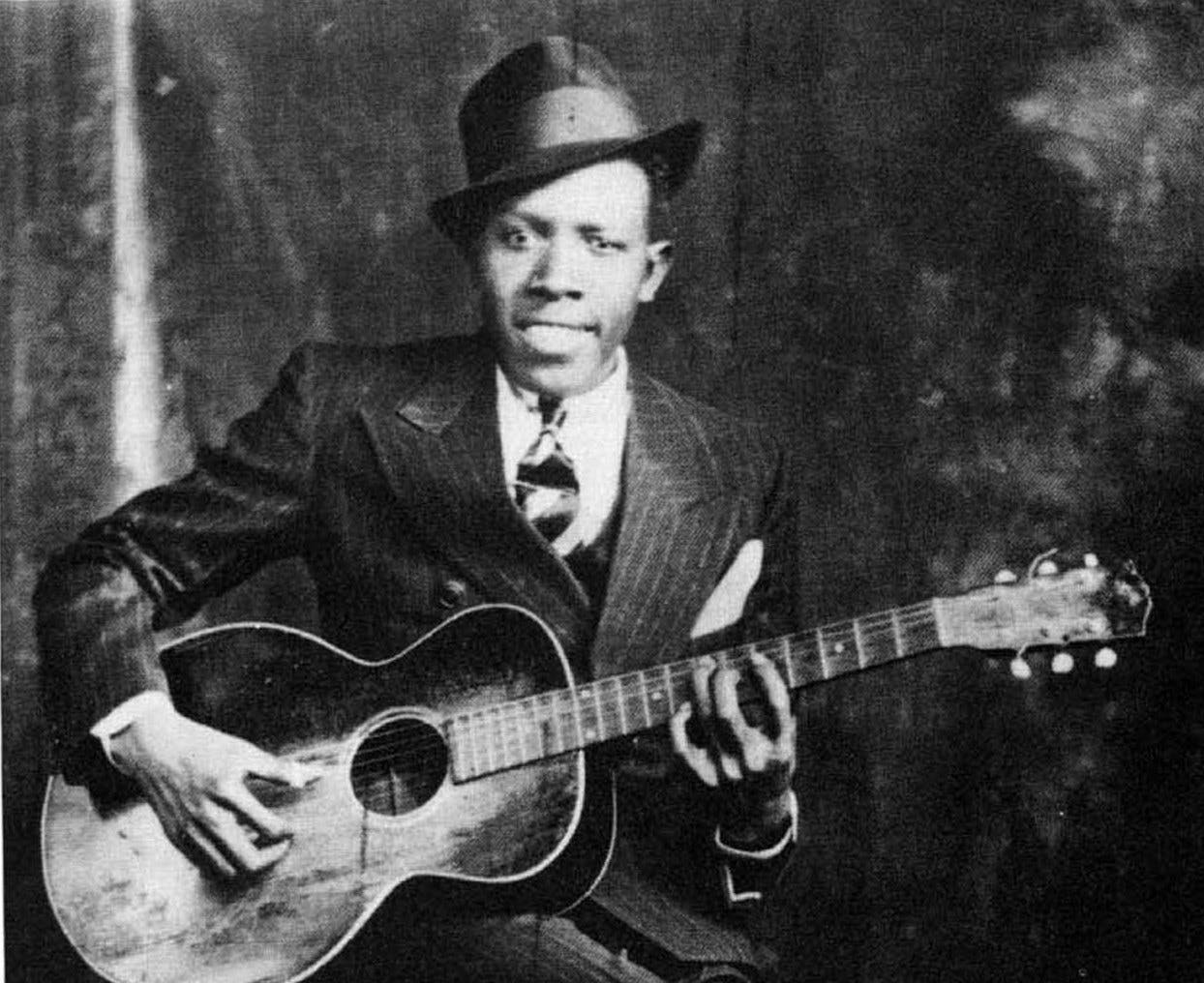
In the footsteps of Robert Johnson, cursed guitarist
Saturday's Netflix & chill - Ivan Garcia
«How much is myth? How much of it is true?»
Netflix sometimes has a few surprises in store for us. While browsing the platform, your editor came across a music documentary entitled ReMastered: Devil at the Crossroads. This short film looks back at the career of Robert Leroy Johnson, an incredible musician and one of the major figures of the Delta blues, one of the first forms of blues music to develop in the state of Mississippi. Until it reached the whole world.
The song Sweet home Chicago probably rings a bell. A classic heard over and over by everyone. And yet, could you name the author? No? Then this is your chance to get to know Robert Leroy Johnson, a major songwriter in the history of the blues!

At the crossroads of viewpoints
Born on the cotton plantations of the American South, where many states ardently defended slavery and racial segregation, the blues is linked to the history of the Afro-American people, their suffering and setbacks. Robert Johnson occupies a special place in this history, having inspired some of the greatest musicians of the 20th century.th century: Muddy Waters, Keith Richards, as well as B. B. King, to name but a few.
Led by historian Bruce Conforth, Robert Johnson's two grandsons, as well as other artists and critics, viewers follow in the footsteps of this doomed musician who, in his lifetime, recorded just twenty-nine songs and met a tragic end at the age of twenty-seven by drinking a bottle of poisoned whisky. Robert Johnson didn't have an easy life. Born in 1911 in the town of Hazlehurst, Mississippi, he was the child of his mother's second husband, the first having had to flee because he was about to be lynched.
A wanderer with his mother, beaten by his stepfather, young Johnson dreams of becoming a musician and refuses to work in the fields to avoid damaging his hands. So he began a career as a bluesman roaming from plantation to plantation and town to town, playing in the joint bar where the African-American community gathered. Married to a young girl, he promises to give up the blues, considered demonic music, and becomes a respectable farmhand. Shortly before his wife gave birth, he took to the road to resume his music career, returning in time to attend the birth of his cherub.
But when he returned, his wife had died in childbirth, and so had the child. His religious in-laws held the evil musician responsible. Johnson never really recovered, and decided to devote himself entirely to music, not only to make a living from it, but above all to exorcise his demons. And this is the beginning of the Johnson legend that the documentary explores.
«Legend has it that he went to a crossroads. There he met the devil. He sold his soul. Then he became the world's greatest guitarist.»
Unlike many short films, Devil at the Crossroads doesn't favor a single point of view dominating all the others, but a multitude that exchanges and enriches the exploration. The director, Brian Oakes, preferred to multiply the speakers and versions rather than impose a single vision on the complex artist that was Johnson. A rather original choice, especially for a genre (documentary) that aims to be as objective as possible. In the case of Johnson, the director's approach pays off, for the musician has become more than just a man; he has become a legend, the subject of many rumors and rumors.
In forty-eight fast-paced minutes, with Johnson's music playing in the background, we're taken along the roads of Mississippi, using archive footage, eyewitness accounts and superb drawings to track down the truth about Robert Johnson, including the legend that he met the devil.

Johnson, Faustian musician
If Robert Johnson has been the talk of the town, it's because a veritable mythology has been created around him, a mythology that he himself has nurtured. As we said earlier, blues has always had a bad reputation. Christian citizens considered it the devil's music (the devil's music). In fact, the term «blues» comes from the expression «to get the blue devils»(to feel blue, to be melancholy).
Also read: Beyond the blue note
One night, as a novice musician, Johnson's mentors, Son House and Willie Brown, tell him to stop playing, because nobody likes his music. Our hero replies, «Just wait and see.» From then on, Johnson disappeared from Mississippi for about a year. When he returns, he has reached a stratospheric level, far above that of his mentors. But what happened?
The myth is that one evening, on the roads of the American countryside, Johnson arrived with his guitar at a crossroads (crossroads) where he met the Devil. The Devil granted him his guitar and Johnson sold him his soul. It's a Christianized version of a spiritual belief. hoodoo, akin to voodoo, which states that you can make a pact with a spirit at crossroads to obtain powers.
Johnson himself refers to this episode in several of his songs, which, according to specialists, contain a large number of references to spirituality. hoodoo. The song Crossroads commence d’ailleurs comme suit: «I went to the crossroad, / fell down on my knees / Asked the Lord above, / « Have mercy, now, save poor Bob if you please »», retraçant ainsi la rencontre du sujet avec le démon. Et, dans Me and the Devil Blues, the character encounters the devil, who comes knocking at his door.
The blues the cemetery
«My grandfather used to say, “That guy from the Delta, Robert Johnson, was always hanging out at the cemetery.”»
In the course of his career, probably due to the death of his first wife, Johnson was a tortured man who forged an image of himself as a cursed poet-musician. The various contributors to the documentary attempt to explain, according to their own interpretations, this myth of a pact with the devil that makes Johnson a kind of modern Orpheus-Faust.
For some, it's a metaphor, because during this year of absence, Johnson actually went in search of a mentor, the best guitarist in southern Mississippi, Ike Zimmerman. Zimmerman took him on as a disciple, and they played together on the graves of a cemetery. Faithful to a belief hoodoo which says that to learn to play the blues, you have to go to a cemetery and play at midnight, when the spirits of the departed manifest themselves and teach the musician the rudiments of blues music.
Devil at the crossroads is a little nugget about a great musician. The documentary, accessible to neophytes and music lovers alike, is exciting and thrilling. Based on this story of a pact with the devil, the director questions our representations and, thanks to various testimonies, attempts to restore the reputation of a man who has been unjustly forgotten by the general public.
Write to the author: [email protected]
Photo credits: © Netflix

-
 Youth passCHF25.00 / year
 -
Digital subscriptionCHF50.00 / year
-
Standard subscription (Switzerland)CHF100.00 / year
-
Support subscriptionCHF200.00 / year

You'll also like


 French
  German
  English
Leave a comment