

When the leader of a nation proposes to broadcast a work of fiction to educate students, it's time to ask whether it's a good idea to rely on it to shape our relationship with reality.
During a speech to the British Parliament, Prime Minister Keir Starmer made a lasting impression with his comment on the Netflix series Adolescence: «It is a very, very good documentary to watch, or drama.» The measure of this sentence should not be overlooked: a work of fiction would be so evocative that it would be confused with a documentary, i.e. a «film of a didactic or cultural nature» (Le Larousse). In the wake of this, Starmer has proposed that the film be screened in schools, to educate young people about the dangers of online masculinism and violence against women.
From cookie-cutter solutions
So, what is it really about? Adolescence's protagonist is a thirteen-year-old English kid from a stable family, radicalized online by influencers à la Andrew Tate, who stabs a girl at his school to death. Yet, as British podcaster Konstantin Kisin:
- Only 17% of knife offences are perpetrated by children between the ages of 10 and 17.
- Most studies on the subject suggest a strong correlation between teenage crime and single-parent families.
- 75% of stabbing victims in Great Britain are men.
Recent figures published by Channel 4 nevertheless show a worrying increase in knife violence in schools - but, until then, no link has even been suggested between online masculinism and such violence. So it's hard to see how Adolescence, despite its undeniable artistic qualities, can inform us about the day-to-day life of British schools. On the other hand, it does offer us a comfortable explanation: there are villains on the Internet who are perverting our boys.
Mistaking your desires for reality
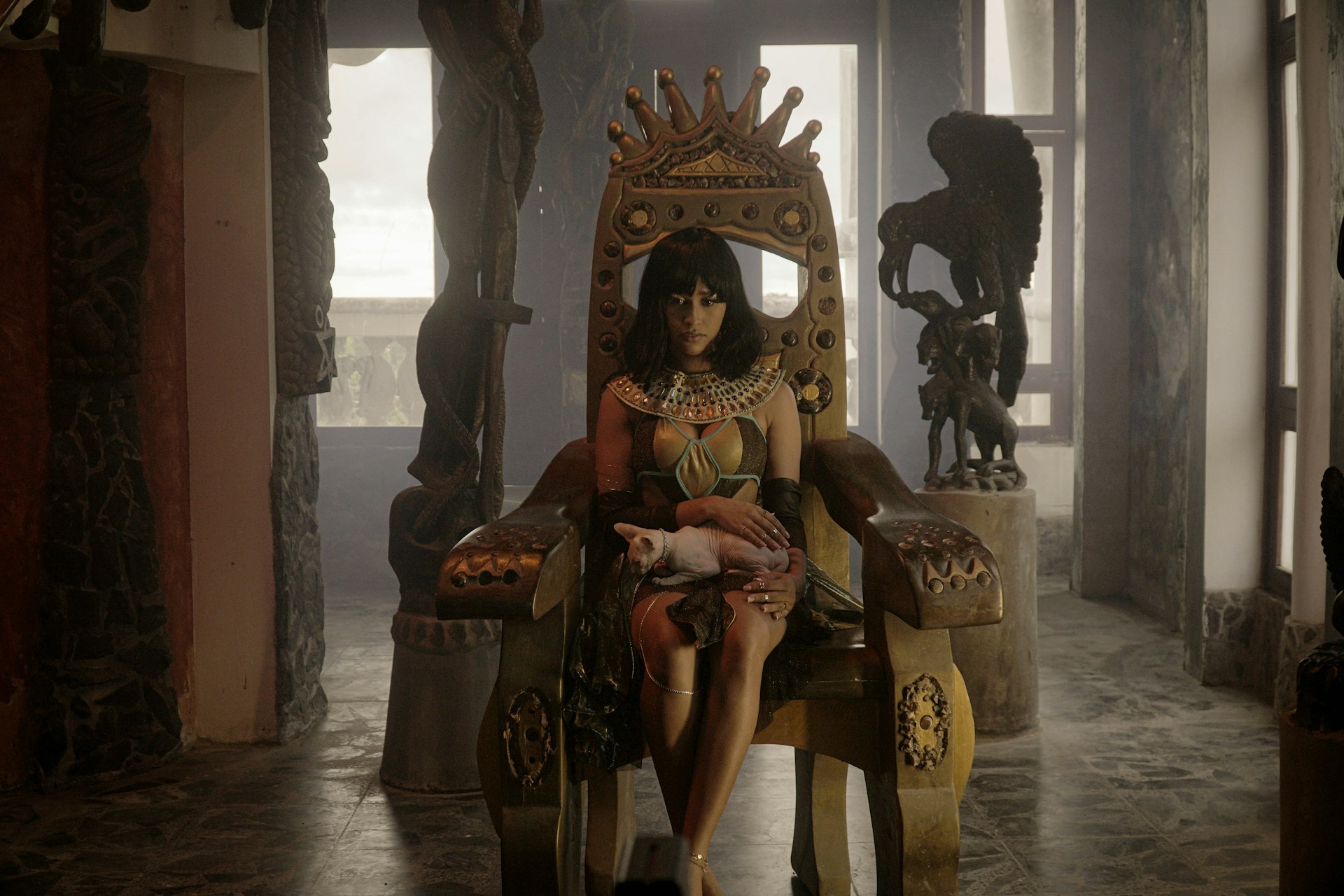
Before fiction as documentary, Netflix did the opposite, with its 2023 docu-drama on Cleopatra, which presents fiction as fact. The Ptolemaic queen is dark-skinned in the re-enactment scenes, which amounts to taking sides in an insoluble historiographical debate: it's not out of the question that Cleopatra was dark-skinned, since we don't know her biological mother, and it's therefore not impossible that she was born to a Nubian or sub-Saharan courtesan.
Except that there's not a shred of evidence for this, and the historiographical current that most vehemently affirms Cleopatra's «negritude» is pan-Africanism, which strives to demonstrate the greatness of African history, denounces the deliberate erasure of black people by racist historiography, and whose theses, notably on the supposed «black» origin of ancient Egypt, are widely criticized by Egyptologists.
The most problematic scene in the documentary produced by Jada Pinkett Smith is an interview with an African-American literature teacher who recalls her grandmother's words, «I don't care what they tell you in school. Cleopatra was black.» In other words: we can choose the facts we choose to believe.
Form over substance
The problem here is not this eminently «cultural left-wing» posturing. The underlying themes are not entirely unfounded: masculinist influencers clearly convey a deleterious and imbecilic message, and many black personalities deserve to be rediscovered and their role in history re-evaluated.
The problem is, firstly, that both examples are not examples. Sexism won't be eradicated by a «documentary» that suggests to thirteen-year-old boys that they're all potential macho murderers, just one click away from radicalization. Nor will racism be eradicated by erecting Cleopatra as an Afro icon, in defiance of historical method.
It would never occur to anyone to substitute Braveheart for a medieval history lesson, or the Euphoria series for a sex education session, despite their artistic qualities or Euphoria's interesting reflections on sex and relationships. To confuse the factual veracity of a work with its evocative power seems revealing of our society, where spectacle crushes everything - fiction, reality, politics, discourse, actions - where form takes precedence over substance, communication replaces action, virtue-signaling takes the place of courage, and the incessant flood of images prevents us from thinking.
In his review, our film critic Jocelyn Daloz explores the seventh art in its socio-historical context. Write to the author: jocelyn.daloz@leregardlibre.com
 French
  German
  English