
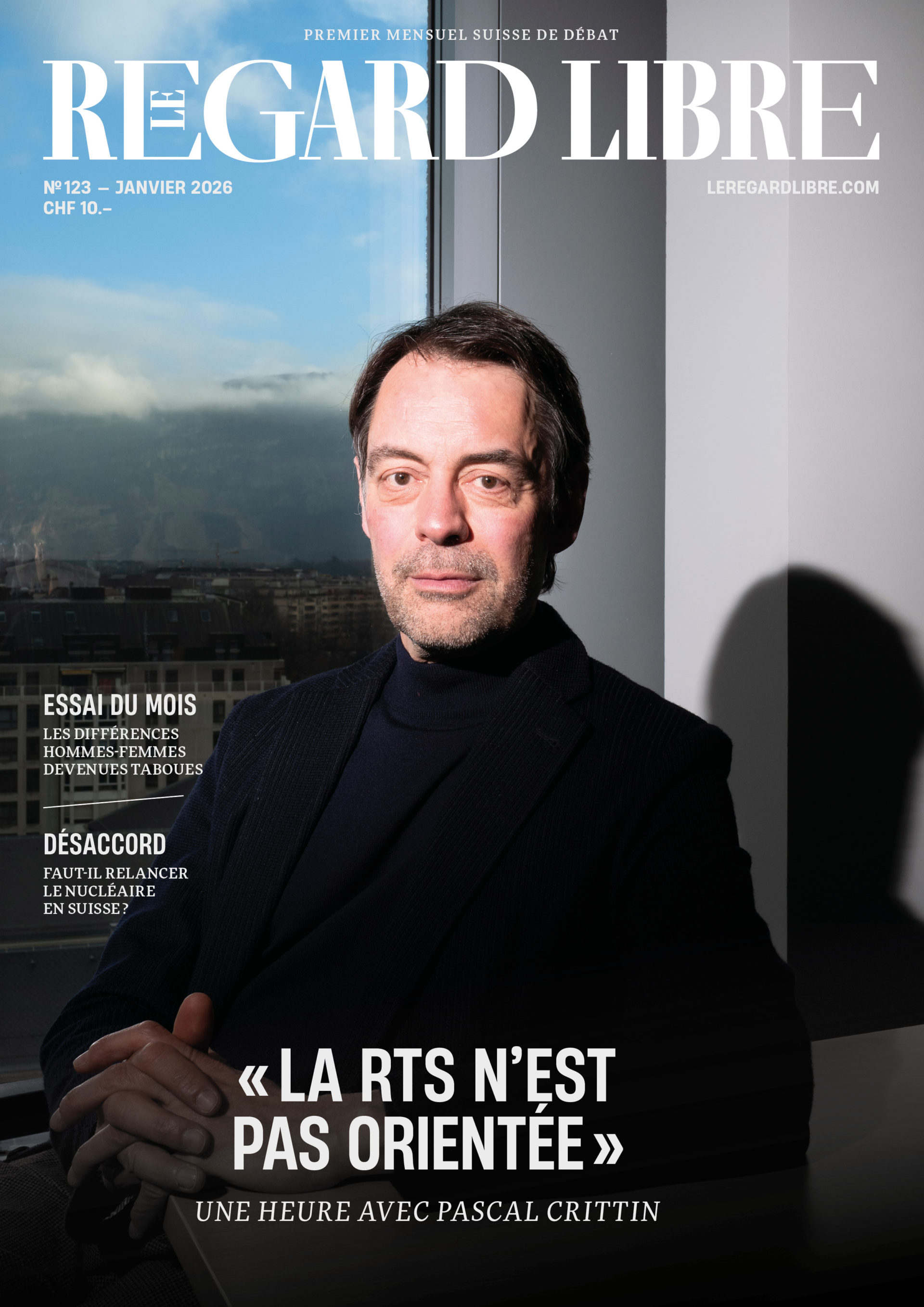


Le Regard Libre N° 48 - Loris S. Musumeci
Twenty-five years since the theatrical release of a film that left its mark on the history of cinema and the way we look at the Holocaust. Schindler's List brought audiences to tears with its melancholy music and unforgettable shots. Let's take a look back at this tragic monument that hasn't aged a day.
Candles in the dark, lighting up in prayer. The image fades to black and white. The candles are extinguished. A wisp of smoke rises into the sky to tell the story of Oskar Schindler, the 1,100 Jews he saved, the six million victims of the Holocaust, the concentration camps, the extermination camps, humanity falling apart and hope rising again. A true story, as told by the survivors and their descendants. Filmed by Steven Spielberg.
A workforce
The Nazis invade Poland and the situation quickly deteriorates for the Jews. Gradually banned from everything, they were eventually confined to a ghetto. Oskar Schindler, a German industrialist, settled in Krakow and took advantage of the situation. Skilled at making contacts, he befriended the Nazi officers present on Polish soil. But he also approached the city's Jewish community. These people, now stripped of their humanity, are seen as an invaluable source of manpower to bounce back in the upper echelons of industry.
Schindler opens an enamel factory and hires Jews, paying them next to nothing. He prospered. When the ghetto is ransacked and its inhabitants deported, Schindler fights to keep his workers. He meets the Kommandant Goeth, in charge of the mission, became his friend of sorts. «They're mine!» Until he becomes aware of the horror unfolding before his eyes. Gradually, it is no longer for his own sake that he continues to fight, but to save the lives of those he considers to be human beings, who are dying by the thousands because of the madness of his own kind, who no longer act like men, but like beasts thirsty for slaughter and blood.
The Shoah on show
The subject of the Holocaust has been tackled time and again in film and literature, to the point of tiring the main characters involved. The fact remains, however, that while some of these films take advantage of the drama of the twentieth century, they are not the only ones to do so.th century to try their hand at clumsy, unoriginal storytelling; others, Schindler's List in the lead, turn the tragic subject into a masterpiece in the service of memory and the beauty of film. However, when Spielberg's film was released in the United States at the end of 1993, it did not meet with unanimous approval. Some disputed the veracity of the facts, the nuances of the characters, notably Schindler himself and Goeth. Others, more interested in the form than the content, deplored the fact that the Shoah was made a crude and unscrupulous spectacle.
While these objections have their legitimacy, they do not cover up the cinematographic statue erected by the director. Staging the Second World War may seem easy, not so much in terms of re-enactment techniques as in terms of a seemingly assured success. Of course, since it's based on a true story, and not the least important one, we're on conquered ground. But that's not how it works. Schindler's List tackles a scenario, admittedly full of horrors, but worthy of telling a story of its own. a priori ineffable.
The characters are drawn with subtlety, revealing both the murderer and the savior in everyone. Schindler saved lives, but his intentions were ungodly and opportunistic. Visit Kommandant Goeth shoots «Jew scum» for fun, but at the same time falls confusedly in love with his maid, «a Jew bitch», as he calls her at one point in the film. His face takes on satanic allure, as when he spares Jews he could have killed according to protocol, he sees in himself, through the mirror, a figure of Christ raising his index and middle fingers sideways at face level. The Jews themselves, in utter despair, reject other Jews in order to save their lives.
A red coat
The photography, which leaves an indelible mark on the mind, allows us to deliver images of the utmost cruelty at the risk of committing a sin of complacency, while at the same time paying homage and dignity to those who were treated worse than cattle. On the one hand, the film is fully in a realistic vein; on the other, it distances itself from its subject by accumulating various devices that indicate that this film is just a film, however powerful it may be. Black and white offers some sublime shots, highlighting details and contrasts impossible with color. Like the snow-white invaded by black, which is blood. Like the cheerful, charming snowflakes that reveal themselves to be ashes when touched, the ashes of burnt bodies.
There are also the cult shots of the little girl Schindler sees wearing a red coat, the only element of color on screen. Color is life, it's hope, it's Schindler's awakening; but it's also death. These shots are undoubtedly the ones that stick in viewers' heads the most. The Shoah is the death of the little girl in the red coat. The Shoah is the absence of color. The gray of hell, whose flames are the gas chambers.
The human face
The Shoah is also about faces and their names. Twenty-five years after the film's release, they still embody the suffering, the terror and the remnants of light. Sometimes plunged into darkness, sometimes overexposed to sunlight, sometimes cut between black and white, the faces cry out. Of despair, of course, but also of dignity. They pierce the screen with their profound humanity. Filmed repeatedly in close-up, they make Schindler, Goeth and the audience realize that you don't kill people, you kill the person. A crime against humanity, they say. Yes, the executioner's crime against himself, erasing himself as a person, and the executioner's crime against his victim, erased as a person.
The place of first and last names in the film parallels that of faces. When the Jews can speak, they pronounce their own names, affirming themselves as fully-fledged human beings. When they can no longer speak, we shout out the names they will no longer bear in this world, because they are about to be executed, with the intention of making them forgotten. Schindler's list, on the other hand, gives back a name to those who are about to lose it. With force and determination, the characters are struck down one by one on paper. In the face of relentless ideology and state-of-the-art extermination techniques, paper saved one person, then another, then 1100. «One person. One more person.»
Visit Schindler's list all these elements carry an essential message: that the human person is always in danger, that nothing is enough to condemn him arbitrarily, but that a name on paper and a face face-to-face save him. The Holocaust, in Poland in the 1940s, was defeated by memory. Nazism, buried by reason. And yet, nothing is over. Extermination is still going on. The death drive rages on in an overconfident age, namely our own. We still need heroes, candles to pray by, names and faces to say that human dignity is not negotiable.
«He who saves one life, saves all mankind.»
Write to the author: loris.musumeci@leregardlibre.com
Photo credit: © Universal Pictures
-
 Le Regard Libre - N° 48CHF10.00
 -
 Standard subscription (Switzerland)CHF100.00 / year
 -
Support subscriptionCHF200.00 / year
 French
  German
  English