




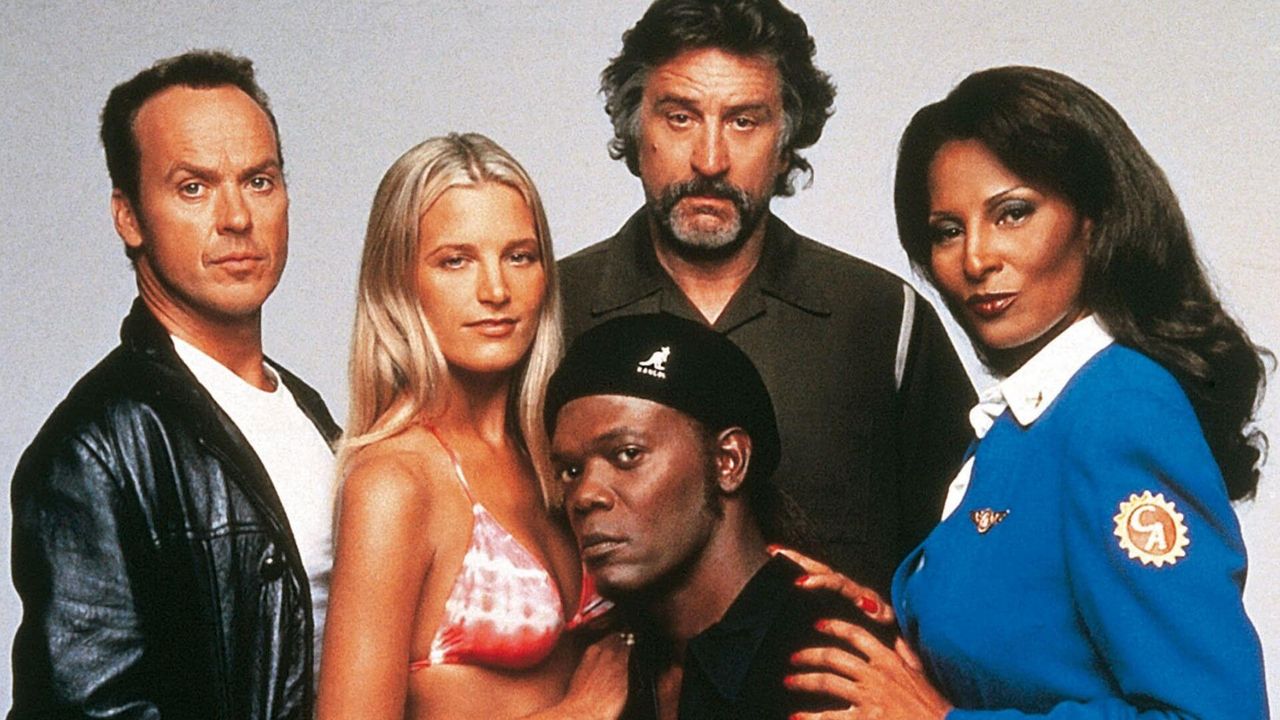
«Jackie Brown»: Pam Grier to the beat of «Across 110th Street».»
Le Regard Libre N° 64 -Loris S. Musumeci
Quentin Tarantino special report
Quentin Tarantino's third film completes his cycle from the beginning. Reservoir Dogs (1992), Pulp Fiction (1994) and Jackie Brown (1997) make up his holy trinity. Three films that revealed him to the world of cinema, three films that imposed him. And yet.., Jackie Brown would tend to be seen as his first loss of steam after the phenomenal success of his first two films. Less successful than the first two, this film is probably the least «Tarantinian» of the nine, both in style and subject. Nevertheless, this film remains the best for my taste, but the best after Once Upon a Time... in Hollywood, the director's unsurpassed masterpiece - at least for the time being.
Under Bobby Womack's lively notes with Across 110th Street shows the heroine in profile on an airport conveyor belt, against a mosaic backdrop of alternating shades of color. In keeping with American popular culture, the viewer encounters a Pam Grier «who's forty-four but looks thirty-four». Twenty years earlier, she was the absolute star of the films blaxploitation, which showcased the Afro-American community in starring roles.
Pam Grier plays Jackie Brown, a stewardess who acts as a mule for a violent, sick, unhealthy but stupid arms dealer, Ordell Robbie, played by Tarantino loyalist Samuel L. Jackson. Problem: Jackie gets caught by the police. She sets up a ruse to get out of the game: make the cops think she's collaborating with them, while making Ordell think she's collaborating with him. She's a strong woman who everyone pretends can take advantage of, but who isn't prepared to be fooled by the first idiot who comes along.
A film that flirts strongly with the detective genre, while paying a vibrant tribute - even if Tarantino still prefers to speak of theft rather than homage - to these films blaxploitation. Tarantino grew up with these very films, and as a teenager, he claims to have been in love with Pam Grier. So, since with Tarantino, when he loves something, he puts it in his films, he remakes this actress into the star she once was. It's a classic Tarantino way of doing things: his love of actors manifests itself either by going out of his way to get the right actors for his films, or by going out of his way to get the right actors for his films. current greats, or to resurrect forgotten greats, like John Travolta in Pulp Fiction.
Pam Grier is back in the spotlight, as is Robert Forster, playing a bail bondsman who helps Jackie and falls in love with her. This role won him the Oscar for Best Supporting Actor, and revived his career. De Niro, on the other hand, needs no relaunch and accepts the role of an idiotic ex-con, taking him back to his heyday with Scorsese. Besides, I think he just wants to please Tarantino, who worships him.
The key to uniqueness
But why Jackie Brown is Tarantino's least «Tarantino-esque» film, and why does it at the same time create such a shock, to the point of surpassing, in my eyes, the cult classic Pulp Fiction or a brilliant Django Unchained - my third favourite Tarantino film, if you're interested? Because, apart from Once Upon a Time... in Hollywood, and possibly SS Colonel Hans Landa in Inglourious Basterds, or Beatrix Kiddo alias La Mariée in Kill Bill, Tarantino has never worked so hard on his characters. This is the first time he has made his protagonists more than just archetypes. This is no doubt due to the film's different origins: for the first and only time, the screenplay is based on a novel, Rum Punch (1992) by Elmore Leonard.
For the first and almost only time, Tarantino draws the melancholy and passionate lines of a love story. And in a very special way, too, since the two lovers in question are the characters played by Pam Grier and Robert Forster, i.e. a woman in her forties and a man in his fifties. On the face of it, it's not the stuff of dreams, two old people falling in love; but here, yes. Thanks, Quentin! And above all, above all and above all, what makes this film so special, enjoyable and endearing is its music. Bobby Womack, The Brothers Johnson and The Delfonics (notably with their poignant hit Didn't I): black American soul, to make you cry, to touch you right in the gut. And Across 110th Street gives cinema one of its finest openings and endings.
We have this sugar of Pam Grier parading on a conveyor belt at the beginning, which sets the mood, and we're left with this sugar of Pam Grier at the end of the film, still with the same music, in a car, driving through L.A., humming the song, because she's free, because she won, because the black woman stood up, because she remains forever engraved in dreams of emancipation, because she's Jackie Brown.
Write to the author: loris.musumeci@leregardlibre.com
Photo credit: © A Band Apart
You'll also like



 French
  German
  English
Leave a comment