



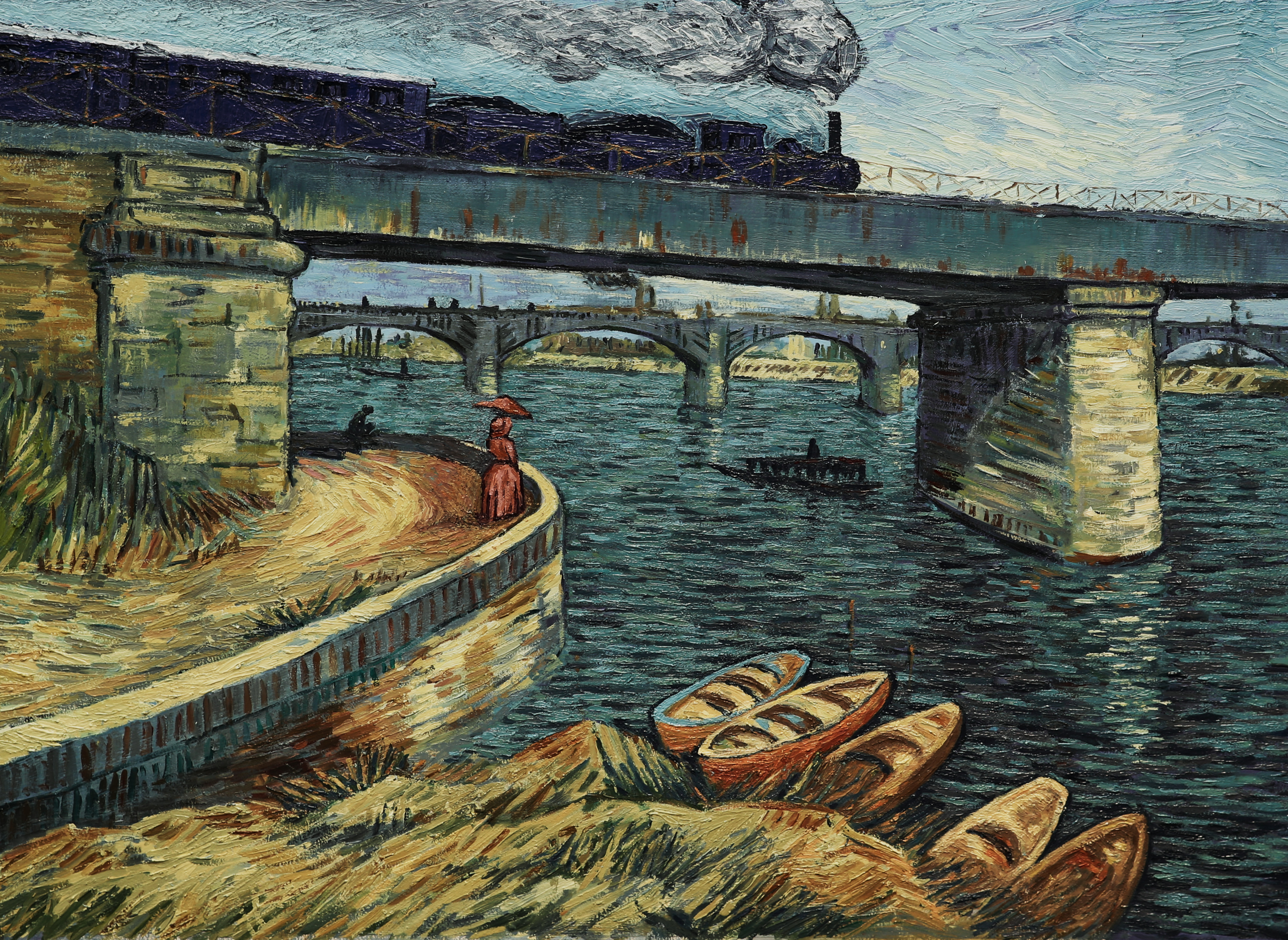
«The Van Gogh Passion», the first animated painting in cinema history
Cinema Wednesdays - Jonas Follonier
For the first time in the history of cinema, an animated film is based on paintings, not images. Hand-painted, as close as possible to the style of Vincent Van Gogh. Van Gogh Passion tells the story of Armand Roulin, son of the letter carrier who delivered the painter's many letters. The letter carrier asked his son to deliver the last letter from Vincent, now dead, to his brother, Theo Van Gogh.
When Armand Roulin learns that Van Gogh has also died, he investigates the artist's death. The characters painted by Van Gogh himself appear one after the other on the screen, to the delight of aesthetes and film buffs alike. Secondly, it's a colossal undertaking: over sixty thousand paintings, hand-painted for the occasion, digitized and animated by modern technology, to give them perpetual motion. The whole of Van Gogh's world is brought to life: the wheat fields, the village of Antwerp, the starry night, the crows, the drowsy drunkard.
A few drawbacks
While the film deserves praise and accolades for its innovative form and content, it does have a few shortcomings. First and foremost, the choice of script poses a problem: by multiplying the contradictory testimonies of villagers under the curious and obsessed eye of the protagonist, the feature film takes on far too many of the trappings of a detective story. And it's not in the quality of a Hercule Poirot that we find ourselves, but in Experts.
Added to this genre awkwardness is the stylistic choice of flashbacks: all the analepses, without exception, are presented in black and white, at regular intervals and announced by fade-in images. What's more, the sequences feature real actors, reworked on the computer to look like paintings. And, as if we hadn't sufficiently understood that these are «flashbacks», they are accompanied by music - extremely beautiful, to be sure, but contributing to a pathos and cinematic mania bordering on the commonplace.
Van Gogh is a mystery
Van Gogh Passion remains one of last week's great releases. The film's greatest beauty lies in its dreamlike quality. Viewed as a whole, the investigation into the painter's death is more like a dream, giving way to the artist's own canvases and the worlds they can inspire. In this way, cinema serves as an alternative medium to museums, enabling a wide audience to discover the man considered to be the father of modern art.
It's not just the film that's a mystery to behold. Vincent Van Gogh himself is a mystery. His death and his painting, too. It doesn't really matter whether the Dutch painter took his own life, or whether some simpleton local child did it. It doesn't matter if Van Gogh had fallen back into his madness. That's what the film tells us at the end. Death is the fate of the melancholy, and melancholy the mark of genius. «I'd like to show through my work what's in the heart of such an original.» Such was the artist's wish. It has been fulfilled.
Write to the author: jonas.follonier@leregardlibre.com
Photo credit: © La Belle Compagny

Vous aimerez aussi

 French
  German
  English
Laisser un commentaire