


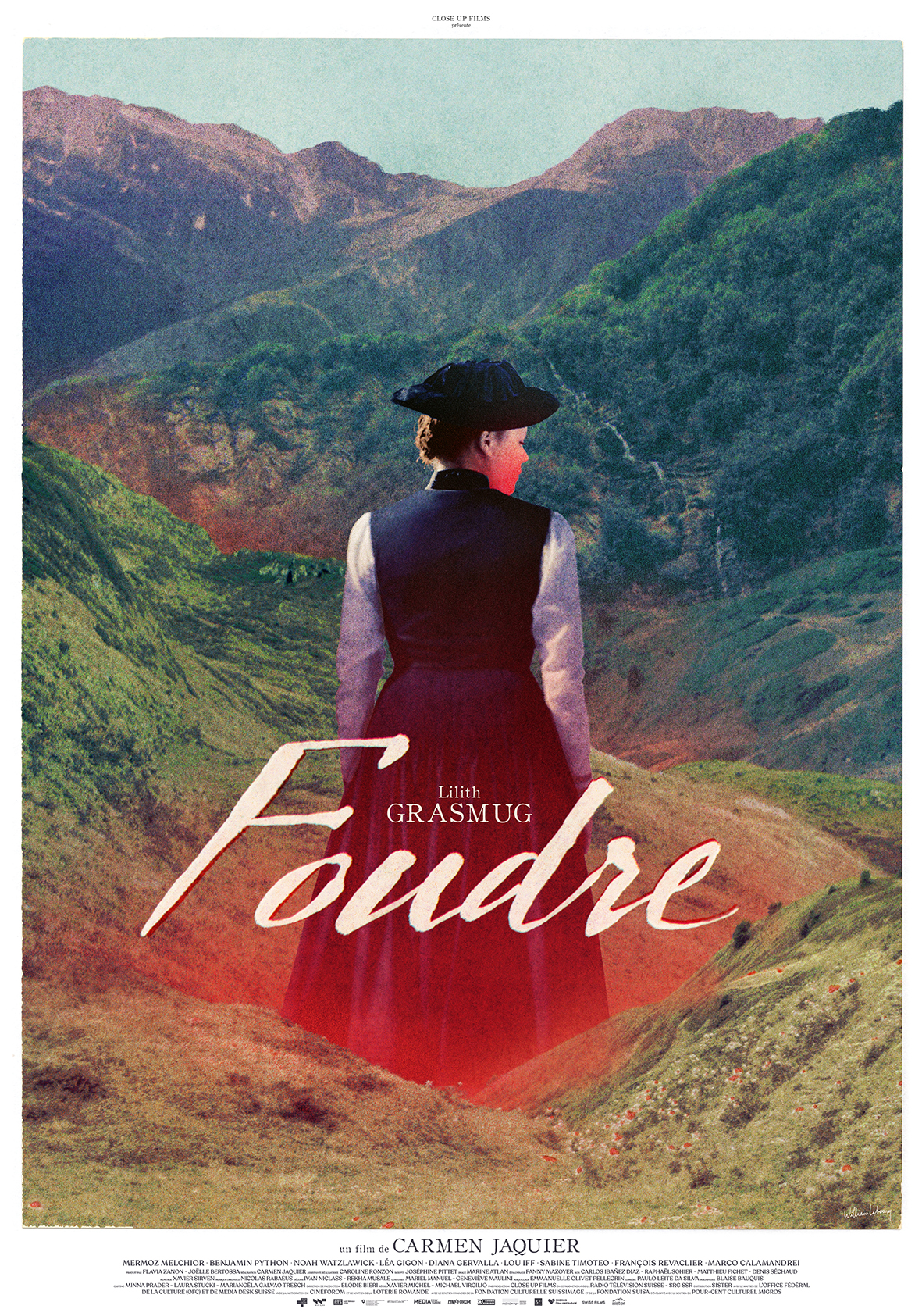
For her first feature film, Carmen Jaquier immerses us in the heights of Switzerland at the beginning of the twentieth century.thcentury. A coming-of-age a militant film that highlights teenage emancipation in a society numbed by firm Catholic practice.
Elizabeth, 17, is preparing to enter the priesthood for good when she learns of her sister's death. This sudden event forces her to return to the bosom of her family. As she returns to the grueling life of her native valley, the young woman wonders about the causes of her elder sister's mysterious death.
Be wise and keep quiet
The film's opening sequence reveals a series of portraits of mountain women in their daily lives. Using photography, painting and then film, this introduction immediately sets out the Swiss director's intention: to retrace the history of these women, blending reality and imagination. Drawing on her great-grandmother's notebooks, exchanges with grandmothers and the writing of fictional characters moving in an almost fantastical universe, Carmen Jaquier attempts to convey the story of these women through the prism of subjectivity. Despite the filmmaker's undeniable desire to share the story of a young woman animated by powerful and still foreign sensations, the film is sometimes too allegorical, strays from emotionality and fails its audience.
This sharing and transmission are the basic notions of the director's project. Form and purpose are unanimous: the inability of all to communicate about the experience of self through the body. Transmission takes the form of a diary, while the world in which Elizabeth evolves remains mute. This silence is reflected in the few brief dialogues and shots showing the young woman alone in the valley. Yet the teenager's last line is a direct address to the audience. Elizabeth is finally able to express herself, despite the authority figures who have stood in her way throughout the film.
This period, known as adolescence
Body expression appears in a crescendo visual. While the image initially focuses on hands and faces in close-ups that are sometimes too frequent and redundant, nudity only appears in the last third of the film. One of the strengths of Lightning occurs in the presentation of the sexuality of Elizabeth and the other young people in the village. This ardor is always approached in a gentle way, in contrast to the protagonist's violent desire. Elizabeth's burgeoning pleasure is based on various exchanges of innocent glances and kisses, without any explicit showing.
The film goes even further: as well as highlighting the awareness of sensuality, it shows the solidarity and warmth of young bodies frozen by boredom and proscription. Several times, the group of young peasants - Elizabeth and her three lovers - sit in nature, waiting in silence for a solution to their lymphatic state. Their emancipation is built on the knowledge of their bodies, both individual and collective.
Lightning features discreet camera movements and is anchored in a certain fixity of frame. Yet the relationship between high and low - fundamental, since it recalls both religion and the mountain - is visible through the composition of shots and the choice of camera angles. The protagonists find themselves either completely lying down or standing up, and certain (counter-)dives accentuate this tension between ground and sky. For her first feature film, Carmen Jaquier's staging and shot composition are very appealing. While the film seems to be born of a personal and intimate questioning, it sometimes sidelines emotion to the detriment of the director's committed discourse. In spite of this, the Swiss filmmaker achieves a tour de force: to make a shock film with a gentle touch.
Write to the author: leila.favre@leregardlibre.com
You've just read an open-access article. Debates, analysis, cultural news: subscribe to support us and get access to all our content!
 French
  German
  English