



«Nostalghia»: what if Baudelaire was Russian?
Cinema Wednesdays - Special edition: The coronarétrospective du cinéma presents Tarkovski - Antoine Bernhard
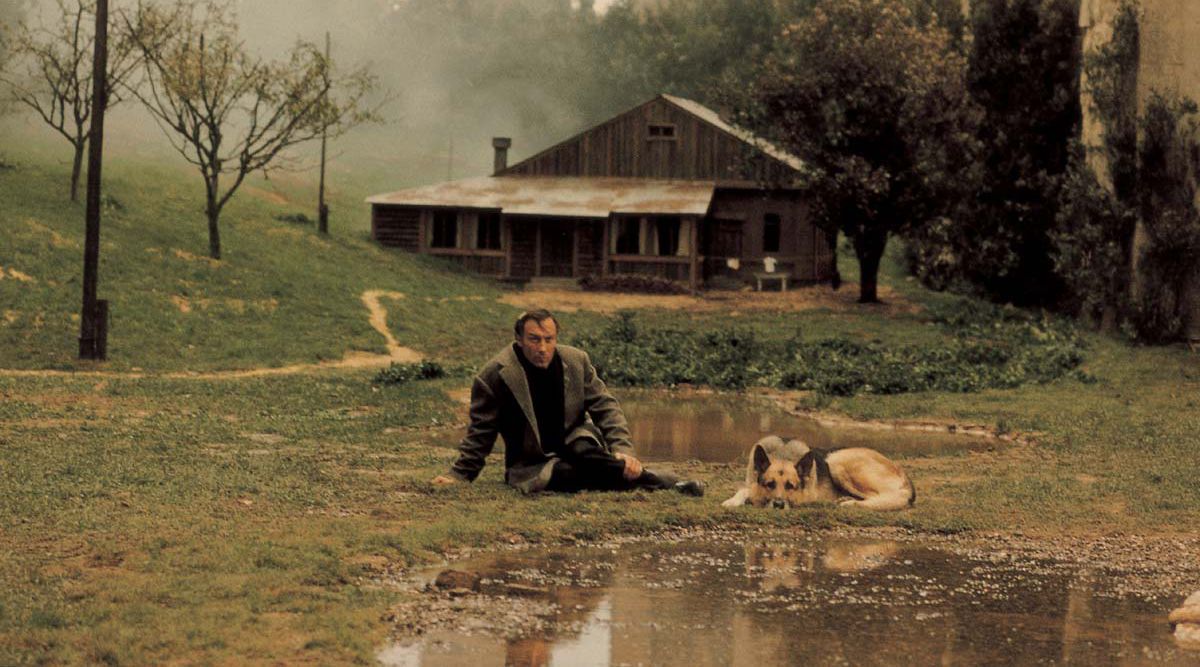
A Russian poet, Gortchakov, is following in the footsteps of a fellow composer who spent time in Italy in the 18th century.th century. With the help of a translator, Eugenia, he travels around the country, discovering the chapel where Piero della Francesca painted the Madonna of the Childbirth, as well as a village with an old hot-water pool dedicated to Saint Catherine. There, Gortchakov meets an enlightened man, Domenico, who seeks to save the world from the materialism in which it revels. Before setting himself on fire, he entrusts Gortchakov with one last task: to cross the drained pool with a candle in hand, without the flame going out...
That's how Tarkovsky sums up his own film: Nostalghia. In a masterly work with a very distinctive aesthetic, the director goes to the very heart of what is at stake in all artistic creation. In two hours of sequence shots, he exposes and consecrates an entire way of looking at the world - at a time when this world is losing its sense of the Sacred, losing its sense of Faith. Although the director didn't like his films to be analyzed, it's nonetheless interesting to take a look at a few essential aspects of his work.
A life, a work
Tarkovsky was notoriously indifferent to the criticism and interpretation of his films. He always refused to comment on them, preferring to approach art through sensibility in order to thwart any ideological recuperation of his films. However, because Tarkovsky's life and his artistic approach are inseparable, it's worth taking a closer look at them before discussing his films. Nostalghia. And with good reason! The poet featured in the film - Andrei Gortchakov - is none other than the mirror image of Andrei Tarkovsky himself. Indeed, like his protagonist, the director went into exile in Italy to escape Soviet censorship. Hence the title of the film: Nostalghia. Nostalgia for an artist torn from his native land. Nostalgia of a poet in search of the Absolute.
For Tarkovsky, nostalgia - like Baudelaire's Spleen - is the driving force behind artistic creation. It makes the artist's approach an existential and spiritual quest. Indeed, Gortchakov - like a misfit - provokes incomprehension and anger all around him. When Eugenia, madly in love with him, seeks his attention, he can't meet her expectations. He remains impassive, because his quest is not there. Eugenia's anger is heightened by the fact that Andrei only seems interested in a madman: Domenico.

Saving the world with truth
Gortchakov recognized a brother in the man everyone thought was crazy: «Why do they think he's crazy? He's not mad. He has faith. Eugenia replies: »In Italy, there are many such lunatics. We've opened asylums, but the families don't want them.« The poet adds: »What is madness? They disturb us. They're embarrassing. We don't want to understand them. They are alone. But surely closer to the truth. The poet's quest is therefore not only a quest for the Absolute, but also for truth. For Tarkovsky, this quest is the very essence of art. Creation imposes itself on the artist as an impulse, a necessity: to create, to «save the world».
This mystical view of art - which Tarkovsky believes to be beneficial to mankind - is epitomized by the much-touted candle scene. At Domenico's request, Gortchakov attempts to cross the dry pool without the flame of a small candle in his hands going out. Twice he fails. Throughout his attempts, we notice that the poet is suffering more and more. After three attempts, filmed in a sumptuous sequence, he manages to place the candle on the other side of the pool. His arms tighten. Gortchakov groans. He succumbs. He has carried the flame to the end, symbolically reaffirming the preeminence of the Sacred. Like a tragic hero, he restored world order. Like a tragic hero, he paid for mankind's salvation with his own skin. «Bonne route Antigone», Wazâân would say, «Bonne route Antigone».
Write to the author: antoine.bernhard@leregardlibre.com
Photo credit: © Rai Cinema

You'll also like

 French
  German
  English
Leave a comment