




«This music plays for no one»: let us be savages in peace!

Cinema Wednesdays - Alice Bruxelle
A comedy whose radicalism lies only in its sadly consensual message, This music plays for no one Released on September 29, the new film directed by Samuel Benchetrit features a thunderous cast that leaves no tangible souvenir behind.
On the subject of wisdom, Marcel Proust wrote: «Wisdom is not given to us, it has to be discovered for ourselves, after a journey that no one can make for us, nor spare us». Thinking I could find truth in books, I obviously believed this mystical figure of French literature. But I shouldn't have. Proudly dismissing the warnings of our column co-manager, I set out to build my own wisdom journey, Fanny Agostino, who replied, after I had warned her that I would go and see This music plays for no one, that the Benchetrit-Paradis duo would have turned her off. Proust or Agostino? My own way or safety? I'm now regretting the safety that would have spared me the hour and a half of indecent farce offered up by Samuel Benchetrit's latest feature.
Luxury casting for an artificial social portrait
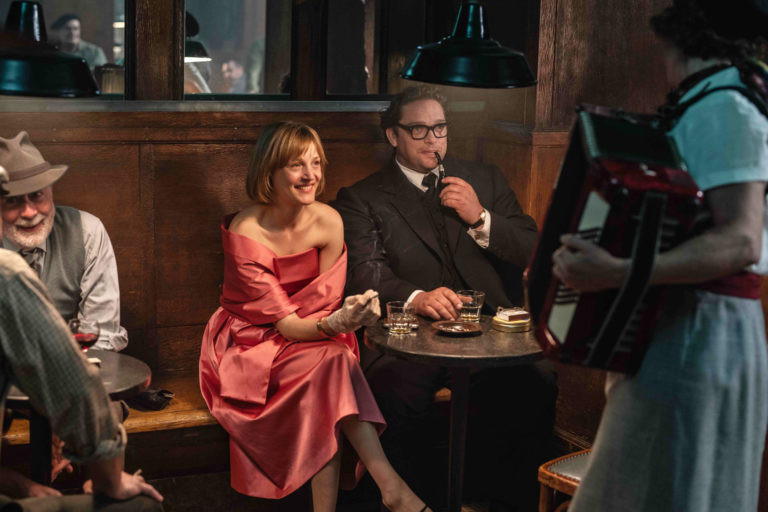
In a port city in northern France, a region where social difficulties are particularly acute, a handful of small-time kingpins live their lives bathed in violence. Played by actors who, taken together, serve more as a media showcase than a real reservoir of talent, we follow Jeff (François Damiens) as a big boss with shady methods, Neptune (Ramzy Bedia) as a lover smitten by the charms of an unknown cashier, Jesus (JoeyStarr), Poussin (Bouli Lanners) as henchmen convincing high-school girls to join them at Jeff's daughter's party, Suzanne (Vanessa Paradis) as a stuttering stage actress, Jacky (Gustave Kervern) as an ax murderer turned Suzanne's acting partner, and Katia (Valeria Bruni Tedeschi) as Jeff's jilted wife, the only touching performance.
What unites this gang? Their dreary, violent daily lives are transformed into a love of each other through contact with art. What follows is a series of incalculable and incomprehensible narrative axes that lead nowhere.
Samuel Benchetrit's films offer the promise of an offbeat universe that sometimes succeeds. This was more or less the case with Dog (2017) featuring the Kafkaesque figure of the loser played by Vincent Macaigne, who finds his final expression in the negation of his own individuality. Or I've always dreamed of being a gangster (2007), which was a rather funny exercise in style, enhanced by the charismatic duo of Anna Mouglalis and Edouard Baer.
Read also | DogmanA dog's life in all its cinematic splendor
Kervern's latest feature is a distillation of the director's worst work: a pseudo-comedy that overdoes its absurdist effects, covered in a pseudo-intellectual, autobiographical veneer. And yet, he had warned us: one of the first scenes reveals Gustave Kervern, axe in hand, in front of a Vanessa Paradis overacting her astonishment. Here, humor is handled with an axe, without subtlety, a gruff humor composed mainly of nonsensical scenes and crude insults, coupled with washed-out photography.

Benchetrit is a humanist
Not only is the humor bad, but the filmmaker draws from the phantasmal reservoir of the habitus generally attributed to the working classes. There are close-ups of the TV screen showing a reality TV show to emphasize their lack of intellectual education, tasteless clothing - the character played by Ramzy wears the same garish T-shirt throughout the film - scenes set in a Carrefour-style shopping mall, and a lack of understanding bordering on illiteracy when they discover the meaning of certain words - words other than their usual cartoonish language, of course. This postcard vision of an exotic safari acts like a hostage situation. When the viewer shows a modicum of resistance by refusing to be fooled by this intellectual simplicity, the film's mechanics fall apart and are replaced by a morbid ennui.
But, of course, Benchetrit couldn't let these new savages wade in their own mire. This modern hero has the solution: Art. Art in its many forms - poetry, writing, theater - scratches away at the shells of these tough guys, allowing love to blossom. Could it get any sillier? From an anti-deterministic perspective, these ill-educated individuals deviate from their trajectory, steeped in absurd violence in the director's vision - but logical for others - by the sheer force of self-transcendence. Added to this are the mantras of a neo-spiritual discourse tirelessly repeated by Poussin's character, proving the absence of politics, even though his subject is fully political. Perhaps out of cowardice or laziness, this allows the director to avoid taking a realistic stance on his subject, leaving his characters free to determine their own lives.
Misplaced compassion
This farce has no other aim than to make the bourgeois accomplice (in)conscious of the disaster on display laugh and wriggle. A look dripping with compassion for a social class reduced to waddling at the carnival for laughs. Compassion, seen in the Nietzschean sense, is a value inherited from Judeo-Christian morality, which, under the guise of appeasement, in reality produces nothing but submission, since the being to whom pity is granted can only be weak. In trying to help the other, Benchetrit helps only himself. Between the stranglehold of compassion and wild, violent life, the figure of the trivial illiterate must be accentuated in order to preserve his dignity.
It's also interesting to consider the place given to Sartre's existentialism. Set against a backdrop of several scenes, this philosophical trend becomes the main issue in the relationship between Suzanne and Jacky. She plays Simone de Beauvoir, and he Jean-Paul Sartre, in a local play. If this current is not chosen at random, it's because the ideology it implies serves the director's interests. With freedom as the fundamental fact of human existence, the individual is the sole master of his or her choices, values and destiny. As a result, he or she bears a great deal of responsibility for them. When Marxist philosopher Georg Lukács wrote in 1948 in his masterly essay Existentialism or Marxism? that «existentialism will undoubtedly very soon become the dominant spiritual current of the dominant bourgeois intellectuals», it's therefore surprising that the filmmaker should propose this philosophical gateway in this small, by no means bourgeois-looking northern town.
Lukács adds:
«Sartre] denies the necessity of evolution, as well as evolution itself, both on the social level and in the individual, since choice is independent of the past. He denies the real relations that unite the individual to society; he creates a world apart from the objective relations that surround man, and the human relations that furnish existence are for him no more than relations between isolated individuals».
What this philosophical trend advocates is an individual removed from all political and societal considerations. Given the proven social difficulties of northern France, it's absurd to emphasize the power of individual responsibility in a context where socio-economic factors are crucial. And a few alexandrines, however well-written, won't be enough to plug the country's ever-widening social gap.
Write to the author: alice.bruxelle@leregardlibre.com

Photo credits: © David Koskas / Single Man Productions
Vous aimerez aussi



 French
  German
  English
Laisser un commentaire