




«Wolkenbruch's wonderful journey»

Cinema Wednesdays - Loris S. Musumeci
«I'd like a woman who really pleases me.»
The Wolkenbruch family lives in Zurich's Jewish quarter. And for Jews, they are Jews! The men are dressed in full regalia: from yarmulke to tallit, not forgetting tsitsits and beard, for an overall sober outfit that gives pride of place to white shirts and black suits. Women, too, have their own clothes: wigs or veils, blouses, skirts and stockings. This is how we recognize young Mordechai, nicknamed Motti, when he goes to his economics classes at university. A place where he meets and falls in love with a sublime, extroverted non-Jewish girl. Her name is Laura. Much to the chagrin of his plump, overbearing mother, who goes out of her way to set him up with nice girls from the community.
Here's a Swiss film that's a pleasure to watch. Of course, it plays on a thousand caricatures, which nonetheless reflect an important part of reality. In addition to the dress code, Motti's father runs a private insurance company, and his mother is more than authoritarian: she's affectionately tyrannical. With his small glasses, red beard and excessive discretion, Motti has all the makings of a Yiddish boy. This doesn't stop the comedy from being a success.
On the contrary, it's these caricatures taken to the limits of ridiculousness - and sometimes beyond - that keep the audience laughing. A series of misadventures leads Motti to an identity crisis, giving him the opportunity to discover life and non-Jews. The actors' performance is well matched to this discovery, as each plays the other's life in astonishment, with a touch of exaggeration that's not unpleasant. Noémie Schmidt, playing the girl Motti falls in love with, takes the trouble to play on two levels: that of the bombshell and that of the sensitive young woman who knows how to see people beyond appearances.
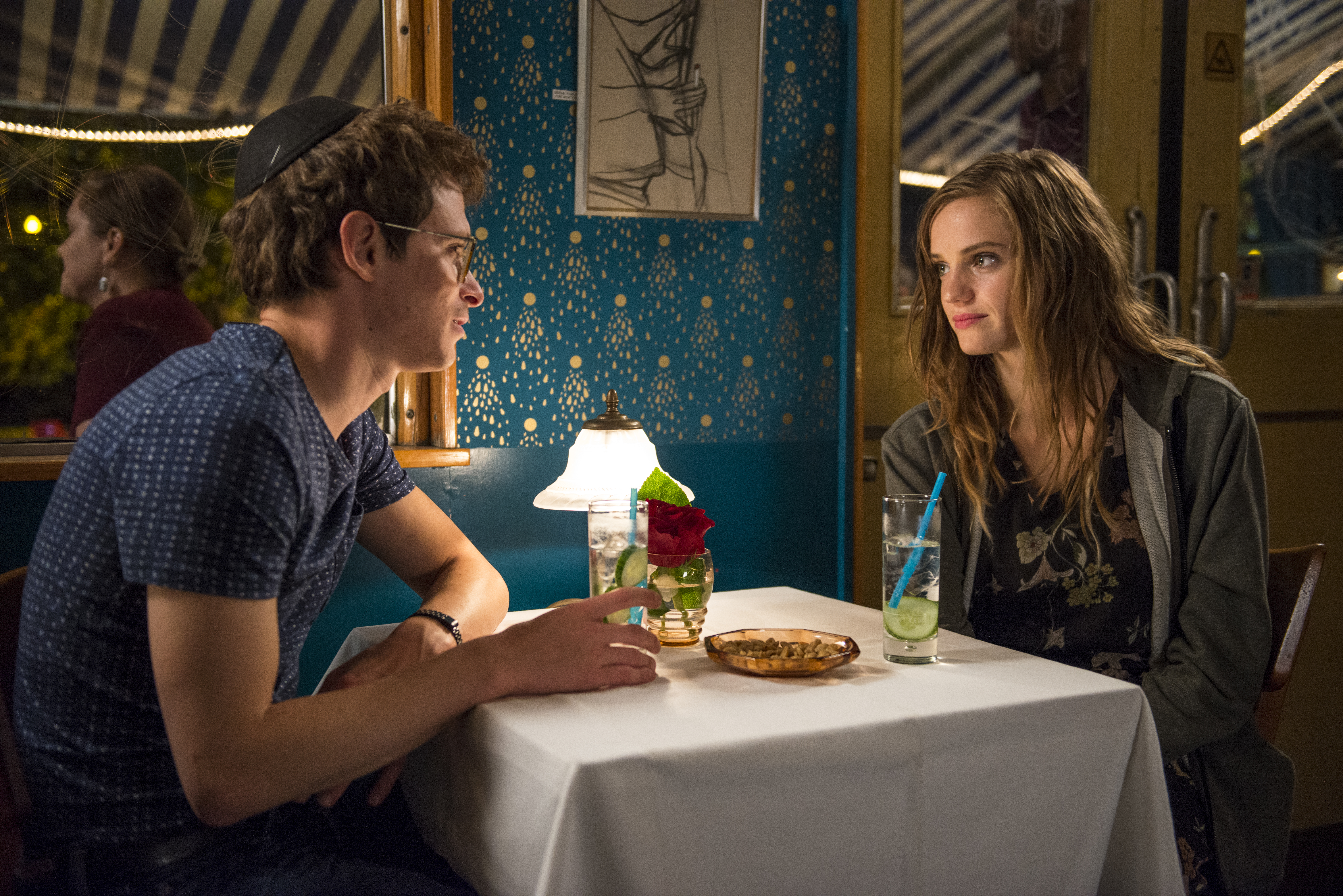
And, you might say, «well, then the super-hot girl also falls in love with the introverted little Jew, but the Yiddish mama doesn't agree, so it's a bit of a laugh, until all ends well in openness and tolerance.» Think again! The scenario is more subtle than that. The girl gradually falls in love, but things don't work out as you'd expect. The main character undergoes a veritable metamorphosis to provide the plot with surprises that only enrich the comic effect. And tragic too.
This is the film's added strength. Certain scenes, certain cries, certain words veer from the light to the serious, leading to genuine reflection on the role of a family and the consequences of emancipation. Because not everything that is opposed to parents and religion is put on a pedestal. Love itself has the merit of not being painted on a canvas of idyll and sentiment. There's more to it than that, and perhaps constraint and self-sacrifice are also part of love.
Technically speaking, there's not much of interest, except that the camera makes an effort to avoid the ugliness typical of comedies. There's a bit of research going on here, with the camera filming from the front, giving way to Motti's direct address to the viewer. Not great, but nice. Otherwise, the photography plays a lot with landscapes, from Switzerland with its trains and cows to the glittering beaches of Tel Aviv. Again, nothing exceptional; and yet, the photography as a whole comes off rather well.
It's an interesting story when young Motti meets the beautiful Laura and embarks on a disaster-filled adventure. Frankly, you can relate to it even if you don't have the problems of a Jew whose family lives in the rigors of Orthodoxy. After all, whatever the culture or setting, the encounter with love and the suffering it engenders are always more or less the same. Fortunately, the pleasures are also universal, because Motti the prude is about to experience the joys of sex, and even then the film manages to be funny. Just goes to show, Wolkenbruch's wonderful journeyis a good move.
«She said it was just a hit, a good hit actually.»
Write to the author: loris.musumeci@leregardlibre.com
Photo credit: © DCM Film Distribution
| WOLKENBRUCH'S WONDERFUL JOURNEY |
|---|
| SWITZERLAND, 2018 |
| Production: Michael Steiner |
| Screenplay: Thomas Meyer |
| Interpretation: Joel Basman, Noémie Schmidt, Udo Samuel, Inge Maux |
| Production: Turnus Film, DCM Pictures |
| Distribution: DCM Film Distribution |
| Duration: 1h32 |
| Output: March 6, 2019 |
You'll also like




 French
  German
  English
Leave a comment