





«Seul face à l'abeille»: the series that gives jam to bumblebees

Beware! The clumsiest comedian of his generation returns to bring us his eternal antics in a mini-series from Netflix. It lasts around an hour and forty minutes, and the episodic structure is so useless that the story seems to have been written to be a film. But what's the value of this new Mr Bean spin-off from Rowan Atkinson and Will Davies?
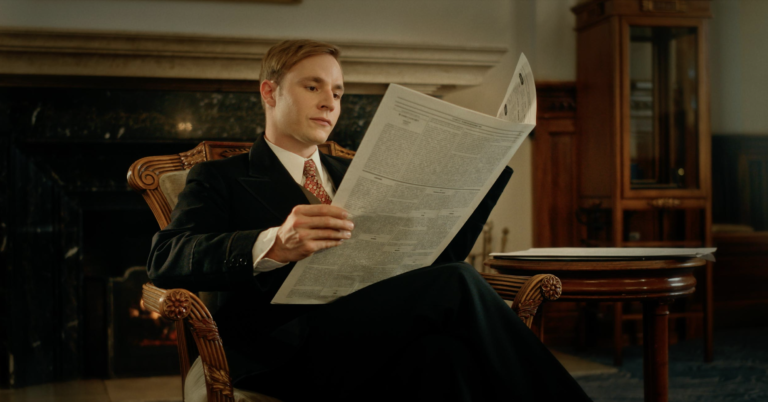
Trevor (Rowan Atkinson) is hired to look after a luxurious house during the owners' vacation. But before long, the universe plunges into absolute chaos in the face of the insurmountable power of a terrible predator. The universe is Trevor's, and the predator is a bee. As you'll have gathered, the premise can be summed up in two lines, but it's nice to be reminded that the stakes don't always have to rise to the call of overkill: in cinema, you just have to get attached to the character for the slightest annoyance to become grandiose. And Rowan Atkinson is a very endearing character.
The last comic figure
Comic films are a rare commodity these days. Let's recall its golden age in the early 20s. Chaplin, hailed by the whole world at the time, represented all the qualities (or, for some, all the faults) of cinema. Behind Chaplin, we admired the figures of Keaton, Laurel & Hardy, Max Linder and Harold Lloyd. Adaptation to talking pictures marked the end of many of these legends. But afterwards, a number of authors drew on these figures to keep these physical, déclassé characters alive: Jacques Tati, Louis de Funès, Jerry Lewis, to name but a few. Even today, a few still draw on this repertoire, in forms as diverse as Jim Carrey or Albert Dupontel. But let's talk about the one we're interested in today: the talented Rowan Atkinson.
He's perhaps the one who best embodies the legacy of early comic cinema: he played the character of Mr Bean, immediately recognizable by his looks and facial expressions, mute and always marginal to his environment, the main driving force behind the gag. This is the formula of the early days: the character is moved from place to place, in a variety of situations, producing a series of gags that constantly remind us of the arbitrariness of the social codes they don't possess. So, contrary to the logic of any good story, here it's not the character who evolves, but his environment. Worse still, the environment doesn't evolve; it regresses as a result of the character's antics! This legacy is still present in Alone with the bee in which the 67-year-old actor continues to play with his body, moving away from the overly verbose Johnny English.
Read also | Johnny English strikes backtension-free fun
A century later, how can we still make people laugh?
Seul face à l'abeille thus consists of a succession of gags in which the usual unfolding of the story gives way to a crescendo of increasingly devastating catastrophes. The direction remains highly functional, focusing on the best way to translate the comic effect to the screen. The same applies to the editing. It's a shame that, over a hundred years on, with today's technology and digital possibilities, visual humor is still struggling to renew itself. And yet, the relationship of scale between our protagonists and the technology that governs space, unknown to Trevor, could have offered something new. This is all too rarely the case.
The gags are for the most part predictable and struggle to set the pace. Worse still, the fact that the film is cut into 10-minute episodes reinforces the impression that all we've witnessed are long set-ups leading to an overly humble finale. However, where many effects rely heavily on rhythm and surprise, the visual gag always manages to trigger in us a certain pleasure, a satisfaction in seeing the inevitable happen. It's easier to forgive a joke that's not funny enough than a drama that's too serious.
The eternal sympathy of comedy
This is because the most important characteristic of the comic character is his ability to win the viewer's sympathy. Even when the comic is immoral (think of some of Groucho Marx's incorrect remarks), he remains appreciated by the viewer. The comic character, by standing on the margins, is a liberator. Through them, we can laugh at things we shouldn't laugh at. To rebel by proxy against norms, rules and obligations.
This is the case with Trevor, who uses the most satisfying comic tool of revolt: destruction. Little by little, each valuable object is crushed, burned, flooded, cut up or blown up, giving us a dose of entertainment tinged with a sense of justice in the face of the excesses of the rich. The whole value of a Piet Mondrian collapses when one of his canvases is hammered through, then repaired with a bit of scotch tape and an added piece of canvas.
This is why Alone with the bee, despite its pacing imperfections and lack of variety in its humor, remains a sympathetic and enjoyable mini-series. Because, in an increasingly compartmentalized industry where the aim is systematically character development, watching a work in the service of an awkward 60-year-old whose sole purpose is the deterioration of his surroundings is one of the most pleasantly regressive things you can do.
Write to the author: jordi.gabioud@leregardlibre.com
Photo credits: © Ana Cristina Blumenkron
You've just read an open-access article. Debates, analysis, cultural news: subscribe to support us and get access to all our content!

Vous aimerez aussi




 French
  German
  English
Laisser un commentaire