




People no longer watch series, they listen to them
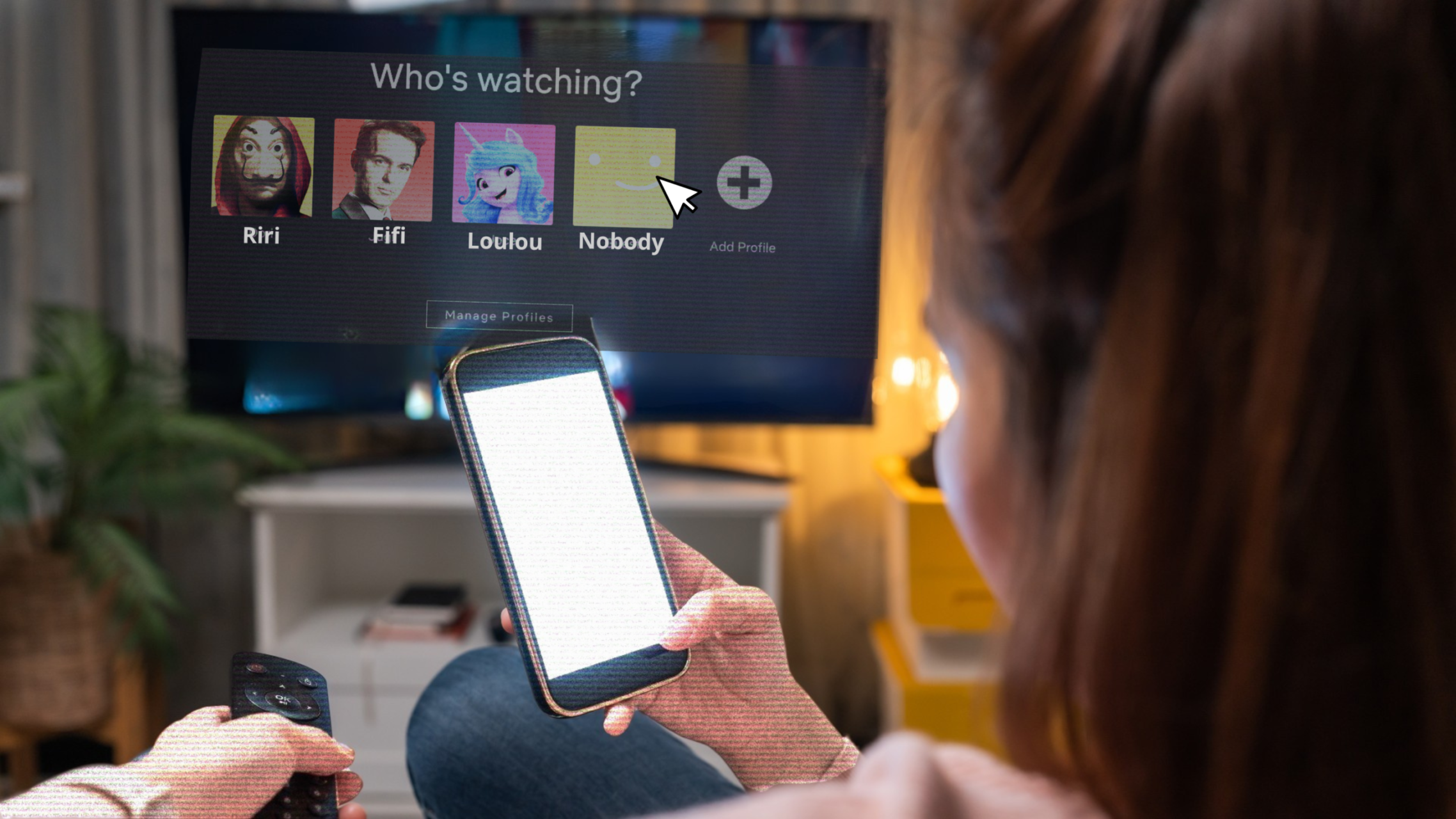
According to a study commissioned by Facebook in 2019, 94% of viewers would look at their phones while watching TV. Photo: Netflix
According to a 2019 study, 90% of people keep an eye on their phone while watching TV. This pushes screenwriters to focus on spoken text rather than image.
- How do you think Justin's doing?
- I hope so. He was weird today.
- How weird?
- (sighs) Angry, scared, reckless. Well, not himself.
- Hopper too. He's not himself.
- If anything, it's weighing on us, undermining us (...) we can't see the end of it. I mean, we're starting to feel lost. I think we need a stroke of luck.
Any good creative writing teacher would reject such dialogue. For one simple reason: it goes against one of the most universal rules of writing: «show, don't tell». Show rather than tell, according to a concept attributed to Russian playwright Anton Chekhov: «Don't tell me the moon is shining, show me its glow on broken glass.»
Whether in drama, prose or, a fortiori, film, a story will be more alive if it makes the reader feel what the protagonists of the story are going through. A spurned lover is not simply sad or depressed; she shaves the walls, shoulders hunched, face set and gaze turned to the ground, indifferent to the rest of the world...
This is all the more true for cinema, which can do without words: rather than dialogue or voice-over, a camera movement, a steady gaze, a close-up on a tiny detail that sums up the whole point of the scene, atmospheric music...
Writers of Stranger Things failures
In the dialogue above, taken from the first episode of the new season of Stranger Things, Justin's state of mind is narrated through the dialogue of two protagonists, Mike and Eleven, when it would have been more effective to... show it to us - which is precisely what the preceding scenes have done, making this dialogue all the more redundant, not to mention the fact that the scene doesn't show much, since the two teenagers are filmed from a distance, or from behind, or poorly lit.
It makes you wonder whether anyone has actually reread the script. The famous Netflix series, which contributed greatly to its success almost ten years ago, seems to have abandoned all script requirements.
It wouldn't be the first time that a series has lost quality over the seasons, either through lack of inspiration or thriftiness, relying on fan loyalty to see it through.
«Explain rather than show»
These days, a second hypothesis is also emerging: that this lazy writing is deliberate. Netflix and other streaming sites have accustomed us to dialogues or voice-overs that over-explain the plot and narrate what is actually visible on screen. According to screenwriters, interviewed by the American cultural magazine n+1, This phenomenon is deliberate - because in the age of streaming, people no longer look at the screen.
«Get this character to announce what he's doing, so that viewers watching in the background can follow along» is a frequent injunction from Netflix producers to scriptwriters, who rely on an implacable statistic: according to a 2019 study commissioned by Facebook, 94% of people who watch TV do so with one eye glued to their cell phone.
It's about providing content that people can consume «passively», while doing something else. «Casual viewing» is even a Netflix category, promoting certain films and series whose primary quality is that they don't have to be watched attentively to be understood and appreciated.
An increasingly deplorable service
For a long time now, the success of Netflix and its competitors has not depended on the quality of their offer, but on its volume. Subscribers, who shunned the constraints of conventional TV channels and believed in an artistic revival with flagship series like Black Mirror or Stranger Things, Netflix subscribers find themselves captive to their subscription, whose price has skyrocketed and which inundates them with new offers all the time. Giving up Netflix means giving up a whole catalog of films and series that you can't find anywhere else, unless you subscribe to several streaming offers simultaneously. Instead of one Canal+ subscription, you need five.
This is just one example of the latest stage in the ’enshittification« phenomenon described by tech journalist and critic Cory Doctorow in his latest book, published in October. In it, he states that the Internet giants all end up deteriorating their services to maximize their profits, after having made their customers - individuals and companies alike - captive and dependent.
If a series or film ends up being nothing more than a glorified podcast to be followed while doing the laundry, with no regard for the work of the actors, make-up artists, cameramen and set designers, perhaps Netflix should just make podcasts, rather than producing «motion pictures» that it doesn't respect.
Every month, our film review Jocelyn Daloz explores the seventh art in its socio-historical context.
You have just read an open-access column from our print edition (Le Regard Libre N°123). Debates, analyses, cultural news: subscribe to support us and access all our content.
You'll also like
 French
  German
  English
Leave a comment