


Le Regard Libre N° 30 - Nicolas Jutzet
Fifty shades of cross-border commuters (1/3)
The issue of cross-border commuters is the talk of the town. The canton of Neuchâtel is one of the regions affected by this phenomenon in Switzerland. An initiative launched by the Swiss People's Party (SVP) has rekindled the debate. But what is the reality?
This series of articles looks at the flow of workers who, almost every day, come from abroad to work in our country. In the first episode, we take a look at the canton of Neuchâtel. Later, we'll look at two other parts of the country that are more clearly identified with this issue: Geneva and Ticino. By treating this theme in the form of a soap opera, it will be possible to compare the results from different regions and reach in-depth, nuanced conclusions on a subject that all too often gives rise to caricatured discussions.
Thanks to its geographical proximity to France, the canton of Neuchâtel offers incentives that are not available in other regions of central Switzerland. However, the question now is to identify whether recourse to labor from neighboring France is leading to a scarcity of jobs for locals, or whether the two populations are compatible and mutually benefit from each other's work.
An initiative by the Neuchâtel UDC
In a tense political climate, due in particular to record unemployment and welfare rates, the Neuchâtel UDC has decided to launch an initiative for indigenous preference in hiring, entitled «Ours before others».» (editor's note: the initiative was withdrawn on July 27 for lack of signatures). Tabled on February 9, 2017, exactly three years after the acceptance, against the advice of the «political class», of the initiative against mass immigration, this initiative is full of symbolism. It implies that «the other», already pilloried during the 2014 campaign, is the one at the root of our problems, and that we must quickly put an end to, or at least stabilize, this influx so that we can protect «our people» who are suffering.
The «Neuchâtel paradox»
The Neuchâtel labor market is responsible for a large part of what is known, with a certain fatality, as the «Neuchâtel paradox». The financially-strapped canton creates jobs, is dynamic, innovative and at the cutting edge of progress, but is unable to solve its problem of endemic unemployment. Since the subprime crisis, a clear decorrelation is visible. Gone are the days when a simple economic recovery automatically led to a return to employment. It's intriguing to know that the number of jobs is increasing, without generating a correlated drop in the number of jobseekers.
To get a clearer picture, and in fact act in full knowledge of the facts, the Department of Economy and Social Action of the canton of Neuchâtel (under the aegis of Nathanaël Karakash) and the Neuchâtel Chamber of Commerce and Industry (CNCI) commissioned an in-depth analysis from the University of Neuchâtel and the Canton's Statistics Service. The results were released in early 2016. Before analyzing them, we need to give a brief overview of the structure of the economic fabric in the canton of Neuchâtel. There are a number of peculiarities that may help to explain the situation.
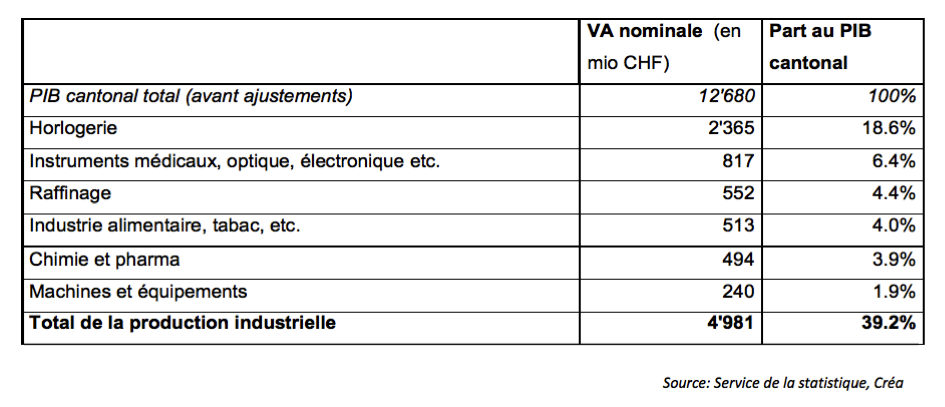

These figures show that the watchmaking sector occupies an important place (18% of the canton's employment) and entails a de facto dangerous dependency, as it can wreak havoc, notably by trickling down to other sectors, if its situation deteriorates (which is in fact what is currently happening). This figure needs to be analyzed in the context of the structure found in the country's other cantons. «For comparison, the highest weight, on average in Switzerland, is 6.5%. Only in a few cantons does the weight of a single branch exceed 12%.» To use a well-known expression, watchmaking is «to big to fail» for the region. Being largely foreign-oriented, Neuchâtel's industry requires highly skilled workers.
Little or no substitution phenomenon
The findings of these studies are as follows: «Overall, it appears that cross-border employment has made it possible to compensate for a real inability to meet local skills needs, particularly in sectors with few skilled jobseekers. If, for the same skills, substitution of local labor by cross-border workers cannot be ruled out in certain branches, particularly in the tertiary sector, the studies carried out show that these phenomena have not played a significant role in the overall increase in cross-border employment over the last ten years».
Further analysis reveals that in certain service sectors, the «substitution phenomenon» cannot be ruled out. Contrary to what is often claimed, the use of cross-border commuters is neither systematic nor at the clear expense of the local population. Moreover, it should be borne in mind that a large proportion of cross-border commuters work in the secondary sector. A clear trend is also emerging: the mismatch between the supply of jobs and the labor force looking for work.
In some sectors of the secondary sector, the lack of available qualified personnel means that they have to look across the border for help. In the tertiary sector, particularly accommodation, catering and retail, there are too many jobseekers, often with insufficient qualifications. We therefore need to focus on retraining, or sometimes simply upgrading, while at the same time trying to redirect these people towards the sectors in demand, who currently have to prospect elsewhere. There is room for manoeuvre, but it requires time and support.
«To name things wrongly is to add to the unhappiness of this world».»
In the light of these conclusions, it appears that the issue of cross-border commuters and the related controversies (labor theft, wage dumping, etc.) are more fiction than reality in the canton of Neuchâtel. Following the publication of this report, the State Council presented an action plan, the «new deal for employment», which aims to smooth relations between the canton's (large) employers and the regional employment offices. The aim is to enable the local population to return to work more easily. The long-term results of this partnership will now have to be observed. It is highly regrettable that the UDC, in a purely electoral move that has, moreover, resulted in a bitter failure, is stirring up resentment by selling a simplistic truth to people who are suffering because of their situation. «(Albert Camus) We'll know at the end of August whether the number of signatures has been reached. In view of the decomposition of the party and the slap in the face it has suffered, this seems compromised.
In conclusion, from a utilitarian point of view, the real battle should focus on reducing the number of commuters from other cantons (a number roughly equal to that of cross-border commuters) and not on cross-border commuters, who, unlike the Vaudois for example, bring a direct financial contribution to the canton of Neuchâtel (France retrocedes 4.5% of this wage bill to the cantons and communes). From a more realistic point of view, let's not forget that the contribution of these mobile workers (commuters and cross-border commuters) to the creation of value amounts to 21% and that the canton of Neuchâtel, even more than others, benefits greatly from open borders and the opportunities offered by a free society.
Write to the author: nicolas.jutzet@leregardlibre.com
 French
  German
  English