



The continent enjoyed free trade and decentralized institutions for centuries before the arrival of the colonizers. Today, Africa's revitalization is in the hands of its citizens.
L’original article is published in German in Schweizer Monat.
For many, it seems that the history of Africa began with the arrival of Europeans and, later, Americans. Yet Africa was home to great civilizations for thousands of years before these events. I'm delighted that Henry Louis Gates, a renowned Harvard professor, recently produced a six-hour documentary for PBS entitled Africa's Great Civilizations. This documentary gives an overview of over 200,000 years of African history, and presents it in an enjoyable and colorful way. This is an invaluable asset, as most of the other resources available are academic and therefore often boring or even off-putting.
Gates points out, for example, that all human beings have African roots. All eight billion of us are cousins! Gates also points out that Africa is the origin of much of what makes us human, including writing, art and music.
Take Mansa Musa, the 14th-century emperor of Mali. At the time, he was the richest man in the world - and probably ever. It was largely thanks to the gold and salt trade that Mansa Musa acquired his wealth, which he used not only to conquer new lands, but also to create in Timbuktu not only a great commercial center, but also a city of universities and scholars.
While the world's first university was founded in Fez in 859 CE (predating Oxford by at least a hundred years), the University of Sankore in Timbuktu (present-day Mali) evolved from a mosque founded in 989 CE and, under Mansa Musa, developed one of the world's greatest libraries - the largest in Africa since the Library of Alexandria.
As Gates puts it, these and other magnificent achievements provide a «profound denial» of the belief that Africa had no history before the arrival of Europeans: «This continent has always been dynamic, interconnected and an integral part of world history.»
Africa and free trade go hand in hand
This interconnection was built and maintained as it still is: through trade and commerce. African civilizations developed on the east coast thanks to trade with Asia. Between 800 and 1600 CE, an estimated 500 tons of gold, much of it from the interior of the continent, passed through eastern ports. The west coast linked up with Europe and the Americas, and trade enabled our early empires to prosper.
And now, African states all have high tariff barriers. What's wrong with this picture? The African Free Trade Agreement, which has been signed by most African nations in recent years, will finally reduce trade barriers (if it is actually implemented as promised by African leaders). But really, why did we have to wait until 2021 to get free trade within Africa, which was our birthright?
Worse still, this agreement only concerns trade. inside of Africa. Unlike the great African kingdoms of old, which traded on a global scale, African nations will almost certainly continue to maintain high tariffs on goods from outside Africa.
As the late economist George Ayittey wrote, freedom of trade existed for centuries before the arrival of the colonists; indeed, it was a fundamental way of life for virtually all the inhabitants of sub-Saharan Africa. The blood of individual freedom runs deep in the veins of African history, from the time when African tribes used a decentralized governance structure totally different from the modern African state (which is essentially a European colonial import).
People from all over the world come to marvel at the Palace of Versailles. But when we talk about Africa, we only talk about its bad sides. Imagine what France's image would have been like if all the articles about France had focused on its bad sides.
The current dominant vision is: Europe is beautiful, America is cool, Africa is a shithole. So I've made it my mission to focus on the parts of history that have been forgotten. I want to show the world a beautiful place, with towns and villages as civilized as anywhere else on the planet. I want to show that Africans were often ahead of their time. I want to make it clear that if we hadn't been interrupted in our stride by slavery and colonialism, we could have gone on to outstrip the rest of the world. I'm not talking about an imaginary Wakandan, as in the film Black Panther of Marvel. I want to talk about a place where people are both flawed and good, and where maybe we would have created ideas that would have changed the world. Maybe we would have built a government that would have been superior to democracy as we know it today.
When Europeans arrived in Somalia, they found a culture that in many ways resembled their own. They found tribes working together. Did they ever fight? Of course they did. We're all human. But most of the time, peace was maintained. There were royal courts and kingdoms expanded through strategic marriages. Nothing like what we know today.
But when the European colonizers arrived, they said, «Oh, you savages, we're going to bring you civilization.» So we went from a sophisticated decentralized system that prevented the domination of strong men to nation-states designed by the colonizers. They introduced centralized systems of control, formal borders and general laws that were and still are susceptible to corruption.
The new colonial borders did not correspond to tribal boundaries; on the contrary, they were and still are perfectly arbitrary. Whoever seizes power within the new borders gets his hands on diamonds, oil, foreign aid and everything else of value, including other tribes. This is how democracy becomes a sectarian or ethnic battlefield.
In the United States, we generally think that the law is what the legislature makes it. But for people who are serious about common law, In many African countries, particularly the British, the law was developed by judges over the centuries. Most African laws were originally much closer to the legal system of common law. The newly imposed colonial «laws» were totally contrary to our traditions, creating unnatural pressures. It was at this point that we moved from tribes to tribalism, today's ethnic conflict.
A revitalization framework for Africa
This is the story we need to teach about Africa: before the arrival of settlers and slavers, Africa had a functioning free market system, linked to the main trade routes of Europe and Asia. The destruction of this system was intentional. It can and must be recreated today, for the benefit of every generation of Africans.
Let me sum it up for you. Call it my manifesto:
1. All prosperous nations must enable their citizens to create value through enterprise. All nations protect property rights, so that citizens and entrepreneurs do not have to worry about their property being arbitrarily seized by criminals or the government. All nations allow their citizens to set up businesses freely, without undue restrictions from the authorities. All nations allow their citizens and businesses to operate within a stable legal framework, with relatively impartial laws and courts able to deal with disputes fairly. Most African countries do not grant these fundamental rights to businesses. In international rankings of economic freedom and business practices, only Mauritius, a tiny island nation that has now achieved an almost European level of prosperity, is in the top tier. A few other nations, including Botswana and Rwanda, are moving in the right direction. Most African nations are in the bottom half, if not the bottom third. Our nations are the worst in the world when it comes to economic freedom.
2. Africa should be full of prosperous nations, but why? Why should we care about Africa? Here's one reason, and it's as interesting to me as it is to you: a rising tide lifts all boats. If Africa is under-producing, and it blatantly is, the continent's citizens aren't the only ones losing out. In the United States, we often say that our greatest resource is our people. In the age of globalization, the loss of the talents and energy of over a billion human beings is incalculable. What could a liberated Africa bring to all aspects of human activity? We have artists, philosophers, academics, businessmen, thinkers and doers of all kinds just waiting to reveal their talents to the world! I believe there are eight billion geniuses in the world. Each of us has come to this Earth with a unique genius, and that genius represents part of the solution to humanity's problems. Every time one human being is deprived of manifesting his or her talent, the whole of humanity is weakened.
3. Africa needs to adopt a voluntarist mentality, and work towards the goals of prosperity through a positive capitalist path. We must not succumb to a victim mentality. Both non-governmental organizations (NGOs) and anti-capitalists can foster this victim mentality. While some NGOs focus on genuine empowerment, others too often see Africans as pathetic objects in need of a white savior. They communicate this message both overtly and indirectly. Yes, it can be difficult because of the lack of opportunities. Anti-capitalist intellectuals, both in Africa and abroad, tirelessly repeat a victimized discourse according to which Africa is poor because of slavery, colonialism and permanent exploitation. Yes, Africa has been a victim. But until these same intellectual forces formulate and endorse the positive capitalist path that will enable us to leave this past behind us, they will be part of the problem, not part of the solution. They're the bad guys.
Finally, a few personal words. I wanted to make products in Africa for two reasons: firstly, because I'm very interested in creating jobs in my country, especially for high-end products that prove we can break the thatched roof ceiling. I have to say that for all my boldness, it took me a while to feel comfortable making products in Africa.
The second reason I wanted to make products in Africa is, admittedly, more idealistic: if we don't cry out for the dignity of the African people, who will? If you and I don't push for Africa's prosperity, who will? Most African leaders are out to line their own pockets. Most of those who run international aid organizations are unwilling to stand up for African entrepreneurship, independence and self-respect. Even today, the norm remains a patronizing, pitying approach to Africans. We need to be leaders of this alternative movement.
My most fervent hope is that we can finally agree that Africans deserve world-class business environments and world-class capitalist institutions, on a par with those enjoyed by the citizens of Denmark, New Zealand, Switzerland and the United States. I ask you, if you really care about black Africans, if you really care about us, to join me as staunch defenders of economic freedom in Africa.
This text is a reworked extract from Magatte Wade's new book, The Heart of a Cheetah («The heart of a cheetah»), an extract originally published in the German-language magazine Schweizer Monat, including Le Regard Libre translates articles from issue to issue.
You have just read an article from our print edition (Le Regard Libre N°103).
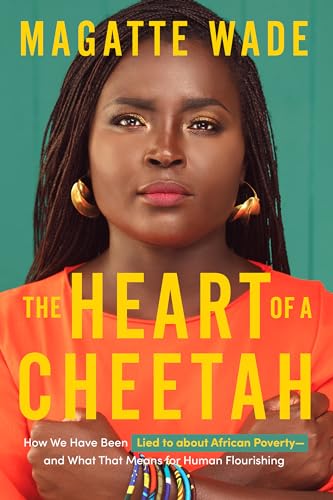
Magatte Wade
The Heart of a Cheetah
Cheetah Press
November 2023
242 pages
 French
  German
  English