




Albert Schweitzer, precursor of respect for animals
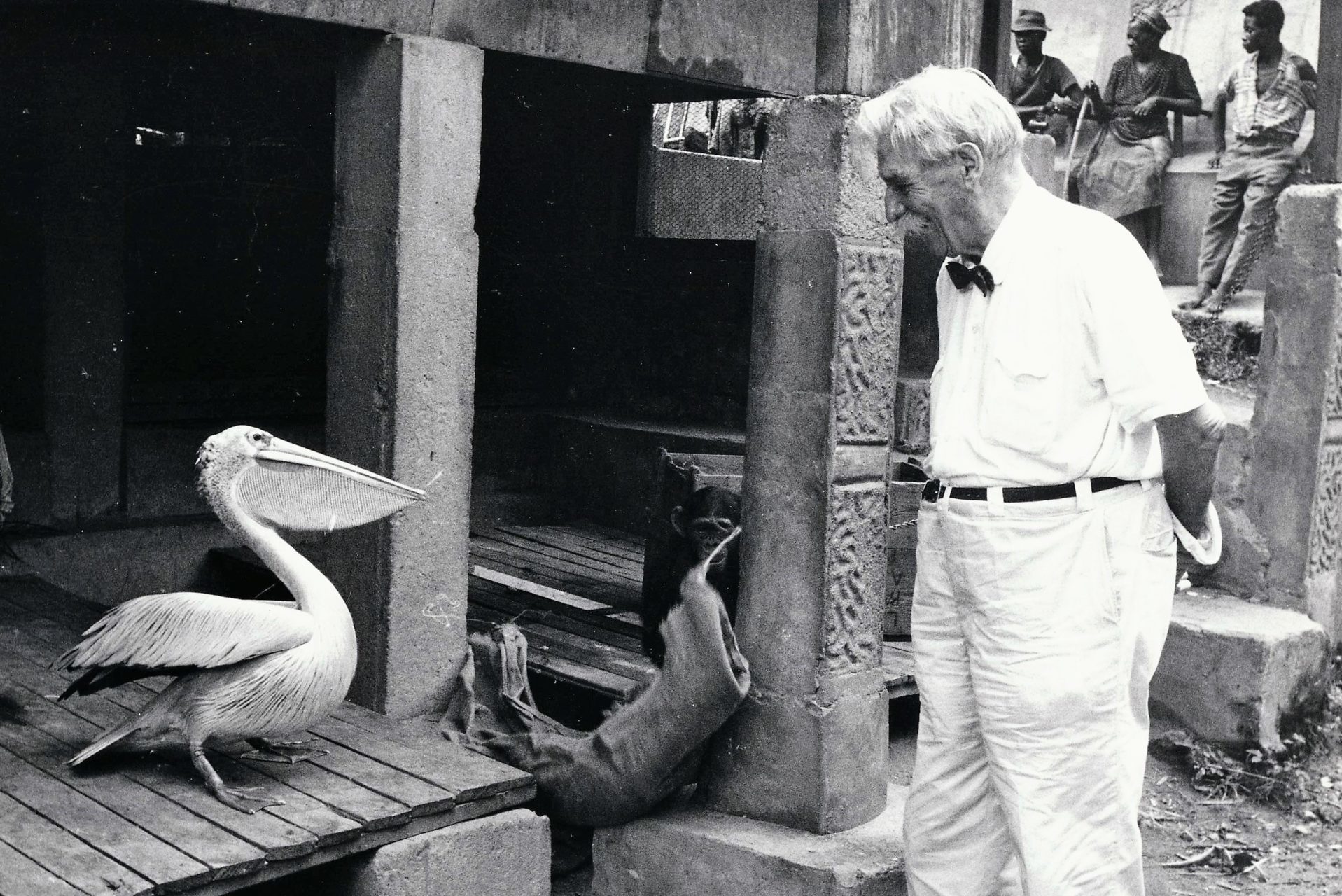
«Albert Schweitzer's »Respect for Life" - a harmless title, but a revolutionary content. Photo Personal archive of Walter Schriber
The Alsatian physician and pastor extended ethics far beyond human relations. Inspired by a revelation in the heart of Africa, he forged a universal ethic embracing people, animals and nature, prefiguring modern ecological ethics.
L’original article is published in German in SICHTWEISENSCHWEIZ.CH
Albert Schweitzer - Respect for life. Few thinkers have so closely linked their lives and their ideas, and Schweitzer even describes the moment when this expression «respect for life» came to mind. It was in 1913, when he was traveling with his wife Hélène from Lambaréné. On the third evening, they were driving along the River Ogooué and «on a sandbank to the left, four hippos were walking in the same direction as us. It was then, in my great fatigue and discouragement, that the expression “respect for life” suddenly came to mind, which, as far as I knew, I had never heard or read before.»
At the source of a universal ethic
An idea, but one that didn't come from nowhere. After all, Albert Schweitzer (1875-1965) had long been concerned that Western ethics were only interested in relationships between human beings, leaving the rest of creation to one side. This experience on the Ogooué was nevertheless decisive for Schweitzer's further thinking, as it gave him the key to developing an ethic that brings us into contact «not only with human beings, but also with all the creatures in our environment» and commits us to action. Indeed, since his childhood, the future Nobel Peace Prize winner had been interested in the fate of animals. He recounted how, every evening, after praying with his mother, he would «secretly add an extra prayer that he had composed himself for all living beings».
Nevertheless, he still had a long way to go to formulate an ethic that does not stop at our fellow human beings, but ultimately places us in a new relationship with all that exists. This liberation of ethics from a narrow anthropocentric corset makes him a pioneer of animal and environmental ethics, and can be considered one of his lasting achievements.
Respect for all life
When Schweitzer speaks of «life», he's not just referring to the life of human beings:
«The error of all ethics up to now has been to fail to recognize life as such as the mysterious value it is dealing with. [...] Attempting to establish universal differences in value between living beings amounts to judging them according to how close or far they are from us humans, according to our perception, which is an entirely subjective criterion. Who among us knows what the significance of another living being is in itself and in the world as a whole?»
The respect Schweitzer speaks of is therefore also respect for animals, respect for bees, earthworms and sparrows. For the respect Schweitzer speaks of is not a respect that a being imposes on me because it has impressive abilities, because it is so similar to man, or because it is as «cute» as my little dog. Not coincidentally, this is reminiscent of Jesus« ethic of love, which does not limit love to those who are lovable and close to us, but invites us to look at the world through the eyes of love and thus discover, on a case-by-case basis, who is »our neighbor« here and now. So it's no coincidence that Schweitzer saw his ethic of respect for life as »the ethic of love extended to the universal".
Between conflict and responsibility
Schweitzer demanded nothing less than to enter into a new relationship with any life, even with the universe. But he was well aware of the contradictions and conflicts that such an attitude entails:
«My existence conflicts with that of others in a thousand ways. The need to destroy and harm life is imposed on me.» This applies not only to his work as a doctor, in which he becomes a «serial killer of bacteria», but to the whole of human existence. Each of us can say, «I am a life that wants to live, in the midst of other lives that want to live.»
So there are conflicts everywhere, and Schweitzer didn't see it as the task of ethics to resolve these conflicts for people and provide them with ready-made recipes for what they can and should do. Those who look to Schweitzer's ethics for answers to a concrete ethical problem will not find them. An ethic designed to appease his own conscience was abhorrent to him, because not only did it fail to do justice to the complexity of our reality, it also made us insensitive to the ever-renewed call to responsibility.
«We must never become blasé,» he said. «It's when we live conflicts ever more deeply that we are in the truth.» Here again, Schweitzer comes close to the message of Jesus, who, in his harshness, also refuses to soften ethical demands and offer compromises.
So, 150 years after his birth and 60 years after his death, we remember Schweitzer as an ethical provocateur. However innocuous the expression «respect for life» may seem, it conceals a revolutionary potential. Even today.
Christoph Ammann is pastor of the Reformed parish of Zurich Witikon. Previously, he worked for many years in academia, including nine years as a lecturer at the Institute for Social Ethics at the University of Zurich. Since 2016, he has been chairman of AKUT, the Church and Animals working group.
You have just read an open-access article. Debates, analyses, cultural news: subscribe to support us and access all our content.

You'll also like




 French
  German
  English
Leave a comment