




Becoming free in Turkey, for the love of Madame Vie
Tuesday books - Diana-Alice Ramsauer
It will take two women for Fazıl to find his way to freedom. One of them gave her name to the book Ms Hayat. The other is more discreet, but also more committed. Two women to tell the story of Fazıl's evolution and awakening in a Turkey that is gradually closing in on itself. Accused of participating in the failed coup of 2016, the author, Ahmet Altan, wrote this book in prison. This gives the story an even more political flavor.
Allusions to Turkey's socio-economic situation begin very early in the book. As early as the second paragraph, the life of (Stamboulian?) Fazıl, a young literature student, changes completely when his family is ruined because «a large country [has] decreed a halt to tomato imports». Writer and journalist Ahmet Altan doesn't tell us, but beyond fiction, this «big country» is Russia, which in 2015 imposed an embargo on Turkish fruit and vegetables. Sanctions imposed as part of the war in Syria. So we quickly understand that the book tells us a certain reality, well anchored in current events.
«You don't learn much about existence in happy families, I now know; it's misfortune that teaches us about life.»
Fazıl becomes poor. He leaves his small apartment and takes a room in a kind of hostel where a whole section of society's outcasts gather: a «poet», who turns out to be more of a journalist, a father raising his daughter alone, a few potential mafiosi and a transsexual. To earn money, the young letter-writer takes up a job as an extra on a TV show where young women sing in front of a paid audience to clap their hands, raise their voices and sway to the beat. It's here that he meets the two women who will inspire him to see the world as it really is, without the filter of naiveté.
A taste for life
The first is none other than the woman who gave her name to the book: Madame Hayat. A woman who could be his mother, with reddish-blond hair, a mischievous face and a curvaceous body, almost always molded in a honey-colored dress with a plunging neckline. A figure never presented as vulgar. Madame Hayat is generous and, above all, lively and sparkling. Hayat is simply the Turkish word for life.
The other, Sıla, is Fazıl's age, with a noble face, «chiseled with care from the smoothest marble by a genius sculptor, a straight, fine nose with soft, round wings [...] Her whole face seemed to look down on you, to judge you, to make you insignificant». The young woman is a literature student who has lost everything when the company her father ran is seized by the authorities, as one of its minority shareholders is arrested for «preparing a plot against the government». Similar fates bring the two characters together. «I imagined us as two baby turtles who'd had their shells ripped off, two baby turtles huddling together to give each other a little warmth.»
Getting a taste for freedom
Beyond the double love story, these encounters allow Fazıl to step out of his carefree, arrogant rich man's son. First of all, Madame Hayat, teaches him to love life. «She] was free. Uncompromising and rebellious, free only out of disinterest, out of quietude, and every time we brushed against each other, her freedom became mine. Soon my life would have no taste outside this freedom I was dependent on her delights». This encounter opens up Fazıl's senses: he suddenly has a mad desire to live actively, not to be a spectator of what surrounds him.
Because unlike Fazıl, who is increasingly free and alive, Turkey is sliding, almost indifferently, into dictatorship. It's suffocating in on itself. The terraces are emptying from page to page. The booksellers' district sees the curtains of its shops close. Groups of men wait on street corners with sticks to lecture revelers. And arrests multiply.
It's Sıla who helps him take the next step on his evolutionary path. A passionate literary critic, she happily throws herself into debate, contradiction and conflict, prompting Fazıl to take a stand and thus, indirectly, become aware of the political situation. For the young woman, it's clear: it's impossible to have a future in this country.
A taste for revolt
Fazıl begins to change: he feels. First fear, but also anger. While some of his comrades are being arrested for posting critical texts on Facebook; When he saw a friend commit suicide to escape the authorities, he began correcting and rewriting texts for a magazine. It was here that he came face to face with the horror of his surroundings. The images never let him go.
«I thought of the confidence I once felt, of the emotions that were nurtured then, emotions that were sparse, discreet, harmless, like little flowers of the field, and now withered, trampled, lost amidst new emotions that, they lacerated my soul and left deep furrows there, and it was with astonishment, with admiration even, to tell the truth with incredulity, that I remembered my past feelings.»
It's a truism... but knowing the author's journalistic background, this book is a clear critique of Erdogan's regime. Locked up in an Istanbul prison between 2016 and 2021, Ahmet Altan is known for his opposition to the government. The book is not available in Turkey. However, while this review insists on the political allusions in the story, the fact remains that the book deals with this issue in an underlying way: always present, but more like a backdrop. The daily lives of Turks are not disrupted at every turn by the government's actions. Author Ahmet Altan even seems to want to show that it's perfectly possible to live with one's eyes closed. But once the reality of the situation has been exposed, there's no turning back. And there's no point in running away.
Finally, Ms Hayat is a declaration of love to Turkey. One could even say that Madame Hayat is/symbolizes the Turkey that Ahmet Altan loves. Mischievous, generous and profoundly free. Elusive too, whose past is hard to discern, let alone its future. Who sometimes retreats into solitude and sometimes finds herself in a bad way. But whom Ahmet Altan loves with an intense, all-consuming love.
Write to the author: diana-alice.ramsauer@leregardlibre.com
Photo Credit: © Nina Dumauthioz
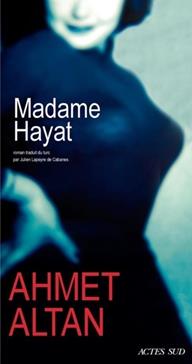
Ahmet Atlan
Ms Hayat
Translation by Julien Lapeyre de Cabanes
Actes Sud
2021
272 pages
You'll also like




 French
  German
  English
Leave a comment