




Guillaume Gagnière's first literary voyage
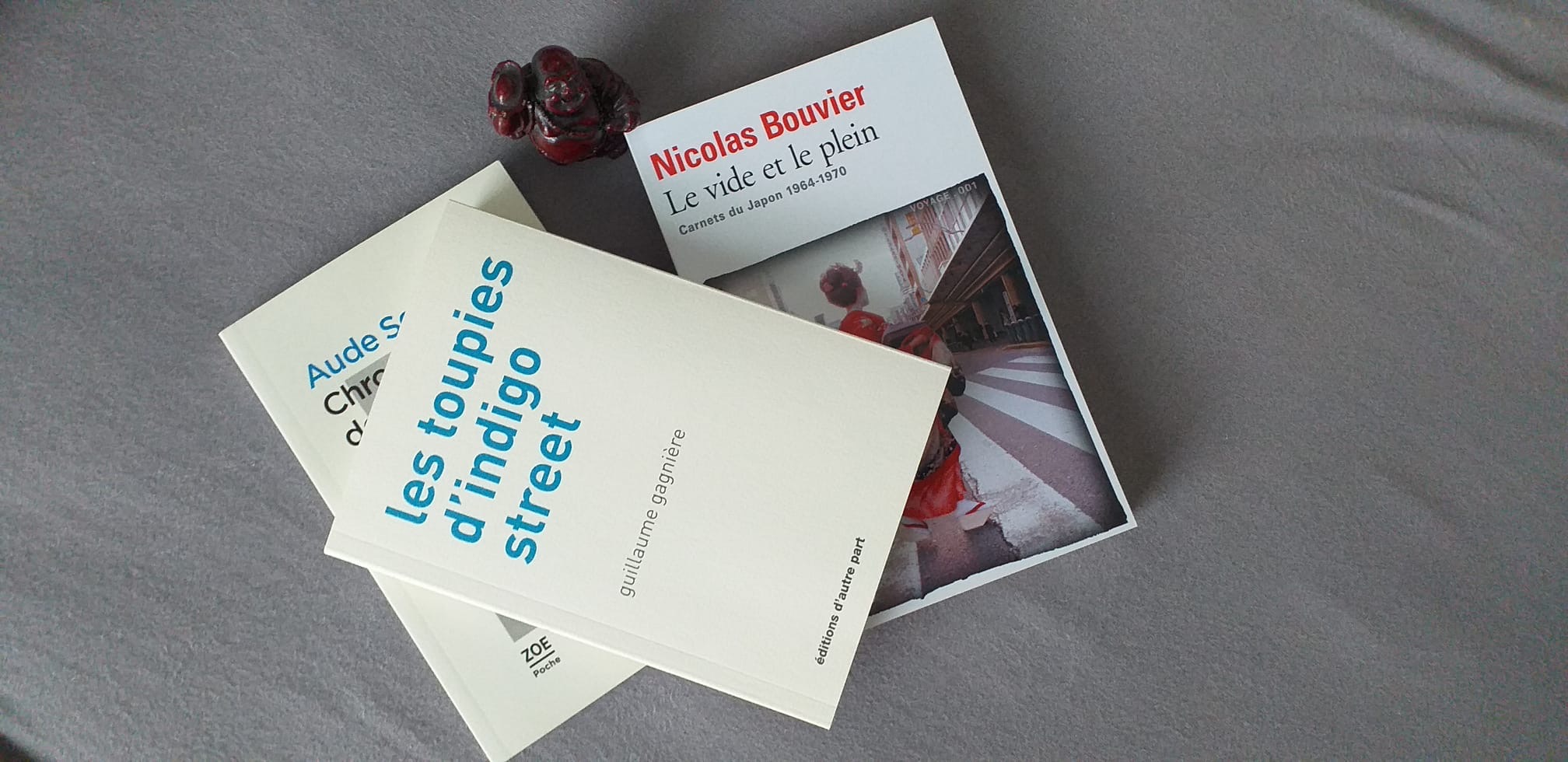
First novel by Geneva-born Guillaume Gagnière, Indigo Street spinning tops offers a soothing tale in the footsteps of Nicolas Bouvier. An intriguing pilgrimage to the Land of the Rising Sun. As if to better (re)find oneself.
A top goes round and round. So, for once, I propose to begin our bookish exploration with the last lines from the novel's epilogue. «I'd found my colors again, and then, when you mistake handles for spinning tops, it's a sign that it's time to stop spinning.» This book is all about spinning tops, both in the title and in the narrative. As if to make it a leitmotiv.
They open and close the novel. Tops bought in Indigo Street, in Sri Lanka, during a trip. The spinning top is also a powerful image, a symbol. It represents something that goes round and round. A bit like a journey, isn't it? Basically, you start from point A and go on to point B. If you're lucky, you'll pass through points C, D, E and so on, and usually end up back at point A. The starting point, the famous «home».
An author in search of peace
In the land of Calvin, travel literature is a genre we know quite well, especially when it comes to Nicolas Bouvier. The man who gave this form of narrative its letters of nobility, between adventure, the quest for self and openness to the world. Given Bouvier's popularity in France, it's no coincidence that Guillaume Gagnère follows in his footsteps. Reading this novel, one can't help but think of Chronicles of the nomadic West d’Aude Seigne, a literary compatriot of the contemporary author, whose story tells of the wanderings of a young woman, between Lonely Planet and adventures, on little solo journeys.
From the very first lines of the prologue, Guillaume Gagnère sets the scene and mentions The Scorpion Fish, and Nicolas Bouvier, in a footnote referring to indigo street, «its Sri Lankan »street« that »sank«. Times have changed. »Some sixty years later, the planet has shrunk. There's no longer any need to bust a gut on board a Fiat Topolino to see the world[1]. Everything moves very fast now.
«I left Switzerland a bit like ripping off a Band-Aid: quickly and without thinking. A year in Sri Lanka, following in the footsteps of Nicolas Bouvier.»
It is these opening lines that let us into Indigo Street spinning tops. A prologue, «one year later», which takes place after the events recounted in the story. The narrative then invites us to travel one year earlier, in the footsteps of Guillaume and his trip to Southeast Asia, from Indonesia to Sri Lanka via Japan. Written in the first person, the story follows a traveler, the author himself, as a tourist but also as a spiritual pilgrim, in search of... something.
The question is: what is this «something»? What is our protagonist looking for, as he sets out on his journey to make the Shikoku pilgrimage, i.e. «[...] the pilgrimage of the 88 temples of Shikoku, a long march of 1200 kilometers under the patronage of Kūkai, a monk of the VIIIth century.» Kūkai or «Kõbõ-Daishi», the author tells us in one of the footnotes throughout the book, is the founder of the Shingon Buddhist school, a form of esoteric Buddhism developed within the Japanese archipelago. Well, it looks as if our hero is seeking to tame his fears and find solace in the crushing loneliness of faraway lands, isolated from family and friends.
«Nevertheless, I too may have found a form of appeasement, in Japan, on the way to the eighty-eight temples...And in front of this wide, blank, vertical notebook presented by the street, I doubt I'll be able to recreate the intensity of these last twelve months.»
Reality in the land of travel
The reader quickly understands that the hero «William-san»[2], as a Japanese innkeeper calls him, doesn't have the same level of charisma as Crocodile Dundee. Under the Asian sun, William/Guillaume suffers from skin rashes, «lumpy» feet, and even «[...] a kind of lupus, a severe irritation of the skin, between the anus and the testicles [...]». We don't envy her. At the same time, we admire her determination to see her pilgrimage through to the end, as well as the few touches of humor and irony sprinkled throughout. His encounter with Taka, a fifty-year-old man, brings a touch of brotherhood and humanism to this solitary but intense adventure.
«Taka is 53, widowed and childless. He has been traveling the roads of Shikoku for 3 years, this is his fifth tour of the island. [...] “You know, I haven't always been lucky in my life... but sometimes there's light in the darkness, if you know how to listen.” A wide, toothless smile lights up his face, reminding me for a moment of the little old man from’Into the Wild.»
Indigo Street spinning tops is divided into eight chapters (not including the prologue and epilogue), and is also composed of different typographies. Readers will find lists of food and equipment compiled by the author-character, as if to reflect the reality of the journey. William's Japanese pilgrimage takes up half the chapters and, strangely enough, it's the Japanese part that made the strongest impression on me, that I found the most beautiful, the most profound too. In the last part, set in Sri Lanka, we learn that the protagonist has set off in search of the room once occupied by Bouvier, in the heart of’Indigo street.
It is under this almost paternal figure that the author-protagonist travels the world. It's as if the author had, in some way, set out to write a journey of his own. alternative to Bouvier's. Gagnère's Japanese part could be considered as his own. Japanese chronicle, XXI versionth century.
In a simple, elegant style, where atmosphere and images take precedence over dialogue, Guillaume Gagnère delivers a touching, realistic account of the loneliness of the contemporary traveler. It's a loneliness we all wish to tame, often by going far away to do so. Then, like a spinning top coming full circle, we return home a conqueror.
[1] Small reference to The use of the world by Nicolas Bouvier who, in this novel, makes a long journey with his friend, Thierry Vernet, aboard a Fiat Topolino.
[2] Readers of this review will note that «William» is the English and German version of «Guillaume».
Write to the author: ivan.garcia@leregardlibre.com
You've just read an open-access brief. Debates, analysis, cultural news: subscribe to support us and get access to all our content!
Cover illustration: © Ivan Garcia for Le Regard Libre

Guillaume Gagnière
Indigo Street spinning tops
Editions d'autre Part
2020
120 pages

You'll also like






 French
  German
  English
Leave a comment