



«The desert... it's like the idea of eternity», March 1970 - August 1979
Le Regard Libre N° 27 - Loris S. Musumeci
Happy days (6/6)
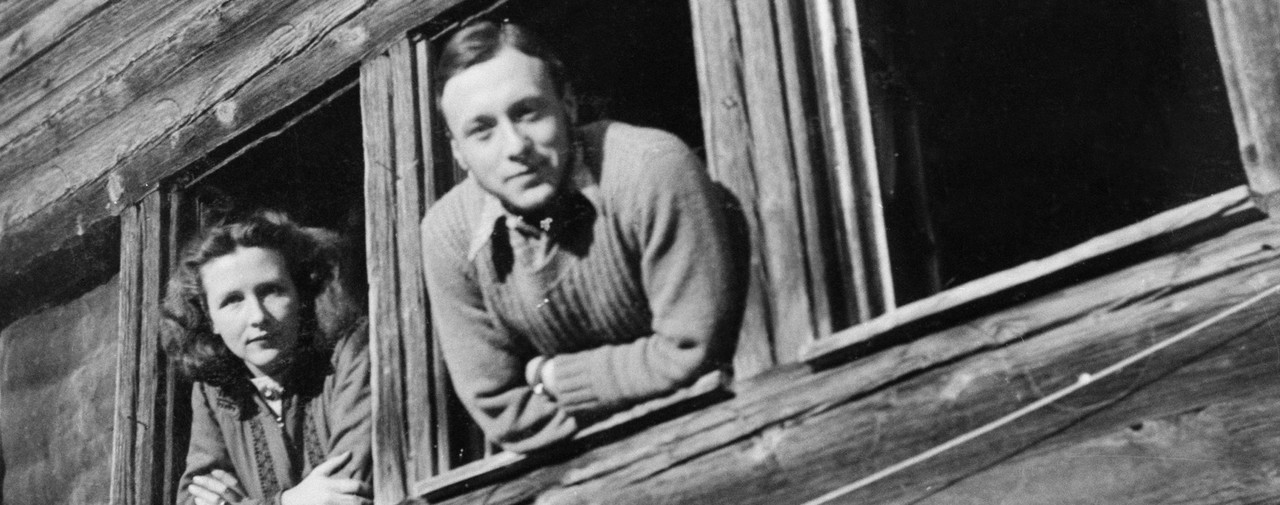
Rich and deeply engaging, these Happy days from 1942 to 1979. The correspondence between husband-and-wife writers Corinna Bille and Maurice Chappaz ends in the perfumes of Africa and the colors of Asia with the fifth chapter: «The desert... it's like the idea of eternity» (1970 to 1979).
Post-family Africa
«But the desert, Maurice, the desert... it's like the idea of eternity that you can't understand until you live it.»
This is the first lasting impression of Corinna's journey to Africa. The desert. Contemplated in the eternity of a dazzled gaze out the window. The adventuress has not yet reached the end of her surprises. She still has everything to discover about the negro continent. What's more, her reunion with her son Blaise, who has moved to Abidjan for work, is just the pretext she needs.
«I was moved to see that Blaise was sometimes homesick - I think you get that after a while. He's thinking of getting a house in Valais. Anything I can tell him about the family is of great interest to him, and I won't forget the overwhelming greed with which he pounced on the little provisions brought from Sierre and Bagnes.»
The smell of Africa.
«Here we are in the heart of a peasant civilization, the air smells of hay, the villages have exactly the same smell as Chandolin, the smell of wood burning under women's black pots on stones, the smell of thin cows, the smell of red earth. The earth is always red, the villages are red, I love them, I feel good among these round huts, these tiny round towers with thatched roofs that are the granaries.»
Its wide waters.
«We bathed in warm, reddish water because of the sand. There are crocodiles, but you never see them, they hide in the very secluded coves. These freshwater lagoons are like a dozen Lacs-des-Quatre-Cantons with countless meanders that get lost between low hills and equatorial forest.»
His earthenware sky.
«I also like the heat, the sun in the evening which is like a moon in the fog and this night which falls suddenly at seven o'clock.»
The majesty of his women.
«The women, too, are very beautiful, with an overwhelming elegance in the draperies that mold them and always fall to their feet. Sometimes one shoulder is bare: in the north, many go topless (but then it's like in Europe: beautiful and ugly). But they all have an astonishing grace: they're quite shameless at times, but also reserved and modest. I've caught some admirable glances.»
Well, his people.
«Yes, I love black people because of the cheerfulness so close to childhood, close to my own. And they're never nervous, always slow and relaxed.»
The roving Orient
«Marie-Noëlle [editor's note: daughter of Corinna and Maurice] works bravely. Blaise is in Africa too, writing to me. We're waiting for Achille to return.»
Achille accompanies his father, Maurice, on his expedition to Asia with a group of Valaisans. Corinna happily awaits their return. Alongside their travels, the letters bear witness to the family's enduring unity.
The wandering distance also gives rise to perpetual affection between the two writers.
«Dear Fifon [editor's note: Corinna's nickname for Maurice], I tell you again how much I love you when I'm proud of Achilles, how much I love you when I discover objects or landscapes, because everything new reminds me of your wondering eyes.
with my tender love
in my own way
Maurice »
As for the treasures of the Oriental stages themselves, Maurice spares no words in detailing his most poetic sensations.
«Istanbul for three days. I loved the shaking Galata Bridge and its bustle of fish and people. Beers, cafés. Hookahs. In the evening, a gentle deluge of colorful mists. Everything is golden. All is purple. The city is so noisy it knocks you out. I limited myself to the Blue Mosque and the Bazaar. What is Turkish oscillates all the time between brutality, cordiality, curiosity. All strong. Small or large, twisted, deformed. Carved, or rather roughed up, with an axe by short-sighted people. The streets: no traffic rules, cars speeding along or turning left or right (there's no such thing) like buffaloes. And the smell: a powerful breath of excrement and very sour whey.»
In Erzurum.
«Poplar avenue. Low, tiered town with fortress belt. Light asserts itself right down to the backs of white sheep.»
In Iran.
«The colors change in Iran. The mountains are receding, the plains widening. Culture« becomes rarer. It suddenly exists. We report on the vineyards. Because there's a grape harvest, and two hundred meters beyond the vines: camels grazing on a kind of thistle. But I mentioned the colors: they look like perfume stains, pink, yellow, blue. They are mountains veiled like women's faces by the dust that is the desert mist. The wind blows it.
People are changing too: browner, less indiscreet, sadder and dreamier.»
In Afghanistan.
«But I discovered one of the most beautiful sites in the world: Bamian.
An oasis in the desert.
A desert of sand hills, endless folds.
In the distance, what you might call the Alps, turning blue with tiny patches of snow.
Up close, the green, grey and pink cliffs with the niches of ten thousand Buddhist monks and two gigantic Buddhas with mutilated heads.»
A wealth of writing
This last part of the correspondence reflects the success of the couple's literary output. Maurice won both admiration and hatred with his must-read Les Maquereaux des cimes blanches (1976). Corinna won the Prix Goncourt for short stories in 1975, and was co-published by Galland and Gallimard.
«I'm glad your first impression of Little Love Stories isn't a bad one. I still wrote some on the boat, but I'm going to stop. This intense vein will now give way to other works: the longer «Baroque Tales» and the short novels «A Passion» etc. As I've been able to make a lot of progress on the boat, with my Demoiselle sauvage almost completely reupholstered, I'll soon be able to send it off to Galland.»
A bond that transcends all
«I'd also like to tell you this:
i love you
it's difficult, there's a misunderstanding on many points
or am I really creating an impossibility, a petty misery for you?
So often I wish things would turn out differently - sometimes so often I believe in a bond between you and me that transcends everything».»
Maurice ne peut être plus juste dans sa déclaration. La couple a connu bien des difficultés, des chutes et des essoufflements, mais il est là : implacable et glorieux, jusqu’au bout, en 1979, année du décès de Corinna. Transcendance au sein d’une relation atypique et sublime.
Les derniers mots épistolaires de l’un envers l’autre se donnent à savourer, dans une simplicité qui leur ressemble.
« Je t’embrasse et salue tes amis.
Fifon »
« A toi tendrement en espérant que tu te reposes bien. Et à bientôt après
Maurice »
Write to the author : loris.musumeci@leregardlibre.com
Crédit photo : © letemps.ch
Vous aimerez aussi


 French
  German
  English
Laisser un commentaire