




«Le fumoir», a nightmarish journey into the heart of the asylum

Tuesday's books - Ivan Garcia
A (forced) internment in a psychiatric ward brings a young man face to face with the darkness of the French hospital system. The smoking room is a first foray into literature for a young author who still has room for improvement, but who delivers an intriguing story about the other side of the system.
Among the multitude of books in this fall's literary season, there's the first novel by a young author whose name is not unknown: Marius Jauffret. As you may have guessed, he's the son of writer Régis Jauffret, whose works include Microfictions or even Love story. So, what is «Jauffret's son» worth? Conclusion: a first novel that takes us pleasantly into a dark universe, but with a stereotyped ending and too rapid a progression.
Alcohol, asylum and cigarettes
The book in question, entitled The smoking room, takes as its setting a Paris psychiatric asylum in which the protagonist, a certain Marius Jauffret, has been committed without his consent for eighteen days. At the start of the novel, Marius, a neurotic twenty-five-year-old who drowns his life in alcohol and drugs, spends a heavily alcoholic evening at the Place des Vosges. A memorable bender ensues, forcing his brother, Thomas, to take him to Sainte-Anne to sober up. But there, a psychiatrist diagnoses Marius as being at risk of developing Korsakoff's syndrome, a serious and dangerous neurological disorder. As a result, Marius' brother is forced to have Marius admitted to a psychiatric asylum for treatment. And so begins Marius's hellish life.
«The psychiatrist, Sun King, reminds my brother that he's not a doctor. If he lets me go, I'll be back sooner or later. And it will be worse. Korsakoff's syndrome is a hecatomb, a catastrophe, an absolute horror. He shouts that he doesn't want that on his ward ever again. He turns to me. The only thing to do to prevent my brain from turning into ratatouille is to put me under observation.»
At the heart of the asylum, Marius quickly befriends a whole cast of characters including Kiki, an overweight man who castrated his girlfriend's lover, N'Goma, a wheelchair-bound former basketball player, Nora, a bride-to-be, Virginie, a young woman who has threatened her husband, and other intriguing personalities. The only escape from this hell? One place: the smoking room. It's a place where they can get together and, for a moment, free themselves from this cursed place, thanks to cigarettes and smoke. The smoking room is an opportunity for the author to show that psychiatric asylums are not places reserved exclusively for the insane, but also for «normal» people who are poor, without family or homeless, and whom society deems deviant. And so society has them committed to keep them away from the world.
At the heart of the asylum: a never-ending nightmare
«The asylum is a BDSM dungeon with no rules. The asylum is the magnifying glass of society, a gigantic magnifying glass.»
The asylum is an integral part of French literary mythology, and even of the French imagination. From the Marquis de Sade's stagings at the Charenton hospice to the famous A History of Madness in the Classical Age by philosopher Michel Foucault, the asylum has been much talked about. It's a place that both frightens and fascinates. In his novel, Marius Jauffret describes the place as a kind of allegory for totalitarian systems, where the Supreme Leader is none other than the chief psychiatrist. In the story, it's Doctor Faucon, also nicknamed «Conf’» by his patients, who is the chief psychiatrist at the asylum where Marius is confined, and rules the establishment with an iron fist.
«I'm better now. I'm clean. Getting out will help me get my life back on track. Listen," asserts Faucon, "I'm the psychiatrist, I'm the one who decides!
- Is there no recourse?
- Yes, you can. You can write a letter to the hospital director.
A shaft of divine light pierces the darkness. But,» clarifies Faucon, raising an inquisitive finger, "I must tell you that I have veto power. I can oppose the director's decision."
Falcon, like the bird that swoops down on its prey, flies freely around the asylum. The patients« only concern is to simulate an improvement in their condition so they can (finally) escape the asylum. At first, poor Marius doesn't understand the coded language of this hospital system populated by abbreviations: »ASH« (agents de service hospitalier) or »HDT" (hospitalisation à la demande d'un tiers) are unknowns to him. But if he wants to get out, he'll have to play his wits against the medical team to secure his release. More than any other place, the asylum transforms patients, who have to forge a new personality in order to survive.
«At the asylum, we're on the lookout for a sign that will give the psychiatrist the opportunity to keep you even longer. If you think you're going to die in a minute, don't tell anyone. Go straight to your room. If it hurts, put a pillow over your face and scream silently. What else can people do when they're locked up here but spend all their free time devising schemes to end their lives?»
Jauffret, Houellebecq and the ugly real
Go figure, the novel smacks of Houellebecq. As soon as you open the book, you come face to face with the following quote: «Every year, 100,000 people are interned in France.’ Which is no mean feat, given that the author of Serotonin describes how 12,000 people in France choose to disappear every year. The smoking room is in this vein of dirty realism, even if it's nowhere near the level of a Bukowski or a Houellebecq. Not least because the novel's ending seems rather conventional.
Marius Jauffret's first novel isn't a masterpiece, but it's a fine entry into the literary world. Its treatment of the psychiatric asylum is original, and the writer's style, with its mix of crude words and psychological writing, proves a pleasant blend for describing this dark universe. Sensitive souls or neurotic people, if you don't want to have nightmares, you'd better refrain...
Write to the author: ivan.garcia@leregardlibre.com
Photo credit: © Andy Li
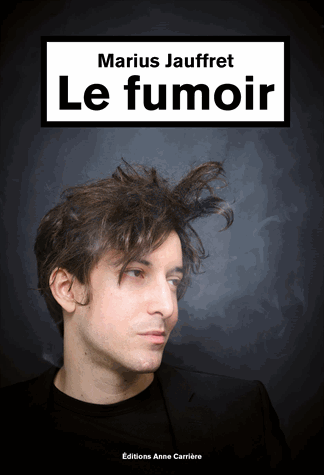
Marius Jauffret
The smoking room
Editions Anne Carrière
2020
192 pages

You'll also like






 French
  German
  English
Leave a comment