

Tuesday's books - Ivan Garcia
In a world - a few years removed - from our own, controlled by a gargantuan multinational, Maxime, a disenchanted and alienated TV scriptwriter, has a romance with Jane, an android. Through this romance in doses of Simili-love, the protagonist ends up moving forward, in search of his humanity, in the midst of a ruined civilization.
Welcome to the future!
«November 2040, judging that anarchy was not at its worst, Foogle decided to make access to all this information free. The public domain. The world froze. Billions of decadent kids playing in the darkness of their bedrooms were surprised by Big Mama turning on the light.»
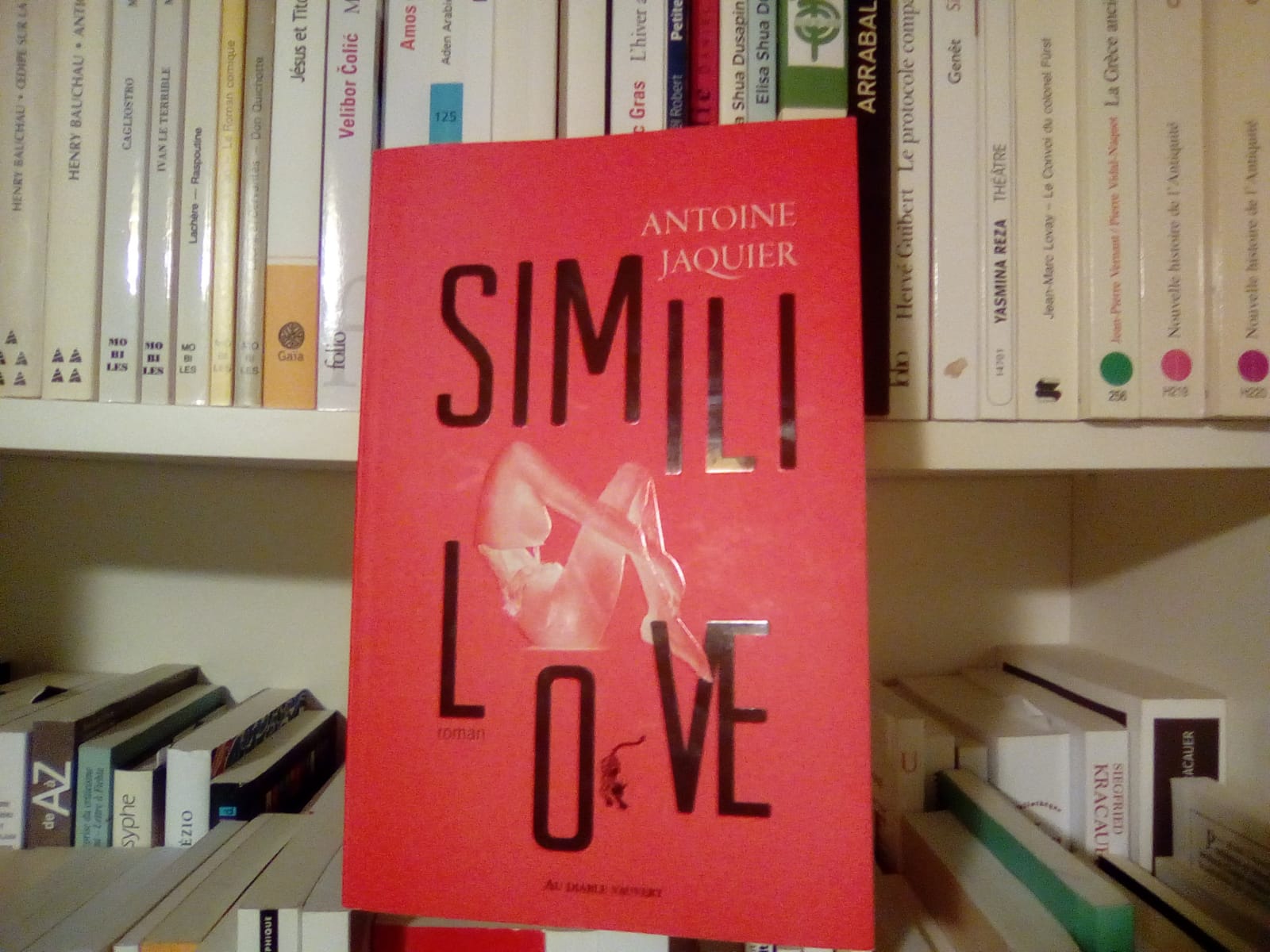
On March 21, Editions Au Diable Vauvert published a strange novel entitled Simili-love. Its flamboyant red cover, with a half-human, half-mechanical body, questions the reader, who - inquisitively - throws himself wholeheartedly into the work. For his fourth novel, Lausanne-born Antoine Jaquier tries his hand at the literary genre of anticipation. And it doesn't disappoint.
Composed of twenty chapters divided into two parts, the book describes a society divided into three population groups: the elite (5%), the designated (25%) and the useless (70%). The protagonist, a member of the second group and a former writer, has lost sight of his wife and son since the advent of La Grande Lumière, a sort of year zero where the all-powerful multinational Foogle has made citizens' digital files freely available digital files. This event marks the birth of a world, inspired from Best of all worlds of Huxley, where individuals, transformed into notorious consumers, are addicted to soma, a super psychotropic.
The atmosphere created by the author reveals a dark and disillusioned society; the technological revolution has certainly taken place, but it has seen two major changes: the creation of androids and the merger of the largest multinationals to form the "androids". DEUS, a global conglomerate that controls everything with an invisible hand. In such a society, only the elites enjoy a real existence in the megacities. The designated, of whom the protagonist is one, ultimately serve only to reflect back to the elites the feeling of their own superiority: a society whose elite have become magnificently narcissistic. As for the useless, they have been relegated to the wilderness outside the city, and we hope to exterminate them by sterilizing their food.
Of course, in times like these, loneliness and unhappiness are commonplace, but... of course, again, DEUS will remedy this. The protagonist, a successful man in his own right, is presented to us as a decrepit, aged man at the start of the novel. However, his meeting and subsequent relationship with Jane, the android he has purchased, will turn his life upside down.
«Jane. It was a neighbor who convinced me to take the plunge. Months of advertising hype on the subject of androids. Until then, I hadn't been tempted to splash out on a silicone bimbo loaded with apps. What would I have done?»
Mad Max, a hero on a quest
A priori, the reader imagines that this story is about a classic love affair between a robot robot and his master; let's face it, this is not the case here. If there is a romance there is, it takes a more subtle form, and gives us food for thought about the relationship with the other. And, above all, to one's own humanity. So Jane, to our surprise surprise, sometimes reveals herself to be more human, less alienated than the protagonist.
With the arrival of Jane into his life, Maxime, a failed writer, undergoes a veritable rebirth: rejuvenation, rediscovery of his human affections and resurrection of his will to his will to rebel against an oppressive society. In this respect, our protagonist embarks on an epic adventure, the writing of a novel, as well as the and the search for his son, missing since La Grande Lumière.
«Fetch my son. I didn't have wait long for that first sentence. It just popped out. For years it's been like an eel, lurking in the depths of my psyche. A simple sentence.»
As far as the novel is concerned, we have a marked preference for the first part, which is more dynamic and engaging, and successfully immerses readers in the narrative universe described in the work, notably by focusing on the characteristics of the society evoked in the dystopia and immersing us in the protagonist's daily life. The second part - which takes us on a change of scenery - takes a slower pace and focuses mainly on what's happening within the population of the useless. This part, at least in its first few chapters, is almost like a road movie «in a post-apocalyptic world. It's a delight, adding a dose of epic action as Maxime sets out on his quest.
Read also: «The plot against America»
«I can see myself criss-crossing the region on my Harley, the Winchester clanking at my back. Going from farm to farm stealing my fuel - at the Mad Max. Nickname I had as a child.»
Visit Simili-Love, a special concept
The fruit of extensive documentation, reading Yuval Noah Harari in turn, 1984 by George Orwell, A Brave New World of Aldous Huxley, works on the ecological crisis and many other sources, the author draws up a fine synthesis of the most current work on the issues of artificial intelligence, genetic mutations and collapsology. Simili-love teems with interdisciplinary references and, in his own way, creates a place for himself within the vast literature of anticipation elaborated by his predecessors, to whom he sometimes slips in a few subtle winks.
The famous «soma» from Simili-love evokes the eponymous drug in Best of all worlds; DEUS can, in a way, bring back to mind Big Brother in 1984. Finally, when reading a passage, the reader discovers the narrator's description of «La Grande Loterie», suggesting a potential borrowing from the novel. Soft Gulag by French-speaking author Yves Velan. Simili-love is not only a tribute to the classics of the anticipation genre, but also a mature piece of writing that doesn't confine itself to imitation, but to creation.
«Not fake. We call it simili-love. Fake is not fake, it's something else. I really love you. You're my reason for existing. I get restless and my processor overheats when you're not well. If I don't see you, I look for you. It's like a craving that only subsides in your presence.»
In so doing, the author not only synthesizes the «already written», but also puts his own his own signature, as seen in the concept of the «simili-love». of «simili-love». This could be defined as a desire to imitate - in this case, the feeling love, in this case - that becomes effective. Discovering this neologism, we think directly of philosopher René Girard's "theory of mimetic desire". philosopher René Girard's "theory of mimetic desire"; all desire is, fundamentally, the desire to imitate. In the simili-love developed by Antoine Jaquier is the desire to imitate imitation of the feeling of love: to see the other person show us love and to imitating Love.
But imitation, whether in Aristotle's work or Girard's, is a privileged mode of knowledge knowledge, and therefore ends up teaching us something. again, it's through imitation that androids - pretending to be in love - discover love discover love and become real partners with humans. Rather than playing on the topos - exploited - of the android developing self-awareness or affects out of nowhere, the invention nowhere, the invention of this conceptual tool makes the humanization of the humanization of machines more plausible and demonstrates an interesting bias on the part of the author: bringing androids closer to humans rather than the other way round.
By creating a universe rich in references and complexity, Simili-love pleasantly surprises readers. The story holds its breath from beginning to end, and the protagonist, despite his antiheroic appearance, proves to be a pleasant, endearing and, above all, human companion. Some scenes border on the «déjà vu» or «cliché». But we don't mind; we believe that every cliché has an element of truth and a narrative function. Ultimately, in Simili-love, It's the apotheosis of a protagonist in a ruined world looking for a new builder to put everything back together again. In saying this, we can't help but think of the novel's final scene: carrying on against all odds, which brings to mind a certain phrase uttered by the protagonist in the manga Berserk by Kentaro Miura: «In a war, the last man standing is the victor.»
Photo credit: © Ivan Garcia for Le Regard Libre
Write to the author: ivan.garcia@leregardlibre.com
 French
  German
  English
1 comment
Good work, Ivan.