




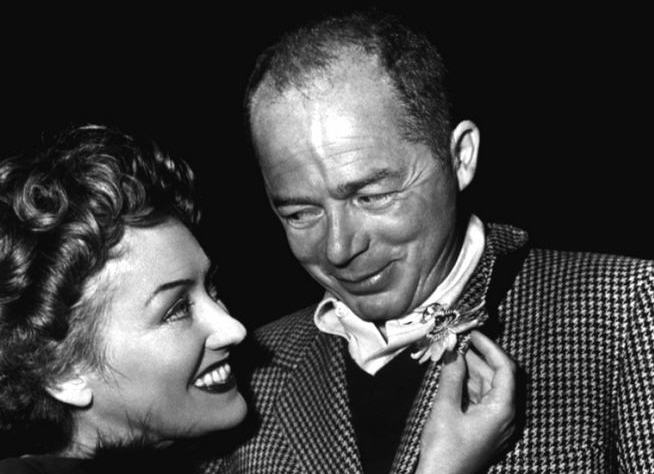
«Billy Wilder and me», when Jonathan Coe writes about the camera
Tuesday books - Lauriane Pipoz
Jonathan Coe's latest book is about cinema, nostalgia and youth. It takes us into the memories of a young Greek woman present on the tumultuous set of Fedora, Billy Wilder's penultimate film. Somewhere between a novel and a biopic, Billy Wilder and me stands out from the British author's other tales, proving that he still knows how to reinvent himself.
«My daughter was right: young people don't notice their parents» feelings, don't even realize they have them most of the time. When it comes to their parents' emotions, they're blissful sociopaths."
In his latest novel, Jonathan Coe achieves the feat of linking themes and eras through a single character. Calista Frangopoulos, a Greek woman in her fifties living in America, has two daughters. As one of them leaves the nest, she suddenly thinks back to the trip she took to America when she was young. This adventure took her to the set of a Billy Wilder film in Corfu, then to Paris. But above all, this interlude introduced her to the cinema, which was to become a real passion: she was to become a film music composer.
Read also | Jonathan Coe, heartbroken by England in the 2010s
Cinema as literary inspiration
The theme of destiny is dear to the British author's heart. But what's most striking about this story is its mastery of mixing literary genres: sometimes it's a novel, sometimes a kind of biopic. Different facets of the director of Some like it hot are presented in a non-linear fashion. They fall into place before us like a jigsaw puzzle, forming a coherent whole through the eyes and discussions drawn from the memories of Calista, an entirely fictional character.
Read also | Jonathan Coe: «It's fascinating how anything can become political in no time»
But the latter disappears in the book's strongest passage, a moment when the narrative turns into a screenplay. As we begin to glimpse the shadowy side of Billy Wilder, a part of his story - the most poignant, linked to Nazism - unfolds before our very eyes. Paradoxically, the face of the Hollywood director fades away to show us a man from an Austrian Jewish family destroyed by Nazism. Was the form of the script chosen to remind us that the filmmaker was shaped by his history and that the two are inseparable, or because literature is not so different from cinema?
Parallels and abysses
This formidably documented tale is made captivating not only by changes in tone, but also by leaps in time. Calista draws parallels between her daughter's life, her youth and the exchanges she would have had with Wilder, leading to reflections on parenthood and the passage of time. The latter is the theme of Fedora, which reflects the director's own questioning. The numerous links and mise en abyme present throughout this book paint a magnificent picture of Hollywood cinema in the mid-twentieth century, carried by the figure of an aging filmmaker who knows he has fallen from grace. Initially outraged by changing public tastes, he may eventually come to accept this inevitability.
But the book's open-ended ending shows a resigned Calista heading down a different path. The book's omnipresent nuances - almost nothing is black or white in Coe's work, but rather we discover protagonists struggling as best they can with their destinies - suggest we remember that if things change, they may not necessarily be over. Yet another philosophical insight into a rich body of work and a filmmaker just waiting to be brought to light.
«You still don't understand," he says patiently. Whether they liked it or not isn't the point. They could have been the best people in the world to judge the quality of a story, and we could have written them Madame Bovary or Moby Dick they wouldn't have cared. It didn't matter if they liked it. They took one look at Fedora, I'm thinking about all this while drinking a little of my cocktail. »But they're wrong,« I say.»
Write to the author: lauriane.pipoz@leregardlibre.com
Photo credit: © Wikimedia Commons

Jonathan Coe
Billy Wilder and me
Translated from the English by Marguerite Capelle
Editions Gallimard
2021
295 pages
You'll also like



 French
  German
  English
Leave a comment