




Humans behind the dead in Qatar
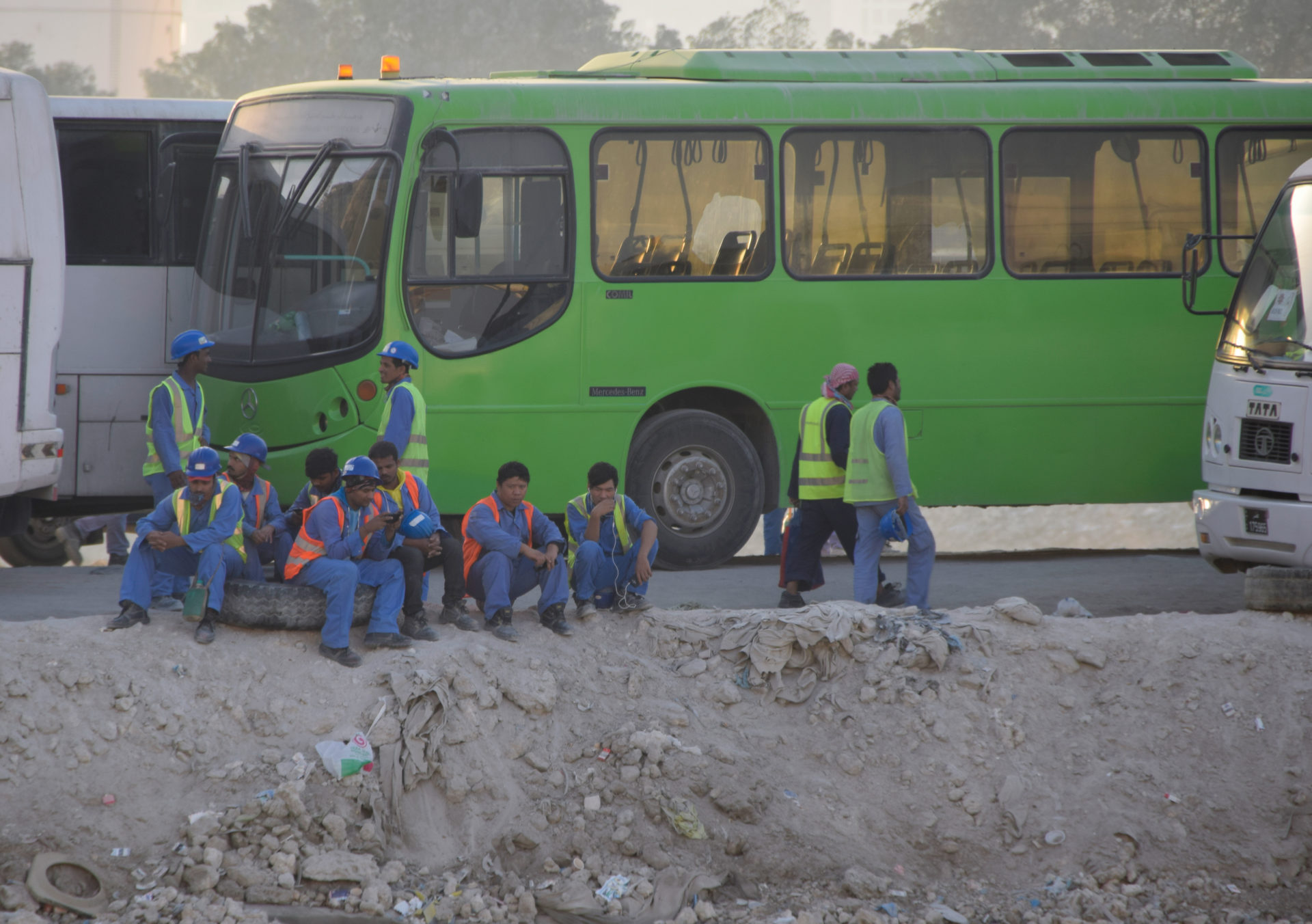
Migrant workers in Doha © Mosbatho / CC BY 4.0
With the World Cup just around the corner, the authors of the Slaves of the Oil Man reports on the scandals in Qatar. A wide range of testimonies to illustrate the reasons why many workers - male and female! - to build in the Gulf States.
First, there are the statistics. They're open to interpretation, but we're beginning to know them. Over 6,500 South Asian workers have died in Qatar in the last decade. Figures revealed by Guardian in 2021. These figures have obviously been released in connection with the organization of the soccer World Cup, which kicked off on November 20.
This book Slaves of the Oil Man proposes to analyze another figure: 10,000 Asian immigrant workers die in the Gulf States every year. For we can say what we like about the organization of this great footballing event. We can criticize it, boycott it, decide to see what's great about soccer or cheerfully counterbalance it, but there is a much more global issue at stake. Migration to the Gulf countries is the result of a system from which everyone is trying to profit: Qatar, Saudi Arabia, Kuwait and the United Arab Emirates are hoping to find sufficient manpower, while certain countries in the South, in Asia and Africa, are trying to find work to support their families back home. There are certainly winners and losers on both sides.
Who are these workers?
So there are the figures: impressive, destabilizing, open to interpretation, tools of information and disinformation. And then there are the men and women behind them. In addition to the statistics, the authors of this book offer their personal accounts. A veritable global ecosystem retraced through multiple life stories.
Authors Sébastien Castelier and Quentin Müller are two journalists specializing in the Arabian Peninsula. For this book, written partly in the form of a «major report» and partly in the form of personal accounts, the two men first offer us an account of the life of workers in Qatar. Thanks to their «fixers» (local guides of sorts, often regional journalists), they were able to visit Doha's 400,000-strong industrial zone, where workers are employed not only on stadium construction sites, but also on new roads and shopping malls.
«Qatar and the bosses use us to build the stadiums and then throw us out when our bodies don't keep up.»
Krishna Timilsina, 36, Nepalese, construction worker for the 2022 World Cup.

They describe their working conditions: passports confiscated, insalubrious housing for many of them, hellish working hours, wages often much lower than promised and sometimes simply not paid at all, and deaths. And then there are the health problems. The water offered to workers is not always of good quality. Back home, workers suffer from kidney problems. Alcohol, which was banned, was also widely consumed, with all the consequences that can be imagined, including cirrhosis and social problems.
Not forgetting the workers
But perhaps even more interesting is the account of all the other workers the two journalists met. Women play an important role in this book. They are employed as domestic servants, for example. For some of them, it's worth mentioning, their stay in the Gulf countries goes well. But for many of them, it meant imprisonment in the homes of wealthy families. They are sometimes beaten, prevented from sleeping, raped. Others end up in real human trafficking networks. Having come to take care of a household as domestic servants, they are forced into prostitution.
To follow up on these issues, the authors interviewed them back in their home countries. When they flee and manage to return home, whether to Kenya, Nepal, Madagascar or the Philippines, they don't always feel relieved: returning without money, sometimes with an illegitimate child, they are rejected. A double punishment.
How they learn not to be raped
Proof that this migration is not just the result of individual will, the authors of this report highlight the role of employment agencies, which are proliferating all over these Asian and African countries. In Kenya, for example, a sort of «maid school» has opened, specializing in migration to the Arabian Peninsula. They prepare the girls for work on the spot: from managing household appliances - often non-existent in their villages - to the rudiments of Gulf culture.
As for violence prevention, one of the people in charge of these training centers sums things up as follows: «In the case of sexual abuse, it very much depends on how the maid behaves towards the boss. If the attitudes or postures are seductive... We teach them how to dress to prevent this from happening. My recommendation is above all to follow the woman's instructions, not to interact too much with the man and above all never to accept his money...» The horrifying testimonials swell the volume of the book. Slaves of the Oil Man.
«What's happening in the Gulf is part of a politically-supervised forced labor network, against the backdrop of a state that turns a blind eye, in concert with unscrupulous recruitment agencies and companies that deceive workers into submitting to deeply abusive labor practices.»
Nicholas McGeehan, co-director of fairesquare, a human rights NGO.
Building a home in Qatar
The two journalists also interviewed researchers and NGO leaders, as well as wealthy businessmen and young people who were able to realize their dreams by emigrating. Examples given: two Filipinos, a brother and a sister, who were able to become dancers in Qatar. A hard but satisfying life, they claim. Many others recount how they were able to buy a house in their own country, offering their children a future or education. Some entire villages in India or Sudan would simply not exist without the Gulf countries, the two authors note.
Read also | Journey to Liberland (published by the same publisher)
While there's little in the way of «big story» in this book, despite Marchialy's narrative-based editorial line, it does offer a glimpse of the global consequences of economic activities rightly criticized in the Gulf peninsula. And while everyone has their own opinion on the Qatar World Cup, the biggest scandal is yet to come: when the international soccer teams return home, Qatar will no longer be accountable to public opinion. And it will be forgotten.
Write to the author: diana-alice.ramsauer@leregardlibre.com
Photo credit: © Diana-Alice Ramsauer for Le Regard Libre
You've just read an open-access article. Debates, analysis, cultural news: subscribe to support us and get access to all our content!
Cover illustration:
Foreign workers wait on a construction site after their shift at The Pearl (Doha, Qatar) in 2018. Buses in the background are used to take workers home. Mosbatho / CC BY 4.0

Quentin Müller and Sébastien Castelier
The slaves of the oil man
Marchialy
2022
400 pages
You'll also like




 French
  German
  English
Leave a comment