



«Soccer Factory», an X-ray of hooliganism

ADN-Pätzold / April 14, 1990 / Schwerin: Leipzig fans "warmed up" in their own way before the FDGB Cup match between 1. FC Lok Leipzig and Dynamo Schwerin. The wave of violence on soccer fields and after games appears to be getting worse.
Tuesday's books - Ivan Garcia
With Soccer Factory, English novelist John King explores the daily life of a gang of hooligans. A much-appreciated soccer outing that explores the hidden sides of British society.
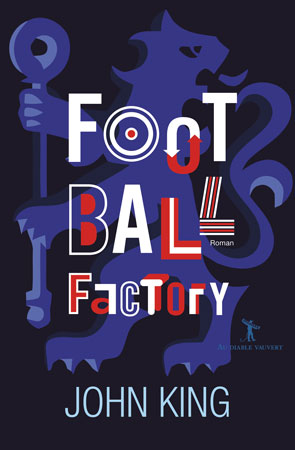
At Au Diable Vauvert, an independent publishing house, we take great care with the cover, which is always very lively and flashy to attract customers. The author of these lines admits it, he's a good audience and curious. So when he received a book with the Stamford Bridge lion, FC Chelsea's emblem, on the cover, he raised his eyebrows. What is this strange UFO? Soccer Factory, is the title of this book. The author? A certain John King. Unknown to the editor until now. A book to be read with interest or, at the very least, with a healthy dose of curiosity about the social phenomenon of hooliganism - somewhat overshadowed these days by the «yellow vests» and the black blocs. We're off to England to talk about fights, beer, sex and a lifestyle that's the antithesis of «Peace and Love».
Pints and soccer
Tom Johnson - his full name doesn't come up until fairly late in the story - is a warehouse worker who breaks his back every week to earn his keep. But that's fine by him, because on weekends and other match days, Tom swaps his quiet clerical clothes for Chelsea emblems. To release the bad energy accumulated at work, the humiliations and their rage for life, Tom and his band of pals drink pints in the pub, attend the match, pick up chicks and hit the streets to castrate the "bad guys". supporters of the opposing team.
Read also | London pubs and the ball of losers
Tom's gang includes Rod, a childhood friend and married hooligan who often cheats on his wife Mandy. There's also «Black Paul», a «Chelsea Negro» who works on the building sites - well received in this milieu. a priori racist - and hard-hitting; Mark, Tom's childhood friend who's a bit of a dick; Harris, a hooligan who plays bus driver to take Chelsea fans to a match in Newcastle... As the story unfolds, the reader follows their adventures and disappointments. We witness a dinner in an Indian restaurant where the team tries to pick up a group of girls, Tom's arrest and time in police custody, an epic fight in the streets of Millwall - after which Tom ends up in hospital...
You meet a guy for a game, and you only know him from a certain angle. Then they blend into everyday life. They don't go around with a sign around their neck, telling everyone that they're hooligans, or whatever. They've got their jobs, their love affairs, even if that doesn't mean they're saints. Soccer is just a meeting point, a way of channelling things. If soccer didn't exist, we'd find something else.
Parallel to the story of Tom and his gang, the narrative follows other secondary characters to depict the little people of contemporary English society, such as Doreen, a pious woman who works in a Laundromat, or Vince Matthews, a supporter of the England team who makes a trip to Spain to support his team, or Mr. Farrell, a World War II veteran who lost his wife and believes she's still alive... All these characters are subtly connected to each other. We discover that Doreen is the mother of Steve, Mark's crazy cousin, that Mr. Farrell is the grandfather of Vince Matthews and so on.
A corrosive portrait of England
Tom's account is written in the first person, so things are described from his point of view. A man who has found in violence and soccer an antidote to (over)living in a rotten society. Skeptical and cynical about English society, Tom hates politics and the media. Indeed, most of his hooligan actions have to be precisely orchestrated to avoid cameras and cops. Chapters about Tom and his gang are often titled according to the clubs Chelsea will be playing against («Coventry, at home», «West Ham», «At Millwall»...). On the other hand, chapters recounting the lives of other characters are titled with a certain irony, such as the chapter on Doreen, which is entitled «Sweet Jesus», or the one recounting Vince's Hispanic journey, which is entitled «The Running of the Bulls».
I guess the older you get, the more cynical and disillusioned you become. England has changed a lot since I was a kid. [...] because, when I was a kid, there were always a few fights and things like that, and there were regular fights in the stadiums themselves, whereas now that everything is repressed and more and more people are glued to their TVs and video games, the only thing to do is to have money and do what's being done. To look good. At least, that's what they want us to believe.
Sometimes you wonder whether the writer isn't overdoing it, whether he isn't being vulgarly gratuitous, as when he describes the scene where the gang dine at the Indian restaurant, or when he delivers political and societal analyses - from the point of view of «real» workers and hooligans alike. A case in point is the meeting between Billy Bright (a.k.a. «Number 46»), an unemployed neo-Nazi, and Michelle Watson, a «radical socialist raised in deepest Hampshire, but now living - and living well - in London» who despises him and would like to liberate black people from white oppression and thus help «overthrow the barriers of white capitalism and racist oppression».
Read also | Jonathan Coe: «It's fascinating how anything can become political in no time»
The writer reveals a fractured English society with little regard for the people who really contribute to the country's greatness. In the background, we always find the question of war, with various characters recounting anecdotes about a friend or relative who took part in such and such a conflict. Characters such as Michelle Watson or Chrissie, a wealthy bourgeoise who Tom flirts with, are rare and presented as a world apart, disconnected from the reality of working people, and even as people who despise the little people. The subject of the novel, then, is the forgotten. And the outsiders English prosperity, in short.
The woman had all the makings of a Trotskyite, with her glasses and pale complexion, her long, unkempt hair and nicotine-stained fingers; the kind of cellar-dweller who landed on her territory to do what they called positive discrimination, for the benefit of every conceivable minority. These people talked about workers without having the slightest idea of what it was like to be a worker. Well, maybe he was wrong, but he didn't think so.
To the joy of fighting
The great success of the novel is the meticulous description of the battle scenes between hooligans. The chase between the two gangs (Chelsea and Millwall) culminates in a major confrontation in a playground. The chase keeps the reader on the edge of his seat. Soccer Factory was published - in its original version - in 1996, before arriving in France in 1998, then in 2004 by Editions de L'Olivier, and being reissued in 2020 by Au Diable Vauvert. Suffice it to say that the realities described in this novel are magnificently topical.
Reading Soccer Factory[1] evokes the film - now a classic Green Street Hooligans. There's no getting bored following the adventures of Tom and his gang, and it's the perfect opportunity to discover the everyday life of the English working classes, as well as the curiosity, even fascination, of the hooligan milieu and violence at a time in history when everything is ultra-secure and no great adventure is allowed...
The three of us have chosen our path, we have money in our pockets. We've got good mates, a close-knit family, and we don't end up like bums when we want a chick. We have a good time. We must be like niggers, in a way. White niggers. White trash. White trash. We're a minority, because we're tight. Few in number. Faithful, loyal. Soccer gives us something extra.
[1] In 2004, the novel was adapted for the screen by director Nick Love, retaining the story's original title. Soccer Factory.
Write to the author: ivan.garcia@leregardlibre.com
Photo credit: © Wolfried Paetzold / Wikimedia CC 3.0
John King
Soccer Factory
Translation by Alain Defossé
Au Diable Vauvert
2020
528 pages

You'll also like





 French
  German
  English
Leave a comment