



«Goldfish and the bitch of life

Les bouquins du mardi - The retrospective - Diana-Alice Ramsauer
The story of Goldfish begins like a fairy tale. But it's not a fairy tale at all. For Laïla's life is the story of a child torn from her family and constantly on the run, thirsting for freedom to slip through the net of human violence and oppression. It's hard to call this a masterpiece by 2008 Nobel Prize winner J.M.G. Le Clézio, but the work, imbued with postcolonial reflections, is not devoid of subtlety.
«Ever since I was a child, people [have] never stopped catching me in their nets. They [entangle] me. They [set] traps for me with their feelings, their weaknesses.’
The novel Goldfish could be summed up in this sentence. Starting out as a young girl, Laïla is taken from her parents and sold to an elderly woman to look after her household. Treated with relative respect, bordering on moral slavery, Laïla is certainly not free. But the road becomes even more complicated when the old woman dies. Wrongly accused and the victim of an attempted rape, the little girl, deaf in one ear, flees to a brothel, not really knowing that this is a brothel, out of youthful naiveté. There, she meets «princesses», one of whom is Houriya.
We are in Morocco, probably at the end of the twentieth century. But Le Clézio's tale is not set in a particular era. It's even temporally blurred, as if it didn't matter. Nor does the exact location. The story told is one of cold, harsh human nature.
So, accompanied by her princess Houriya, Laïla sets off for France, with no clear goal other than Paris. She's always on the run: from lack of deference, precariousness, boredom, sadness, illness, blackmail and, above all, from the hands of men. Hands that know where they're going.
Like a caged animal
But in France, history repeats itself. It may be different, but it's always the same: the exploitation of a child who has become a teenager and then a young adult. An exploitation that often resembles bourgeois charity: offering a roof over one's head to ease one's conscience; taking in a newborn child from a poor family, and turning a blind eye to the misery of her environment; taking advantage of exoticism for political reasons, but ducking when adversity comes. Helping while dispossessing. Like a dog picked up at the SPA, but always on a leash.
«My brain was boiling. At the same time, I could see Simone's face, her big Egyptian cow eyes, expressing deep distress, and all of a sudden I understood why she had said that we were similar, that we both no longer had our bodies, because we had never wanted anything and it was always others who had decided our fate.»
The hypocrisy of the wealthy social classes is portrayed by a whole succession of characters: doctors, journalists, artists, professors, all of whom confine Laïla in spite of herself; in spite of themselves. And there, always, like an unhealthy rhythm: the hands of men (and women) who allow themselves imperialist inroads.
Oppressed brothers and sisters
The impunity of violence. It's a theme that's constantly in the background. Sometimes in a political way. First with the book The damned of the earth by Frantz Fanon, the famous thinker from Martinique who was involved in decolonization. A book that Laïla discovered through a friend, Hakim, and which followed her long after her arrival in France. But the theme is also dealt with simply in the depiction of a solidarity between «oppressed brothers and sisters» that is nurtured throughout the story. An altruistic impulse that develops and yet disintegrates as each person flees, leaving Laïla emotionally and socially precarious.
So no, the novel doesn't end badly. In close proximity to addicts, or sometimes perverts, Laïla flees. Perhaps until she finds herself. Herself. The story doesn't really tell us.
Write to the author: diana-alice.ramsauer@leregardlibre.com
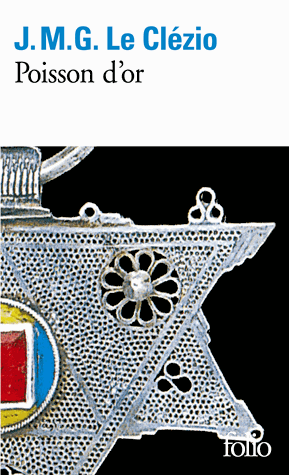
Jean-Marie-Gustave le Clézio
Goldfish
Editions Gallimard
1999
298 pages
You'll also like





 French
  German
  English
Leave a comment