






Les Trois Accords: «It's not about making people laugh, it's about originality».»
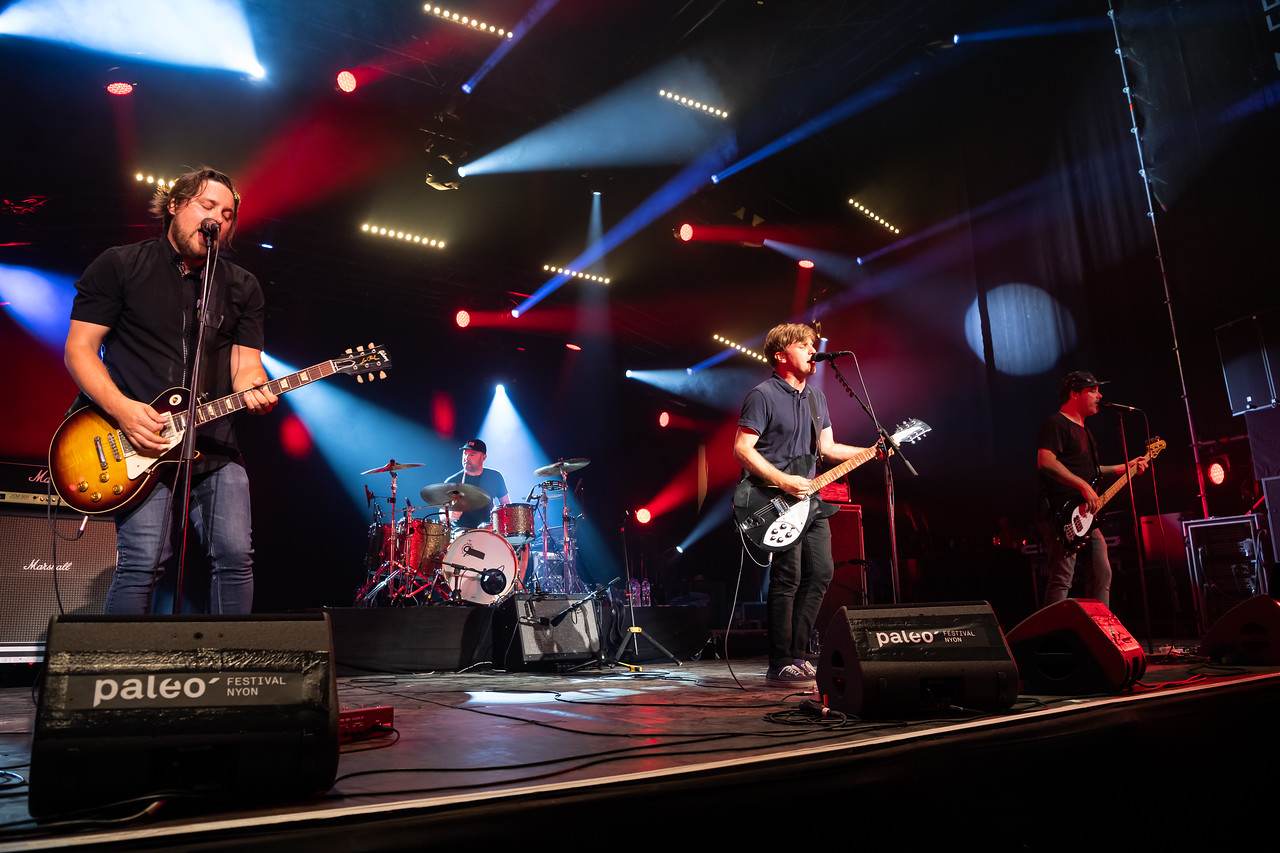
Paleo Festival 2019 - Lauriane Pipoz
Les Trois Accords is an extraordinary Quebec group. Made up of four musicians, this lyrically delirious rock band has a knack for not only releasing albums, but also shows, that breathe fun and good humor. Before their concert at the Paléo Festival in Nyon, two of their musicians, Charles Dubreuil and Pierre-Luc Boisvert, answered a few questions about their original compositions and musical choices.
This meeting was an opportunity for them to tell us about their desire to honor humor and self-mockery, but also to underline the fact that their compositions were not made «just» to make people laugh. It's all about making music, music they like - rock music - and music that sounds like them, since their primary aim is to have fun. As their latest album expresses, A lot of fun (2018), and above all, as their live show on July 25 clearly showed: jumping around and having fun, the band has lost none of its early superbness. Meet musicians who love to show, tour and are proud of what they do.
Le Regard LibreDo you think the Paléo audience will understand all your lyrics?
Charles Dubreuil: We've never had an accent problem when we've toured Europe, but sometimes a vocabulary problem: there are regional peculiarities, in terms of words or turns of phrase. But audiences rarely discover us in concert.
Read also | Paléo: The Quebec lexicon for «paying the piper» at the Village du Monde
Why the musical choice of rock with humorous songs? Does it go well together?
C.D.: We've always wanted to do rock'n'roll. I don't know if we're humorous. Of course, there are songs that make you laugh, that make you smile, but we don't want to make people laugh the way a comedian would, for example. The mechanics aren't the same: a comedian writes with the aim of making people laugh, whereas we write and make music from an angle. We're more of a rock'n'roll band, singing songs in French: we fit that description. But not just as a rock'n'roll band, but as a French-speaking rock'n'roll band. Simon is perfectly capable of writing in English - he's already proved that on several occasions - but we're more at home in French. It has nothing to do with a political choice, it's just cultural.
Pierre-Luc Boisvert: But if we ever write in another language, that doesn't mean we're at war. (Laughter)
C.D.: That's right, it's just the best strategic choice for us, our best market.
Is rock really strategic right now?
C.D.: Since the Three Agreements work, yes! (Laughter) I think there's room for everyone. I don't mind seeing different styles on the same night, and I don't mind seeing different styles on the same stage. They're simply different languages.
How do you choose the angle of your songs? Is it just one person who composes?
P.-L.B.: Yes, it's Simon, singer-songwriter. He's our lyricist, he does 100% of the songs! As for us, the four of us come up with the music together. Sometimes he has the idea for the melody, but the official form of the songs as you listen to them, that's what we do afterwards.
And he also wrote Open your eyes Simon?
C.D.: So for this song, we were in the studio in Quebec, and Pierre-Luc and Alexandre (editor's note: the fourth member of the group) started singing a chorus criticizing him on his own staging of the show. And he had a flash from there: that's how we conceive most of our songs. So the song was written from that angle - because it is an angle - which we thought was pretty cool: that of a band criticizing itself while something's going on. At live, This idea really comes into its own: the two guys singing, Simon receiving the criticism and explaining his position on it. That's the kind of flash Simon looks for when he starts writing each of his songs: the aim isn't just to make people laugh, we're looking for things that are original.
And for song lyrics like I love your grandmother?
For this one, too, it's really a flash: it was the initial flash, and a good one, since it then became the theme of the whole album. We deconstructed it into a story: a young boy meets his friend's grandmother. We then discover with him all the problems this creates.
On each album, you have a different angle: is it something that comes naturally or do you discuss it beforehand?
C.D.: The angles started with «Grand Champion».» (editor's note: their second album) which was written about obsessions: it's about someone extremely motivated in all spheres of life, a great champion. It was even clearer with In my body, where even the cover was in line with the idea, and every song was about the body. Now, with I love your grandmother and even more with The joy of being gay, We just wanted to go somewhere else: we made music and enjoyed ourselves. That's what came out of A lot of funThat's what we kept thinking about all through our days in the studio. In the end, we realized that this was really the concept of our album: all the songs revolve around this general idea.
Have you always accepted Simon's ideas easily, or was it difficult at first?
P.-L.B.: Ah, sometimes I need a little more explanation! (Laughter) Sometimes he'll explain a text to me and I'll say, «OK, but can you correct a few sentences?» Because if I don't understand it, it can happen that other guys don't understand it either. really not. It's no good if people don't understand the songs: some things can of course remain mysterious, but the main message has to be clear enough.
C.D.: It's a duty of clarity that we're now reminding Simon of. It was less necessary in the first two albums. With more specific themes, it's sometimes interesting to go back to the drawing board to clarify certain points. In general, it's pretty easy to do. Only once did we feel the need to censor ourselves: it was a song about homosexuality. We didn't want to put it on the album; not because we didn't want to deal with the theme, but rather because we didn't want the message to be hijacked, for example in schoolyards. When we released a full album on the subject, we felt we were ready to really tackle it. For us, it was really done with respect: we felt that in this form, people would appropriate it in a different way.
In the Francophone tradition, there are times when there are serious songs and times when the songs are rather funny. Do you feel there's been a revival?
C.D.: Even if we're not music historians, yes, there are phases. Moments when music is lighter, when serious music will come across as almost snobbish. It's really cycles of coolnesswhat is cool changes over time.
Interview conducted in collaboration with Jonas Follonier.
Write to the author: lauriane.pipoz@leregardlibre.com
Photo credits: © Paléo / Lionel Flusin
-
 Standard subscription (Switzerland)CHF100.00 / year
 -
Support subscriptionCHF200.00 / year

Vous aimerez aussi



 French
  German
  English
Laisser un commentaire