
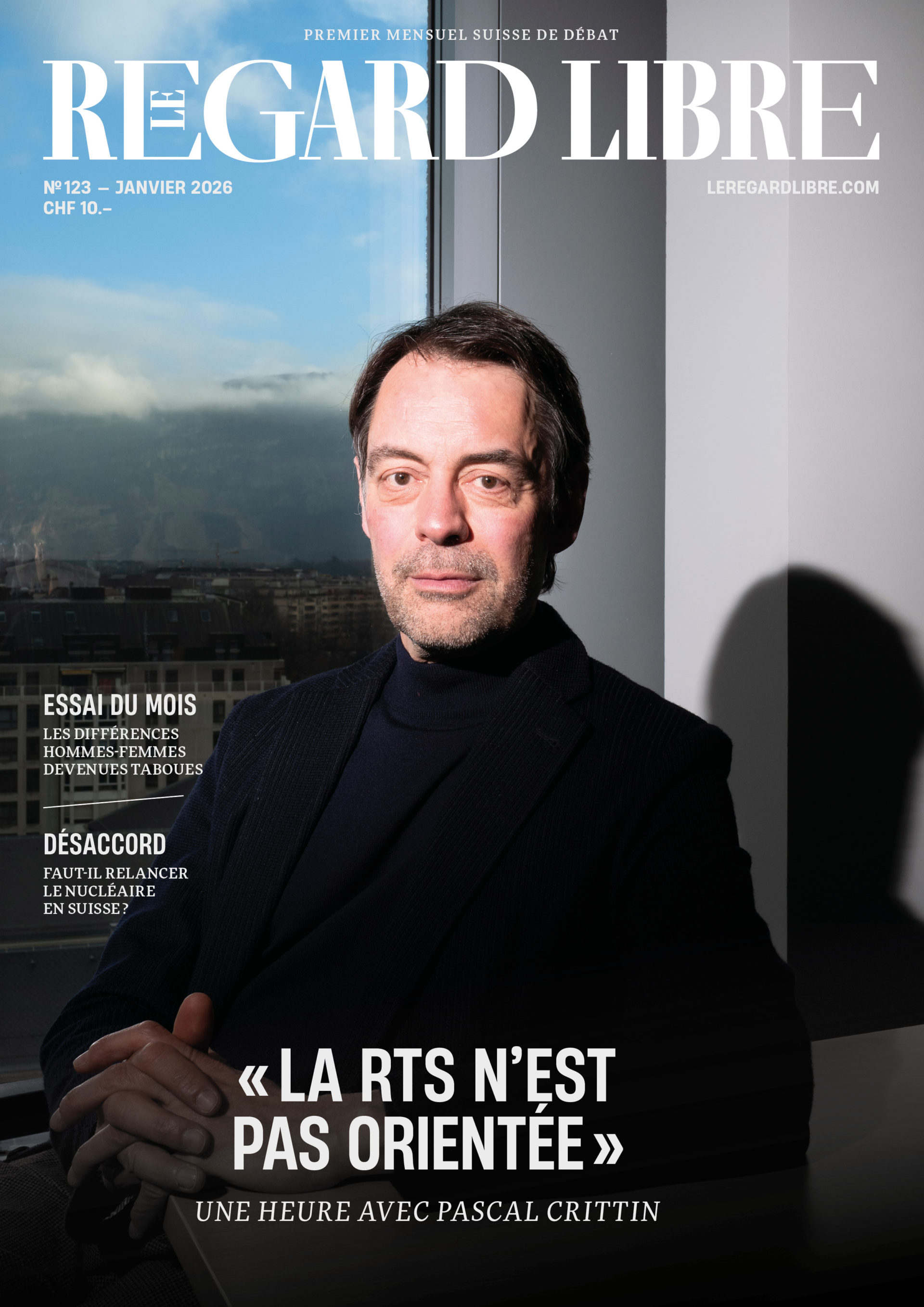

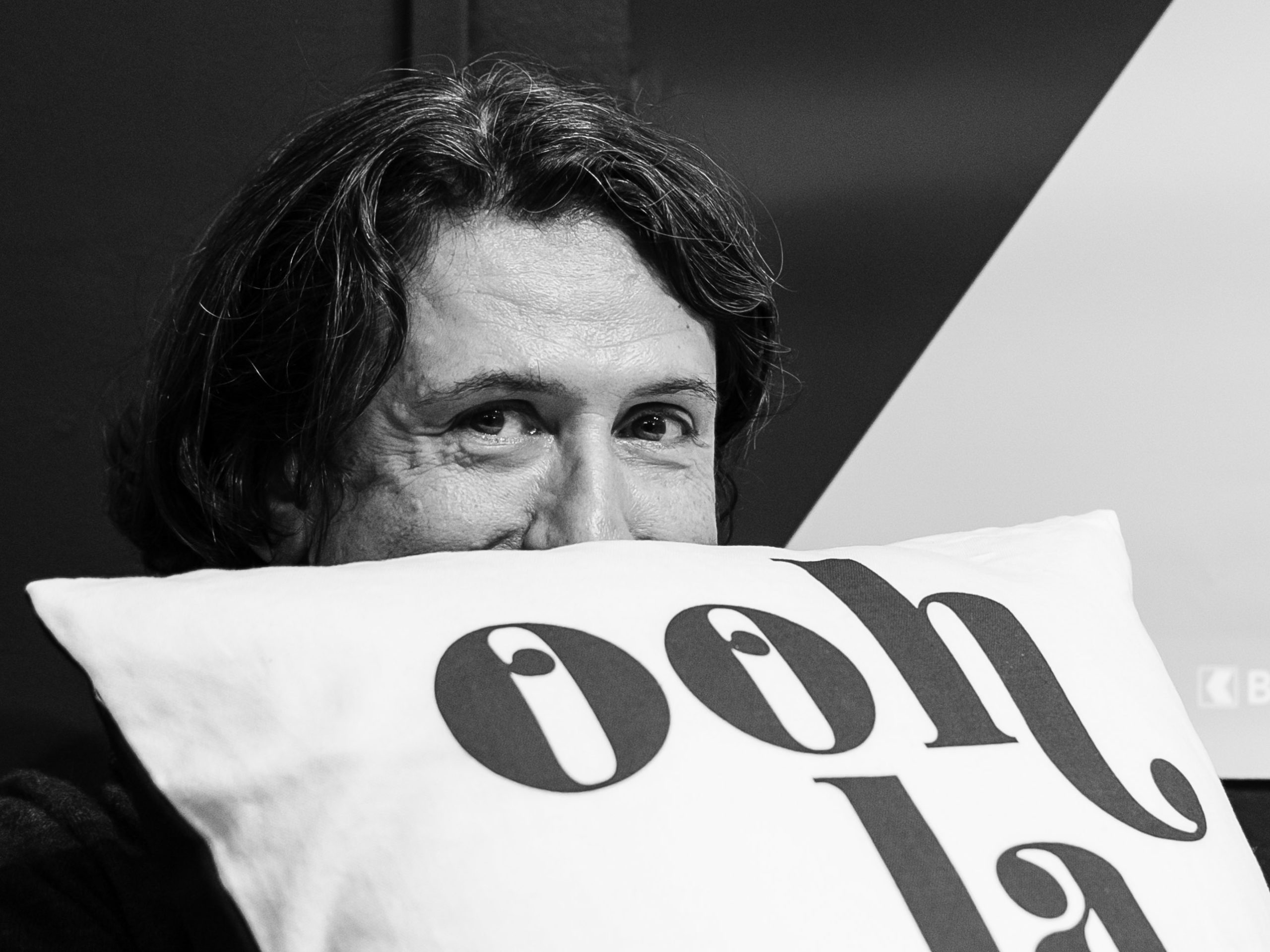
Le Regard Libre N° 57 - Ivan Garcia
series «The adventures of the stage», episode #4
From ancient tragedy to alexandrine declamation, characteristic of classical theater, via the text-based theater of the 19th centuryth From the beginning of the 20th century to the advent of contemporary staging and performance, the dramatic genre has undergone many (counter-)revolutions and evolutions. Each episode of «Les aventures de la scène» focuses on a particular company or artist, whether playwright, scriptwriter, director, dancer or other, or on theorists of the performing arts who have all, in one way or another, helped to shape theater as we understand it today, as a specific way for people to tell stories.
The theatrical scene in French-speaking Switzerland boasts a wide variety of personalities. These include artists who, in the course of their careers, wear many hats: actor, choreographer, director, theater manager and playwright, to name but a few. Sometimes, more rarely, an artist is equally at ease with art and with the more pragmatic and committed aspects of his or her profession, such as union action. For this fourth episode, Le Regard Libre has therefore chosen to present an interview with a well-known figure in the performing arts scene in French-speaking Switzerland: Georges Grbic.
Born in Belgrade in 1964, of Serbian-Bosnian-German origin, Georges Grbic became a naturalized Swiss citizen in Fribourg. At the age of twenty-three, he graduated from the Conservatoire d'art dramatique de Lausanne, and went on to work in theatre and film. In 1990, together with Simone Audemars and Hélène Firla, he was a founding member of the Brechtian-inspired l'Organon theater company; their first show, The death of Pythia by Friedrich Dürrenmatt, is performed at the Hermes-Precisa typewriter factory in Yverdon-les-Bains. Founder of the Cie Champs d'actions, since 2011 he has devoted himself to the art of directing, with original creations such as The Three Little Pigs (2015) based on a text by Noëlle Revaz, Perplexed (2016) by German playwright Marius Von Mayenburg, On target (2017) by Thomas Bernhard and The Two Brothers (2019), a new cultural mediation show for classes in and around Yverdon, based on a text by Mali Van Valenberg. In addition to his work as an actor, director and company co-director, Georges Grbic was appointed director of the Théâtre Benno Besson d'Yverdon-les-Bains in 2017, following in the footsteps of his predecessor Thierry Luisier, which brought him face-to-face with the task of developing programming and creating numerous dynamics between the artistic, political and civic spheres. Now a member of the board of directors of the Fédération romande des arts de la scène (FRAS), Georges Grbic is an active, serene and enthusiastic figure, who welcomed us into his office to talk about his career, his plans as director of TBB, and his thoughts on the theatrical scene in French-speaking Switzerland. Meeting at the theater.
Le Regard LibreYou come from a background unfamiliar to the theater; your father was a doctor. At the age of twenty-three, you graduated as an actor from the Conservatoire d'art dramatique de Lausanne. You did a lot of acting, and later became a stage director and theater manager. What were your reasons for going into the theater?
Georges Grbic: First of all, I'd like to point out that I came to Switzerland with my father when I was three years old. My mother and sister - the latter of whom came to Switzerland for a while but then left - stayed in Belgrade. It was when I arrived in Lausanne that I turned to the theater. When I was in Fribourg, I was more attracted to the fine arts than to the theater, even though a performance at Collège Saint-Michel introduced me to the world of backstage and secrecy. That all changed when I started taking optional drama classes at Lausanne's Gymnase de la Cité. There, a teacher introduced me to theater. He also taught at the Conservatoire. His introduction enthralled me. I discovered a world totally opposed to the idea I had of a solitary workshop. It was about sharing a collective thought and, strangely enough, this experience gave me the opportunity to express myself. As a child, I'd had a lot of problems with stuttering, and thanks to these workshops, I was now able to express myself and declaim texts. It was quite an incredible moment! Being able to express myself also contained an element of fun. I wanted to make other people laugh. In a way, it was a pleasure I'd never experienced before. In short, the theater was the place that offered me all these things: expression, a relationship with others and, finally, a relationship with literature, which was a great joy for me.
How do you see the role of director in an institution such as the Théâtre Benno Besson, which is municipal?
When I arrived in the theatrical world, I quickly became interested in the structural issues of the profession and became very involved in the subject.
This is reflected, among other things, in your position as President of the Syndicat suisse romand du spectacle, which you held from 2004 to 2007, and your current position as a member of the Board of Directors of FRAS (the Fédération romande des arts de la scène).
That's right. I have to say that I've always tried to keep a watchful and attentive eye on the profession. I had the impression that Switzerland had a lot of wonderful talent, but of course the French-speaking culture was still predominant in the creative process. I must also say that I experienced an extremely powerful moment in the Lausanne theater scene, when the city decided to place its theater on a European level. In the same vein, at the time, Lausanne wanted to host the Olympic Games, around 1988 or 1992. This desire to create a theatrical space of European stature was evident in the invitations extended to great names such as Maurice Béjart and Matthias Langhoff. This was also visible in the artistic milieu; on leaving the Conservatoire, I myself was soon performing on major stages such as Théâtre de Vidy-Lausanne, Théâtre Poche de Genève, Comédie de Genève, and others. I was soon involved in numerous productions and creations with local actors. However, this dynamic came to an abrupt end and many things came to a halt... At that point, we were left with the few companies that existed. At that time, in the eighties, there were only about forty companies active in French-speaking Switzerland.
Surprising. Currently, the number of companies has exploded. How many are there? Two hundred? Three hundred?
Yes, the increase is mind-boggling! In terms of registered employers in French-speaking Switzerland, the figure currently stands at six hundred, and we have twelve creative theaters. So we have to demand and support Swiss and local creation, and find ways of expressing ourselves to achieve it, even if we're sometimes not on the same level as some European artists. In saying this, I'm not saying that we should «close the borders» and prevent European artists from performing on Swiss stages. On the contrary, the Théâtre de Vidy-Lausanne and the Comédie de Genève, formerly run by Benno Besson, have brought major international shows to our stages, bringing extraordinary artistic added value and challenging our codes. At the same time, we had to make room for our own creations, so as to be able to confront international productions. Numerous structures were then put in place, notably within the dance industry, which was quick to react. It's worth noting that the acting profession was not recognized as a salaried status until 1982, when the first collective labor agreement was signed. Prior to that, actors were not entitled to unemployment benefits or compensation. All these factors prompted me to become involved in demanding rights for our workers, as well as defending this profession, which requires specific skills. In my view, it's essential to maintain a pool of local actors, even if they don't have direct employment. As an actor and director, I've never been afraid of structural issues, and I've been very involved in these union structures. Finally, organizing and running a theater, as well as trying to create a place where artists can express themselves and be showcased, are things that follow this logic. I figure there's just as much to be done here by opening up the stage to certain artists as there is by holding union meetings with other people in Switzerland.
The Théâtre Benno Besson used to have the reputation of being a «host» theater, more interested in hosting companies, often from abroad. However, since your arrival at the Théâtre Benno Besson, like most of your colleagues in the French-speaking part of Switzerland, you have been devoting yourself to creating shows. Do you intend to turn this venue into a kind of platform for contemporary creation?
The Théâtre Benno Besson must become a place for theater (Laughter). TBB has a long history. It's quite funny to see the association that was quickly made between our theater and the Kokodyniack company. Kokodyniack is a documentary theater company founded by Jean-Baptiste Roybon and Véronique Doleyres. Their show, Faces, is a collection of words recounted by personalities with special professions in the Nord-Vaudois region. Next year, they will present the show My Little Country which tells the story of their neighbor living in the region. These two artists had actually settled in the Yverdon area, and we quickly decided to work on a project together. I then saw the reportage work they had done on the various people who now make up the Yverdonn area. Faces, as well as their neighbors and other personalities. That's how our collaboration began, with the project for this show Faces which will be presented on the occasion of TBB's 125th anniversary in 2023. After that, the two artists will carry out a similar project in the villages and, finally, a final show which is still in the planning stage. This fruitful and intense collaboration, as well as the various shows produced, should position our theater in this region and in this country.
Finally, where does the Théâtre Benno Besson fit into all this?
As director, my aim is to encourage strong creativity within our institution. You also have to bear in mind that history changes. At one time, it was clear that TBB was a municipal theater that referred a lot to media artists and tried to give an overview of what the stages could show. At the same time, this theater was open to a wide range of different forms and genres, such as dance and music, which tended to be found at international level. In recent years, however, we've seen Swiss creation find its feet at the Festival d'Avignon, for example. We are also witnessing a kind of artistic cross-fertilization taking place within our universities, such as Les Teintureries and La Manufacture. A fair number of students come from abroad and settle here, bringing with them an absolutely formidable mix of cultures and artistic practices. There are therefore extremely strong creative possibilities, as well as very high quality, in our latitudes. Located in the second-largest city in the canton of Vaud, the Théâtre Benno Besson must play a role and participate in this creative emulation in this ultra-connected world. That's why, in my opinion, we mustn't give spectators the feeling that they've come to see extraordinary shows: they need to feel that this theater is part of something that's local, not necessarily something to do with the region itself, but with Romandie. When they come to the theater, they have to feel part of this movement and encourage these creative forces.
Write to the author: ivan.garcia@leregardlibre.com
Photo credit: © Indra Crittin pour le Regard Libre
 French
  German
  English