
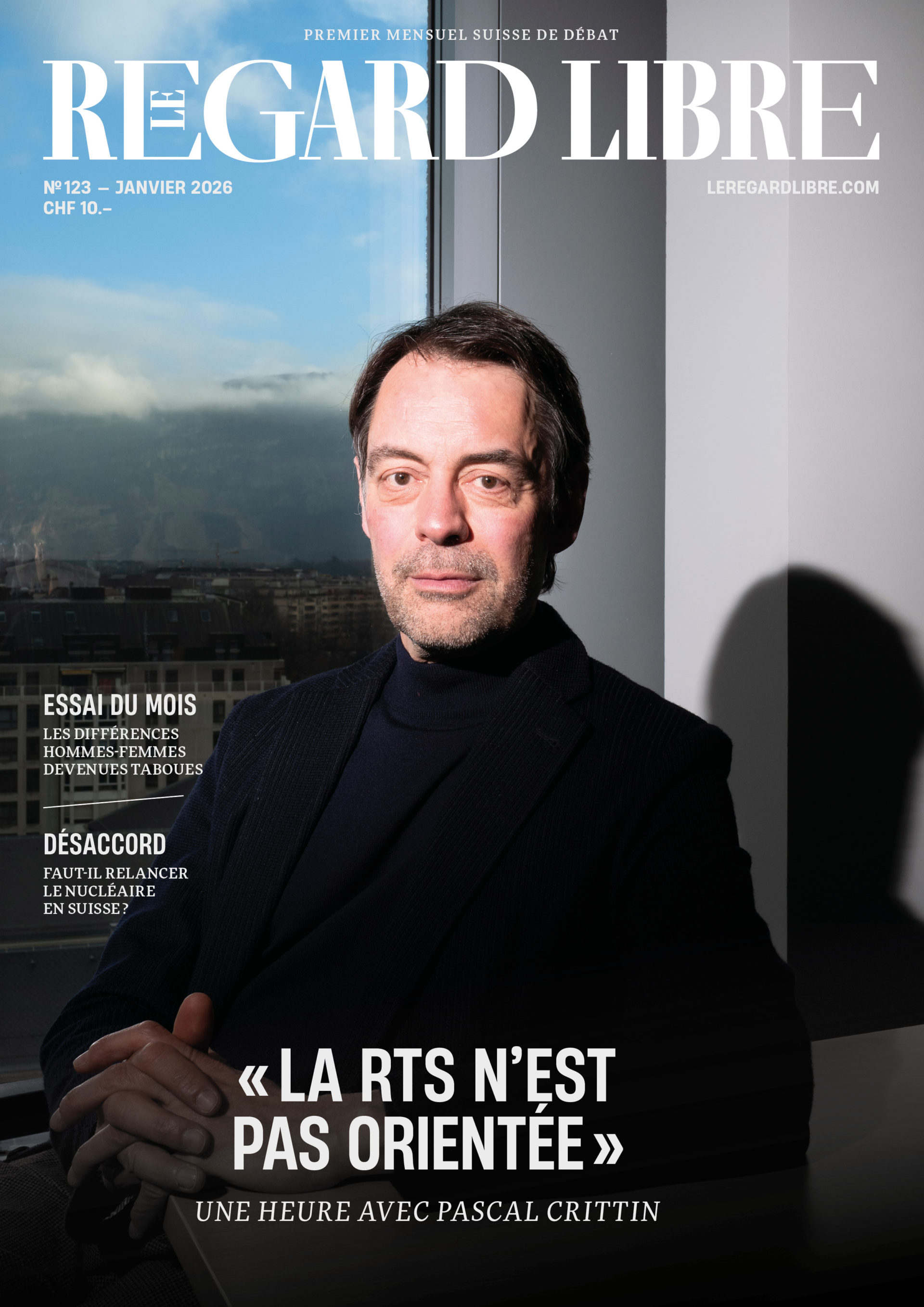


Le Regard Libre N° 54 - Ivan Garcia
series «The adventures of the stage», episode #1
From ancient tragedy to alexandrine declamation, characteristic of classical theater, via the text-based theater of the 19th centuryth From the beginning of the 20th century to the advent of contemporary staging and performance, the dramatic genre has undergone many (counter-)revolutions and evolutions. Each episode of «Les aventures de la scène» focuses on a particular company or artist, whether playwright, scriptwriter, director, dancer or other, or on theorists of the performing arts who have all, in one way or another, helped to shape theater as we understand it today, as a specific way for people to tell stories.
The city of Cesena, in Italy's Emilia-Romagna region, is the setting for the first episode of our series dedicated to the adventures of the stage. More precisely, at the Teatro Comandini, a hotbed of contemporary dramatic experimentation and headquarters for a mysterious theater company: the Socìetas Raffello Sanzio. Founded in 1981 by Romeo and Claudia Castellucci, along with Clara Guichi (Romeo Castellucci's partner), the Socìetas' highly political and cultural art combines theology, art history, philosophy, theater, biology and many other disciplines. At the heart of this praxis of theater lies in a single desire: to reconnect with the essence of tragedy.
The story of an experimental company
Officially founded in 1981 in Cesena, but unofficially taking shape long before, the Castellucci theatre company is named after the Italian painter Raphael (in Italian, Raffaello Sanzio). In 2007, on the occasion of the Festival d'Avignon and the presentation of Hey girl - a new staging - Jean-François Perrier asks Romeo Castellucci about this reference to the Italian Renaissance painter. According to Romeo Castellucci, the reference to Raphael is intended to express the ambivalence inherent in Socìetas' work, between the desire for representation and the presence of emptiness: «[...] Raphael was tormented in his paintings by the perfection of form, light, volume and balance, and at the same time, he had a sense of doubt and a perception of the abyss. This ambivalence explains why we chose him as the tutelary figure of our work.»
When we look at Socìetas, and even more so at its core group of three Castellucci family members, one detail stands out: they don't come directly from a theatrical background. Originally a farmer, Romeo Castellucci took up amateur theater as a child. After his agricultural training, he became interested in painting and turned to his great passion: art history. He studied art history at the Bologna Academy of Fine Arts, graduating with a degree in painting and stage design. Influenced by the Italian director and actor Carmelo Bene and the French theorist Antonin Artaud, Romeo Castellucci devoted himself to directing and designing the company's various shows.
His future wife, Chiara Guidi, studied art history at the University of Bologna, graduating with a degree in literature. At Socìetas, she is in charge of the artistic co-production of the various shows, the writing processes linked to the texts, and the actors' vocal careers. As for Claudia Castellucci, in addition to her training as an actress, she studied at the Academy of Fine Arts in Bologna and works on theoretical and dramatic texts for the company. It was she who wrote the text that can be considered a kind of manifesto for the company, and which was their first real dramatic work: Santa Sofia Teatro Khmer, a manifesto of iconoclastic theater (1986).
As we can see, the Castellucci family are more influenced by the history of art than by theater per se. Their main references come from painting and sculpture. Yet this is precisely where their strength lies: in showing, destroying or constructing images. The whole aesthetic challenge of Socìetas Raffaello Sanzio's theater is to bring to the fore the great icons of Western culture and destroy them, in order to reconfigure them in a different way, with a view to returning to the origins of theatrical art.
Iconoclastic theater
Rooted in an Aristotelian tradition, our Western vision of theater is profoundly mimetic. In other words, we consider that the function of theater is to offer a representation (mimesis) of something. This aesthetic presupposition has given rise to many topoi like the famous teatro mundi (the world is a theater) or the baroque notion that theater is an art of illusion and artifice. For the traditional spectator and director, Western theater is based on a triple translation: the writer writes a dramatic text for the stage; the director, through his or her choices, produces a reading of the text which he or she transposes onto the stage; then, the actor learns this text and interprets it on stage. The result of this triple translation is the theatrical performance that is intended to represent the text and its interpretation.
In their theatrical practice, strongly inspired by art history, the Socìetas aim to do away with the concept of representation and, even more so, with the image and the icon. The Castellucci family define their theatrical practice as iconoclastic. In other words, they are interested in the great icons that shape our Western vision, particularly Christianity, which is the religion of the West. The dramatic intent of their theater is to destroy these icons, whether pictorial - a portrait of Christ, a representation of an ancient hero, our vision of a protagonist, etc. - or textual.
For the dramatic theory of the Socìetas, the only way to banish representation is to destroy it purely in order to retain its essence. In the case of the icon (a sacred image par excellence), its destruction undoubtedly entails comparison with what existed before, to see what remains afterwards. The icon is first and foremost a sacred image - recalling the ritual dimension of dramatic art - which creates a union within the community.
In the case of text, Castellucci's never give the source text to be heard or seen verbatim, but rather suggest it. The company questions the power of the dramatic text to describe stage reality. In their shows, the text is not respected. to the letter or is not represented on stage, yet its presence remains tangible. Socìetas Raffaello Sanzio develops its texts using «stage writing». In other words, contrary to the dramatic tradition which sees the text precede the stage or emerge outside it, the process of "stage writing" consists in writing one's own text. from the stage and its realities. These conceptions of text and drama aim to translate a material reading - as close as possible to the stage - of texts and their interpretations. Socìetas Raffaello Sanzio's iconoclasm involves playing with the sacred icons of Western art and rewriting the great texts of the world theatrical tradition.
«Face the world, walk away, here we don't tell traditional biographical stories. Come, you who want to fight the fact of being born, and the fact of being here, and the fact of using these instruments. This is the theater that refuses representation. “When there is no representation, then the true representations spring forth” - this phrase is not mine.» (Claudia Castellucci, Pilgrims of Matter. Theory and praxis theater, writings by Socìetas Raffello Sanzio, translated by Karin Espinosa, Les Solitaires Intempestifs, 2011)
The text graveyard
For anyone attending a performance by this company, its theater seems a priori devoid of text. Not that the actors remain mute on stage, but Socìetas does not - strictly speaking - perform text-based theater. However, this does not mean that text is non-existent in their practice. On the contrary, the Castellucci family - most of whose shows focus on the great texts of human civilization (the Bible, the Epic of Gilgamesh, Shakespeare, etc.) - are masters of texts, and have an extreme knowledge of them. The breaking point between this company and the textual theatrical tradition lies in the latter's consideration of the text and, above all, its role on stage.
For Romeo Castellucci, Western theater places too much emphasis on the representation of the text and, as a result, prevents an invisible part of the drama from being seen. By making use of music, the actors' bodies and other scenographic devices, the director makes the text visible, but without summoning it - textually - to the stage. By reducing the text to its strict minimum, Castellucci's work reveals the essential. True to their iconoclastic theory, they destroy the superfluous to reveal the essence of the text and materialize it through an original stage translation. «The book is a corpse. It's a dead letter, always and no matter what you do. Hamlet becomes a name and a body; on stage, he's not a book.»
Let there be no mistake. Socìetas Raffaello Sanzio has immense respect for the texts it uses and studies. However, according to Castellucci, by wishing to freeze the drama, the text ends up lying lifeless in a cemetery. The corpse that is the book must undergo the ordeal of the stage in order to be resurrected, but to do so, it must take on another form and reveal itself to the public in a different way. The company's dramatic intention is not to produce a complete story, but to produce a drama in which the spectator - depending on how he or she feels - will weave the threads and complete the missing part.
A tragedy of matter
Socìetas Raffello Sanzio has become an internationally renowned experimental theater company, staging a number of memorable performances. Here are just a few of them. In 1992, the company created its show Amleto. La veemente esteriorità della morte di un mollusco (Hamlet. The vehement exteriority of a mollusc's death), featuring a kind of autistic child-Hamlet, locked in a room in his own world, surrounded by his toys, trying to answer the question «To be or not to be? Embodied by actor Paolo Tonti, the character of Horatio embodies and recounts the legend of the Danish prince in a poignant and surprising way.
At the 2008 Avignon Festival, The Divine Comedy des Castellucci illuminates three venues in the city of the Popes during this event. This three-part show allows Romeo Castellucci to focus on the figure of the poet, Dante Alighieri. Alighieri, at once the main narrator-protagonist and the actor in his poem The Divine Comedy, Castellucci's aim was to identify perfectly with the poet in his staging of this classic of Western literature. As the press has pointed out, this show will go down as one of the great theatrical works of the early years of this century.
In 2010, their new creation Sul concetto di volto nel figlio di Dio (On the concept of the face of the Son of God) was a great success. However, when it was performed in 2011 at the Théâtre de la Ville in Paris, it provoked protests from religious fundamentalists who considered the work blasphemous. The play features an elderly father and his son in their prime. The latter looks after the former, who is prone to frequent diarrhea. At the back of the stage, a giant portrait of Christ, probably painted by Antonello de Messina, dominates the stage and the audience. As the performance draws to a close, this icon gives way to a text, You are my Shepherd (You are my shepherd, from the Bible), and gradually the painting shatters: the icon has been destroyed.
Far from seeing himself as a provocateur, Castellucci wanted to show the relationship between a father and son and, more specifically, how to link the most banal (scatology embodied by the father's diarrhea) with the most sacred dimension (eschatology, the study of the end times, embodied by the figure of Christ). The father's incontinence embodies humanity in its lowest extraction, under the gaze of the redeeming, good-hearted Christ. And yet, to become a man, he had to empty himself, abandoning his divine part to join organic, material human misery. Through this lowly matter, humanity and divinity would have something in common.
A theater of division
At a time when public and cultural institutions are calling for a unifying and civic-minded theater, the Castellucci's assert their vision of a theater of division and confrontation in the tradition of ancient Greek tragedy. In their interpretation of ancient tragedy, the Castellucci's consider that it was built on the acknowledgement of the non-existence of God, which created a void and the desire to gather around this nothingness. However, far from being a unifying gathering, it does not seek to fill the void, but results from a crisis - the death of God - that no one can fill.
In their conception of the dramatic arts, Socìetas Raffaello Sanzio are opposed to any didactic theater that aims to tell the audience what to think or do, because, in their view, their theater is precisely not about reconciliation or resolution, but about crisis and conflict. Spectators should not come to the theater to recognize what they already know - by attending traditional stagings of the classics, for example - but to confront the unknown and the invisible. According to the Castellucci family, theater is «about experiencing another time». A time of emptiness and crisis, in which icons are shattered, but in which the stage and our impressions allow us to replay their origins.
«Tragedy took on the name of tragedy because someone started shouting: the god Pan is dead. The function of theater, like that of the actor, has always been a religious, unifying one, in the etymological sense of the word. The instantaneous community that theater creates - a communion between people who don't know each other - is organized precisely around this void.» (Bruno Tackels, The Castellucci, Stage Writers I, Les Solitaires Intempestifs, 2005)
Write to the author: ivan.garcia@leregardlibre.com
 French
  German
  English