




Programme Commun, the musings of a scenic gourmet

Le Regard Libre N° 50 - Ivan Garcia
From March 27 to April 7, the international performing arts festival Programme Commun took place in Lausanne. This was an opportunity for your editor to select four plays for you, dear readers, from among some twenty, to reflect on today's theater.
Organized by the Théâtre de Vidy, L'Arsenic and Théâtre Sévelin 36, the Programme Commun festival is the annual meeting place for programmers in search of new shows, and critics in search of new theatrical fare. Among these, your editor has chosen - arbitrarily - four, in order to invite you to a dramatic feast; why choose one show over another when, in theory at least, all deserve to be seen? It's a question of both time and taste. The following selection includes one show at L'Arsenic and three at Théâtre de Vidy, ranging from documentary theater to performance art.
Without further ado, let's get down to the menu for this fifth edition:
1. The cowboy's aperitif, The Wide West Show!
As an aperitif, dear readers, our reveries begin at L'Arsenic. More precisely, in a darkened room where everyone is free to roam. As the spectators move about - avoiding two large boulders and the actors seated on them - and everyone struggles to find their place in the space, the anticipation is palpable. The further we move into the gloom, the more our eyes are drawn to the strangely clad actors above the boulders, like little hills in a Western.
An eventful performance
And suddenly, there was light. A red spotlight shines on one of the actors, dressed in a cowboy hat and red onesie. He begins a dance solo, set to electronic music. Then, once again, darkness invades the stage... for a few moments. After that, another person, also dressed as a cowboy, responds with a robotic dance; the two cowboys duel, armed only with their bodies and the music. At first, the pace of the confrontation seems slow, but as it accelerates, the audience struggles to take it all in. In fact, they move from right to left to get the best view of the actors, which is not always easy as the intervals become shorter.
Then two other men, disguised as office workers, move around - with the help of virtual reality helmets at their disposal. design bread toast - in the middle of the audience. Clearly as lost as the audience, they wander around the room imitating robot gestures. At this point, some spectators decide to sit down, others to keep moving, and still others are clearly waiting for something.
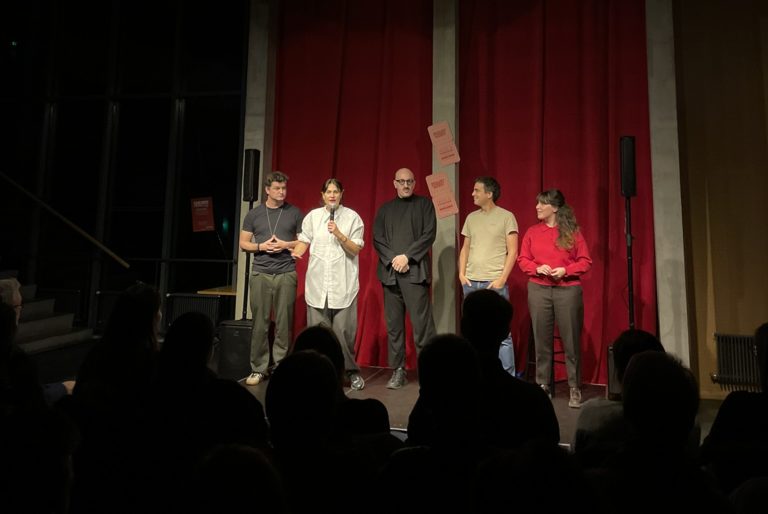
Finally, the lights come up. The show begins. A tall blond man in a Hawaiian shirt explains to those present that «That's the moment, guys, there we go! English! And, indicating that they'll need room, he asks the audience to move away from the center aisle. And off we go!
Clearly, the tall blond is the leader of this crazy trio. He charismatically leads his other two cowboy colleagues in a sort of fitness improvised. They make several rounds of the room, screaming, running, jumping, grabbing chequered flags and even attending a course in handling the lasso. We certainly laugh a lot, but... some spectators end up leaving the room, proof if any were needed that the first part of the performance struggles to convince.
Reconversion of an American cowboy
However, the second half of the show, focusing on one of the actors, a heavyset, bespectacled man, demonstrates how the former cowboy attempts to humanize a piece of wood. Spontaneously forming an arc around the actor, the audience listens attentively as this strange man interacts with us to make this wooden man. We sometimes wonder what we're doing sitting there listening to a man talk to a piece of wood, but the audience has a good time nonetheless, if only by virtue of the excellent embodiment of the actor. perfomer made in USA by the actor. In fact, he wakes us up with explosive phrases in Americanized English: «Are you ok Programme Commun?» or, to test our reactivity on the subject of the piece of wood: «Ohhh he has no nose»... In this performance, we jump from rooster to donkey, which doesn't really bother us; it seems to be the sensation the actors wanted to communicate to us: the blur. A kind of light, catchy blur that, rather than spoiling the moment with «why?», replaces it with «well, why not?.
The Wide West Show! develops an improvisation on the future of the cowboy in a world that has done everything to kill him. Constantly on the move, humans no longer have time to sit in a bar and enjoy a good whisky. Incessantly stressed, they need a course in fitness or handling the lasso, We're trying to find a way back into our lives. In the end, as we can see with the story of the wooden man, perhaps the solution to this eudemonic problem lies in calm and building something. Although the meaning of this performance is not self-evident, particularly as it mixes heterogeneous elements without strong links, we admire the physical work of the actors, as well as their explosive character.
All in all, a show to be enjoyed in moderation.
2. Pot-au-feu from Granma. The trombones of Havana
After last year's success with Cargo Congo-Lausanne, Stefan Kaegi's Rimini Protokoll collective offers the audience a tasty, carefully prepared main course. The performance's fable describes the current situation on the island of Cuba, more than half a century after Fidel Castro's socialist revolution. An island facing contemporary challenges, including a gradual opening-up that is calling into question the gains of the revolution. Granma. The trombones of Havana belongs to the genre of documentary theater, a specialty of Rimini Protokoll, with actors-characters who come on stage to tell us about their lives. In this case, the project examines the role of the Cuban family, the neuralgic point of the regime. After all, isn't the basis of every state the family, a kind of micro-society within a larger whole?
Life stories
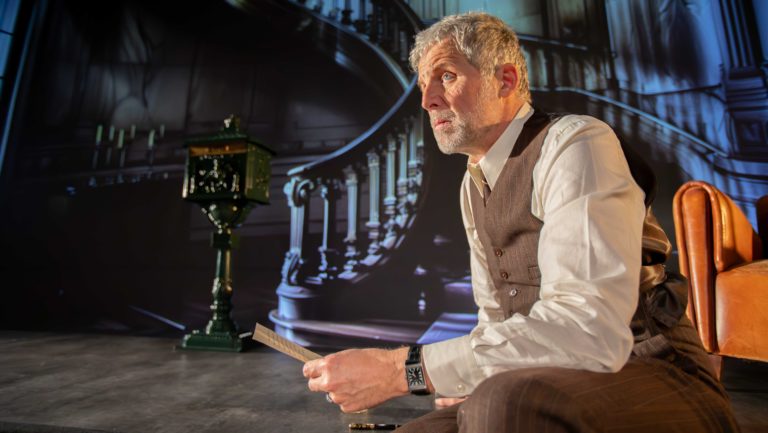
The viewer is treated to the stories of Diana, Christian, Milagro and Daniel, four Cuban citizens with their own perspectives and experiences. They form a musical group, in which they play the trombone. In turn, they explain to the audience the major events that have marked the island over the last sixty years, and how they live their daily lives there. On the set, the décor is fundamental to understanding what's unfolding before our eyes. Cuban flags, political podiums and screens all contribute to the picturesque atmosphere, as if Stefan Kaegi wanted to match the mood of his play to our imaginary Cuban representations. A noteworthy feature is a sewing machine on the right-hand side of the stage, on which the actors take turns sewing a sheet representing a timeline. The more the sheet is sewn, the closer the story gets to our own time. Time becomes a central element of the play, as it plays on the dichotomy between the current generation - which did not live through the revolution - and the older one.
To do so, Granma. The trombones of Havana juggles different media: oral discourse, video, Skype conferences and music, proposing a reflexive theater in the tradition of German playwright Bertolt Brecht. The same man who brought the theory of distancing to Western dramaturgy (Verfremdungseffekt), literally «strangeness effect». The combination of, on the one hand, our identification with the characters, through their life stories, and, on the other, their distancing - the brief realization that we are witnessing an illusion - is manifested here by the various musical interludes performed by the quartet.
A dialogue between audience and troupe
The set-up proposed by the director gradually blurs the boundaries between fiction and reality. The use of Skype conferences transmits real testimonies from existing people, so that the actors' family members, such as Milagro's grandmother or Christian's grandfather, can be heard, thus confronting the points of view of different generations in Cuba. In addition to these direct testimonials, when the actors digress historically on controversial figures in Cuban history such as General Arnaldo Ochoa Sánchez, they involve the audience head-on in their discourse. They'll even be happy to recruit spectators to play at the baseball with them, as a sign of protest against the injustice suffered by the island. The idea was that the device used, i.e. the testimony mixed with archival images, should make the public - in this case Swiss - reflect on its own experiences. a priori towards Cuba.
With Granma. The trombones of Havana, Rimini Protokoll brings Cuba to Switzerland. By combining different media, the show anchors its fable in a coherent, immersive universe, within which the spectator reflects as a critical observer and draws an enriching experience.
A carefully concocted dish that leaves no one indifferent.
.... To read the rest of this dossier on Programme Commun, there's just one thing to do: order our fiftieth edition!
Write to the author: ivan.garcia@leregardlibre.com
Photo credit: © Dorothea Tucher
-
 Le Regard Libre - N° 50CHF10.00
 -
 Standard subscription (Switzerland)CHF100.00 / year
 -
Support subscriptionCHF200.00 / year

Vous aimerez aussi

 French
  German
  English
Laisser un commentaire