


Le Regard Libre N° 26 - Léa Farine
«The philosopher's soul watches over his head. The poet's soul flies in his heart. The singer's soul vibrates in his throat. But the soul of the dancer lives in her whole body», writes Khalil Gibran in his poem «The Dancer».
Many schools of thought, or religious movements, recognize the body as a vehicle in which the soul can truly unfold and come into contact with God. Salvation, then, requires incarnation: no liberation is possible after death, since this liberation needs the body to take place, whether through asceticism, dance or eroticism.
Creatures and creator
Far from this conception, Islam and Christianity perceive the body differently, for theological and historical reasons that cannot be ignored. In each of these two great monotheisms, redemption occurs only after death. If contact with God can nevertheless be established, it is through an immense distance, for God is breath, the Word, but never flesh. Body and soul cannot meet because, by definition, God is «all that is not the body» and matter is «all that is not God», since creation cannot be confused with the Creator. God or a particle of God may inhabit a body, or visit it during a being's physical existence, but the being cannot fully return to God as long as that body exists.
The opposition can be summed up as follows. On the one hand, salvation is achieved through the perfect association of body and soul, so that the very duality of the two concepts no longer makes sense. On the other, a liberation that takes place through separation from the body, after the soul has undergone the difficult experience of incarnation, enabling union with God. There are, of course, points of contact between these two conceptions. I'd like to give two examples: the Song of Songs from the Christian Old Testament, and the place given to love in Sufism, a mystical current in Islam.
Visit Song of Songs
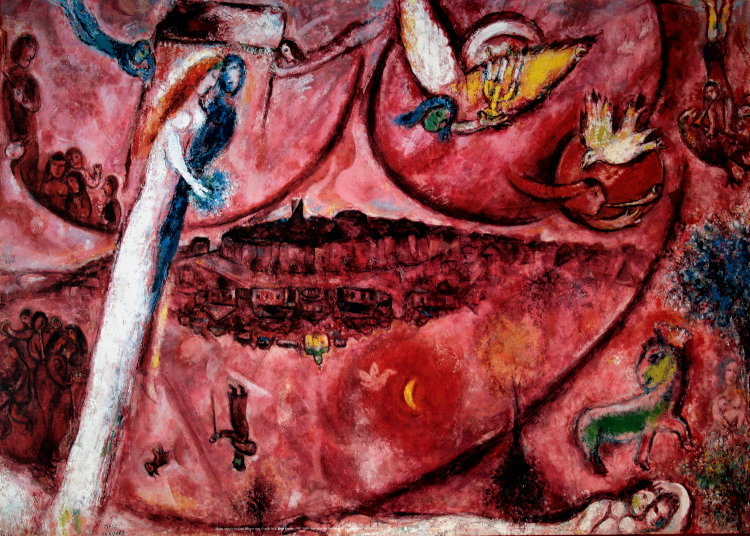
The Song of Songs, included in the part of the Old Testament commonly known as the «Poetic and Sapiental Books», is a love song in which two lovers take turns recounting their passion for each other, before being able to join and unite: «Let him kiss me with the kisses of his mouth. Your loves are more delicious than wine [...] How beautiful you are, my beloved, how beautiful you are! Your eyes are like doves behind your veil». Interpretations of the text differ, but I retain here that of a double metaphorical meaning: the desire for the other, and the reunion that follows the desire when it is fulfilled, is comparable to the desire for God and the covenant with him. In other words, the love of the other and the love of God are of the same nature, and both the pain of separation and the joy of reunion can be experienced, through the body, by lovers.
Here's what we read in the last poem, the epilogue to the Song of Songs, where the experience of love is compared to that of death: «Put me like a seal on your heart, like a seal on your arm. For love is strong as Death, jealousy inflexible as Sheol. Its features are features of fire, a flame of Yahweh. Great waters cannot extinguish love, nor rivers submerge it. Who would offer all the riches of his house to buy love, would gather only contempt.»
Sufi love
Sufism accords a similar place to love, even more so than in the Song of Songs. The spiritual center of Sufi mysticism is a jihad waged not outside oneself, not against the other, but an inner quest whose sole object is the discovery, in stages, of God's love and, at the ultimate stage, a full and perfect reunion with him. The 13th-century Persian poetth century, Mevlana Celaleddin Rumi, wrote: «O Day arise, the atoms are dancing. Thanks to Him, the universe is dancing. Souls are dancing, triumphant with ecstasy. I'll whisper in your ear where this dance is leading them. All the atoms in the air and the desert know it well, they seem mad. Every single atom, happy or miserable, falls in love with the sun, of which nothing can be said.»
Love between men and women, but also friendship, are themes abundantly addressed in Sufi texts, because these human loves reveal the love of God. In other words, there's no difference between love or desire for oneself, for others and for the world, because, through matter, it's always God who is desired and loved. To put it more simply, if God is love, then creation - the division of original matter so that it becomes a world - is an act of love that permeates all reality. Through love, it is possible to return beyond this separation, to see God.
It's interesting to note, when we take a comparative look at religions, that from sometimes apparently antinomic theological substrata, we can identify similar fields of force. Love, for example, in the broadest sense of the term, occupies an important place in most religions and in many currents of thought, regardless of the particular form it takes: Buddhist benevolence, Nietzsche's love of self, «eros» in Hesiod's theogony, or love of God in Sufism and Christianity. We are, inevitably, radically separated from one another. And yet, we sometimes manage to reach out and understand each other beyond the material. Proof once again that no concept is more unifying and transcendent than the notion of ’love«.
Write to the author : leafarine@gmail.com
Image: Marc Chagall, Song of Songs III, 1960 (© passion-estampes.com)
 French
  German
  English