



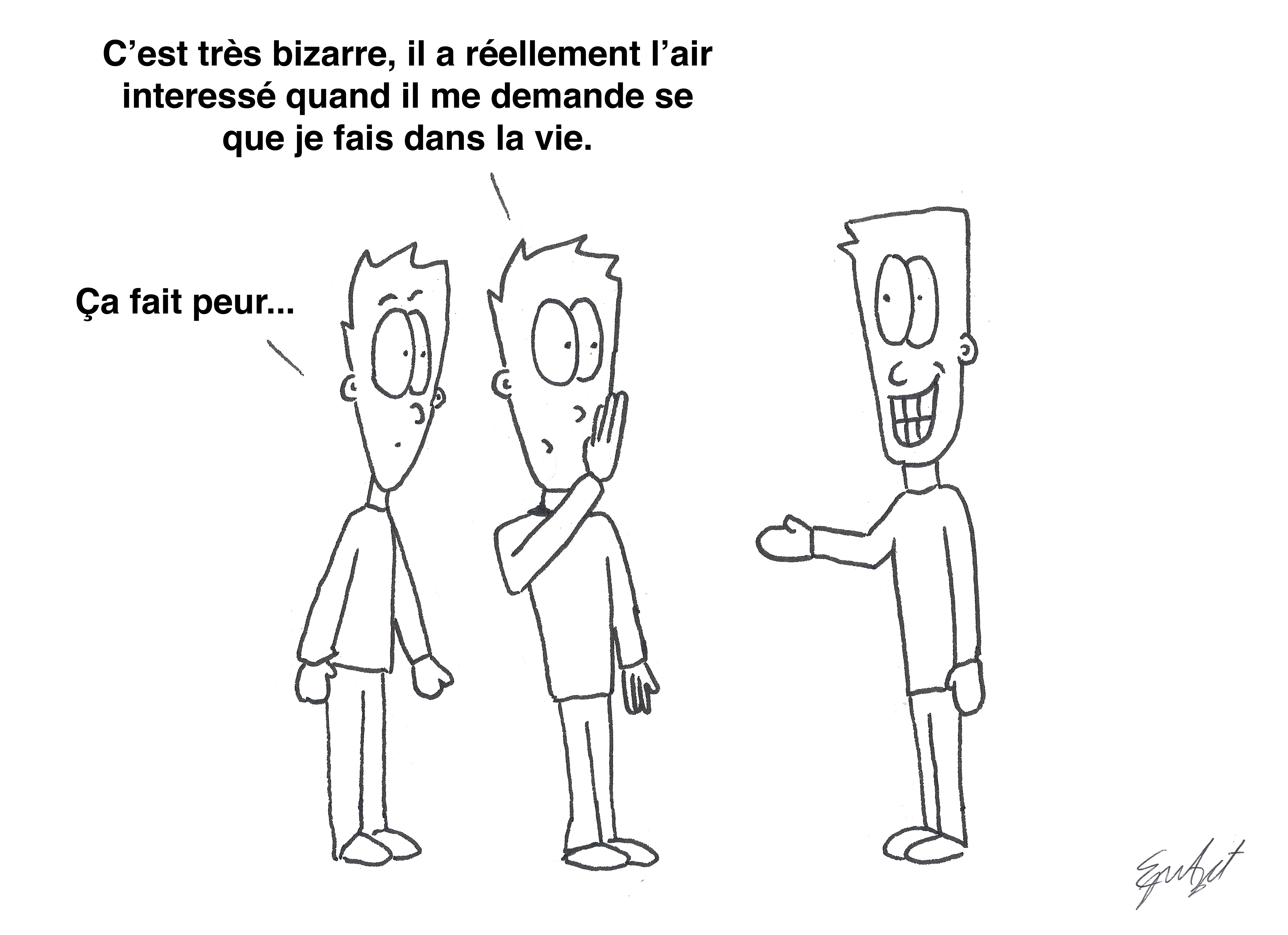
The disturbing valley theory
Le Regard Libre N° 23 - Léa Farine
The uncanny valley is an experiment devised and published by Japanese roboticist Masahiro Mori in the 1970s. According to Mori, the more an animated or inanimate object resembles us, the more likely it is to trigger a feeling of familiarity in the human observer. For example, objects such as a stuffed animal, an industrial robot, a domestic robot or a humanoid robot all evoke such an impression at different amplitudes. However, from a certain degree of similarity, just short of perfect representation, the feeling of empathy drops sharply. The familiar then becomes disturbing. This is what happens, again according to Mori, when we are confronted with corpses, zombies, robots whose imperfections we perceive but imitate very well, or human beings with facial deformities or burns, for example. An automatic electric lawnmower, a teddy bear, or even a shapeless figurine with two eyes drawn on it, seem more familiar to us than a zombie, a corpse or a prosthetic hand, all of which look much more like us.
A pseudo-scientific experiment
The experiment is disputed mainly on one point. While it is possible to determine with relative certainty and statistical accuracy the feeling provoked by a given object in an observer, for example, while it can be seen that in a certain percentage of cases studied, the corpse provokes a feeling of rejection and the teddy bear a feeling of familiarity, the similarity with a human being is difficult to quantify. The problem arises, if we look at the graph, with the Buraki puppet. How can we define whether or not it looks more human than a corpse? Perhaps it lies beyond the valley of the uncanny. In the same way, the face of the Buddha statue, which Mori sees as the artistic expression of the human ideal, doesn't necessarily resemble us any more than a humanoid robot.
The «strange familiar»
Although clearly pseudo-scientific, the experiment nevertheless has a philosophical significance that's worth dwelling on. To do so, we need to return to the concept of «unheimlich», «das Unheimliche», theorized by Freud and often translated into French as «inquiétante étrangeté», which is slightly incorrect. Indeed, the word «heimlich», whose literal translation is «secret», also refers to the word «Heim», the house, the home. «Unheimlich», then, which means «bizarre», «strange», is a kind of what disturbs because it's intimate, because it's familiar, because it belongs to you. A better translation of ’disquieting strangeness« might therefore be »the strange familiar« or »the intimate unfamiliar«. More concretely, »das Unheimliche« refers to a feeling of strangeness aroused by elements that are or should normally be familiar, but which, for various reasons, become bizarre or disturbing. Let's take the example of zombies, corpses or ghosts. They generate anxiety precisely because they are familiar enough to be recognized as very close, or even as doubles, but at the same time evoke an equally intimate fear, that of death.
However - and this is why the experience of the valley of the uncanny has an important subjective dimension that devalues it scientifically - in all individuals, in all societies and in all times, the relationship to death differs according to whether the fear of it is more or less repressed, because it is repression that constitutes the characteristic haunting of the feeling of strangeness. Western societies, however, reject death as a component of life on a massive scale - it's hidden, swept under the carpet. There is denial. But it does come back, in a form of masked reality, for example when faced with a corpse or a zombie, we are gripped by an impression of anguish or strangeness. And yet, if death is universally sad, a normal and conscious feeling triggered by the phenomenon, it is not universally frightening - in many cultic rites, certain rites of passage for example, we even engage in potentially lethal experiences precisely in order to assure ourselves, and the community, that we have enough strength to live our adult lives, with all the dangers that entails.
Fear and repression
Generally speaking, any fear or experience that has been repressed, either by an individual or by an entire society, can return in the form of a feeling of the uncanny. What most certainly and precisely characterizes this feeling is its return, a form of haunting in relation to an element that «recalls repeatedly», until the original fear is brought to light, i.e., until repression ceases. At that point, it loses its disturbing character and becomes familiar again, since it is known, identified and integrated. According to Freud, the fears that give rise to repression are usually closely or distantly linked to death or sexuality. For my part, I'd add that this reading grid, although questionable on certain points of detail, seems adequate, since like other animals, we are driven above all by the desire to live and reproduce.
The unknown in ourselves
To return to Mori's experience, in the light of what has just been said, I believe that its interest lies not in identifying what does or does not belong to the «valley of the uncanny», because nothing does or does not belong there definitively, but in going beyond it, in what it calls this haunted place which, individually or for society as a whole, constitutes the dark pit where the spectres located at the edge of our consciousness evolve - spectres which can take an infinite number of different forms. Consequently, anguish and fear are most often not linked to the outside world or to the other, but, on the contrary, to the intimate, to the self, to the unknown within ourselves. This is why the latter are irrational and must be recognized as such, and integrated, to enable progress towards ever-deeper awareness. Real, enlightened freedom doesn't seem to me to consist of anything other than this.
Write to the author : lea.farine@leregardlibre.com
Photo credit: © Elias Jutzet / Le Regard Libre

Vous aimerez aussi
 French
  German
  English
Laisser un commentaire