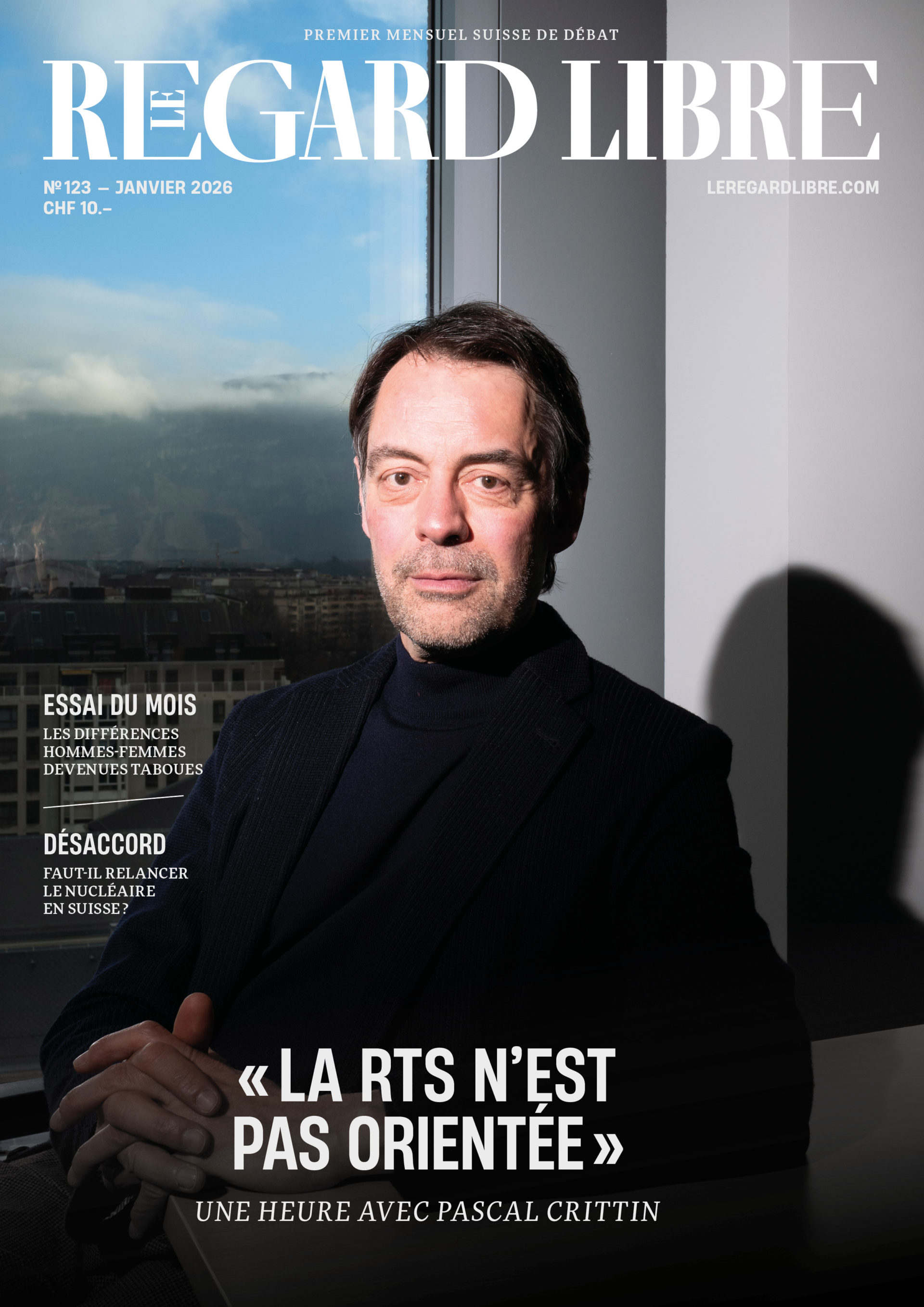




Extreme center, definition

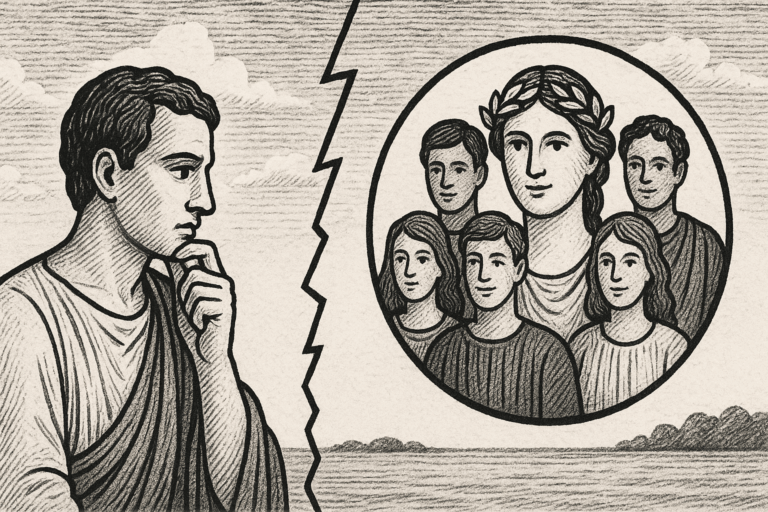
Drawing by Nathanaël Schmid for Le Regard Libre
In touting the idea of a label that would distinguish «reliable» media from others, Emmanuel Macron betrayed an authoritarian attitude of believing that one or more individuals have the legitimacy to define what everyone should trust.
Some words are reassuring because they give a sense of balance. Center« is one of them. It evokes moderation, nuance, attention to every point of view, drawing good from all political camps. These are demands we have always made of ourselves here, while remaining convinced that the center does not have a monopoly on this quest for balance. It's not because we call ourselves nuanced that we are. Worse still, when the center presents itself as the only space for reason, it becomes something else: an extreme that ignores itself. The extreme center.
The idea, formulated last month by Emmanuel Macron, of a label to distinguish reliable media from others is a perfect illustration. The declared intention is virtuous: to protect the public from false information, restore confidence in journalism and guarantee quality democracy. But behind this consensual facade lies a dangerous vision that is doomed to failure: that individuals - within or outside the state - have the legitimacy to define for others what they should trust.
Read also | Neither reason without debate nor debate without reason
This concept is based on a fiction: on the one hand, there are those involved in disinformation, on both the left and the right; on the other, there is an impartial space, where ethics are respected.
This is to forget that it is not the truth that serves the debate. It's the debate that serves the truth. There's nothing worse than the notion of a «circle of reason»! As Yann Costa explains in this issue in the same issue, To distinguish between facts and opinions as if they were two different kinds of content is a category error. Opinions are on facts It is by allowing all opinions to be expressed, contradicted and enriched that knowledge – always provisional but increasingly solid – can progress. It's by allowing all opinions to be expressed, contradicted and enriched that knowledge – always provisional but increasingly solid – can progress. What's more, labelling people or entities as «unreliable» makes them attractive to anti-systems and a priori uninteresting to others, thus creating polarization and undermining the dialectic necessary to the quest for facts.
Read also | Skepticism, to escape dogmatism and relativism
So it's important to leave open the confrontation of opinions, the competition between media... and labels! As is the case in Switzerland, for example, with the diversity of organizations issuing press cards based on respect for the rules of the trade.
During his speech, Emmanuel Macron made it clear that it would not be up to the State to create this label, but to professionals – although he did refer to a label in the singular. This raises the question of who would appoint or validate these professionals, if not the State. Or the industry itself, through self-regulation? We run the risk of a closed authority defined by an influential circle, if only because it is in the majority.
There's no doubt that, with his usual sense of backtracking and «at the same time», the Elysée's occupant could subscribe to this analysis and thus support the sole relevance of spontaneously created labels. Except that this is already the exact current situation, in France as in Switzerland... The extreme center also means blowing hot air. When there are so many other things to say - and, above all, to do.
Graduate in philosophy and journalist by profession, Jonas Follonier is the founder and editor-in-chief of the Regard Libre.
You've just read an open-access editorial. Debates, analyses, cultural news: subscribe to support us and access all our content.

You'll also like


 French
  German
  English
Leave a comment