




Greenland and the ethics of annexation
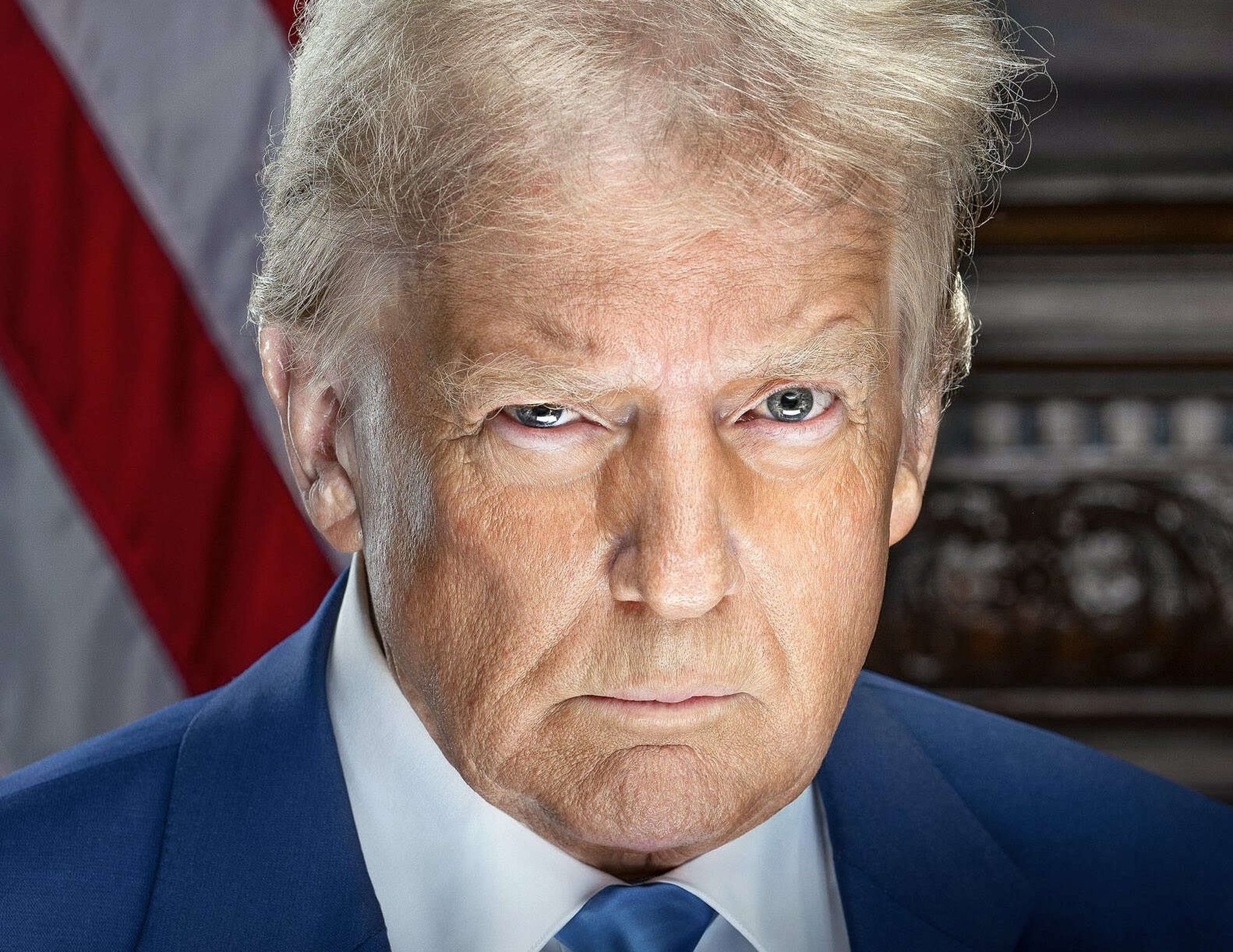
Inaugural portrait of Donald Trump in 2025. Photo: Wikimedia
Professor at Pasadena City College in Los Angeles, Edward Feser is a conservative American philosopher. Recently, on his blog, where he regularly comments on current affairs, he was highly critical of Donald Trump's expansionist ambitions.[1].
On several occasions, President Trump has expressed the wish to attach Greenland to the United States. His motivations lie in the island's strategic position, as well as its mineral resources. Neither the government of Denmark (of which Greenland is a territory) nor the Greenlanders themselves support this idea. However, this opposition does not seem to be holding Trump back, and he has refused on several occasions to rule out the possibility of annexing the island by force. In January, for example, when asked whether he would renounce all forms of military coercion to take control of Greenland, Trump replied: «No, I can't assure you of that», «I'm not going to commit to that». Questioned again this month[2] on the possible use of force to seize Greenland, he declared that «it could happen, something could happen with Greenland» and «I'm not ruling it out».
Such military action would clearly run counter to the traditional criteria of just war theory.[3]. I would add that even if the threat is only intended as leverage in a negotiation (which is probably the case), it remains contrary to the principles of natural law that govern international relations. These facts should be obvious to everyone, and would have been so not so long ago. However, Trump's most fervent supporters have a disturbing tendency to reflexively defend even his most outrageous acts, cobbling together flimsy justifications for words and deeds they would condemn if they came from anyone else. In such a context, it's worth spelling out why Trump's statements about Greenland are indefensible.
The annexation of Greenland and just war criteria
I repeat: military action to annex Greenland would be clearly unjust. It would clearly fail to meet one of the criteria established by just war theory: that of «just cause». According to this criterion, a country can legitimately go to war against another only if the latter has committed a sufficiently serious violation of rights for war to constitute a proportionate response. The most obvious example is when a country takes up arms to repel an aggressor. Yet neither Denmark nor Greenland has attacked the United States, or committed any other violation of the latter's rights. In fact, they are long-standing allies.
The fact that Greenland's position and resources could be useful to the United States for defense purposes doesn't change a thing. If I deem it useful to seize my neighbor's property to better protect my own against thieves, that in no way gives me the right to do so. That would be acting like a thief. It is equally futile to claim that governments are not subject to the same moral prohibition against theft as individuals. As St Thomas Aquinas wrote:
«As far as princes are concerned, public power is entrusted to them to be the guardians of justice; consequently, they are only permitted to use violence or coercion within the limits of justice... To violently and unjustly appropriate the property of others under the pretext of public authority is to act illegitimately and to be guilty of theft.»
(Summa of theology, II-II, 66, 8)
The injustice of wars of territorial expansion is the subject of consensus among natural law theorists stemming from the Thomistic tradition. It has long been the standard position. For example, in Man as Man. The Science and Art of Ethics, Thomas Higgins states that «a war of aggression is a violent attempt to deprive another people of their independence, territory or similar property, in order to increase one's own power and prestige [...] The natural law forbids all wars of aggression» (p. 543). [Natural law forbids all wars of aggression" (p. 543). In Right and Reason, Austin Fagothey states that «[such motives as] territorial aggrandizement, glory and fame, envy of a neighbor's possessions, fear of a rising rival, or maintaining the balance of power [...] are invalid reasons» for going to war (p. 564). He also points out that, while the acquisition of new lands may in certain circumstances be lawful, this is not the case for lands «recognized as forming part of the territory of an existing State», and that ’an existing State cannot be deprived of its territory« (p. 547). The importance of these elements cannot be overstated. Not only would the forcible annexation of Greenland be tantamount to theft on a massive scale, but, by resulting in deaths, such unjust military action would actually be tantamount to murder. It would make the president a war criminal, responsible for a massive injustice not only to the Greenlandic people, but also to the US military, transformed by Trump into the instrument of such a crime.
A negotiating tactic?
Many Trump supporters would say that he has no real intention of using military force, but is simply employing such rhetoric as a negotiating tactic. This is probably true. It's also likely that he would refrain from using force in any case, if only because the political cost would be too high.
It remains significant, however, that in his most recent statements, Trump seemed to draw a distinction between the situation of Greenland and that of Canada, which he has also repeatedly asserted should also be integrated into the United States. Asked about the possibility of using military force to take over Canada, Trump said, «Well, I don't think it will ever come to that» and «I don't see it with Canada, I just don't see it.» This is not a clear acknowledgement that acquiring Canada by force would be morally wrong. objectionable, and therefore categorically excluded. It sounds more like a judgment that attacking Canada would simply be pointless or unrealistic. But in the case of Greenland, Trump's response is different. He repeated that «something could happen» and that he wasn't ruling it out, even though he also says it was unlikely. Overall, his statements give the impression that he does indeed regard military action against Greenland as at least conceivable, albeit highly hypothetical. It should also be noted that the administration has recently stepped up its intelligence operations concerning Greenland.
In any case, even if this rhetoric is intended as a negotiating tactic, it remains gravely immoral. In reality, there are at least two ways in which refusing to rule out the use of force can serve as a negotiating tactic. Trump could either genuinely intend to keep open the possibility to use force against Greenland, in order to frighten Denmark and Greenland into concluding an agreement, even if it has no concrete plans at present to actually carry out this threat; or it is simply bluffing, with the aim of intimidating them into negotiating, without ever intending to actually do so. Both tactics are reprehensible, albeit for different reasons.
In their book Nuclear Deterrence, Morality, and Realism, John Finnis, Joseph Boyle and Germain Grisez discuss the difference between actually keeping an option open and simply bluffing. Some of their arguments are relevant here.
Let's take the first possibility: Trump wishes to keep open the option of military action against Greenland, while hoping and believing that he will never have to carry out this threat. As Finnis, Boyle and Grisez point out, it's disingenuous to assume that, if someone hopes and believes they'll never have to carry out an action they threaten to execute, it means they don't actually intend to do so. In reality, «those who, by chance, avoid doing what they only reluctantly contemplate, or who might change their minds in the future, are people who have already made up their minds» (pp. 104-105). In this case, if Trump does indeed want to keep this option open, then he does, in the relevant sense of the word, intend to use military force against Greenland if it fails to get it any other way. And this remains true even if he hopes and believes he can acquire it peacefully.
However, as we have seen, acquiring Greenland in this way would violate the criteria of just war and would therefore be tantamount to murder. As Finnis, Boyle and Grisez write about not ruling out the option of committing a murderous act:
«Admittedly, it would be subject to a double condition: not only to the adversary's defying the threat, but also to a decision still to be taken to carry it out. Nevertheless, such an intention, even if doubly conditional, would still be homicidal. For if one already intends to place oneself in a position to commit murder, should one later decide that the situation justifies it, then, already now, one is willing (albeit reluctantly) to kill.»
(p. 111)
So to keep open the possibility of military action against Greenland, even if only as a negotiating tactic, is still to harbor murderous intent, and therefore gravely immoral. Let's now consider the other possible scenario, in which Trump is simply bluffing. In this hypothesis, Trump is not really considering the military option. He simply wants Denmark and Greenland to believe that he considers it. Even if this is the case, it remains gravely immoral for at least three reasons, the first two of which are outlined by Finnis, Boyle and Grisez.
Firstly, when a country threatens to take immoral military action, it is not only the intentions of its leaders that are morally relevant. So are those of everyone else connected in some way with that action, whether soldiers or ordinary citizens. In this case, even if Trump is bluffing, that bluff can only work if he isn't perceived as such, That is, if a critical mass of people believe he could actually carry out his threat. This will lead at least some individuals (government officials, the military, voters) to decide to support the action if it is actually undertaken. In other words, they will harbor the intention of supporting a murderous act. Them won't be bluffing, even if Trump is. And as Finnis, Boyle and Grisez write: «Those who deliberately lead others to intend evil are guilty not only of the evil that those people intend, but also of leading them to become evil-willed people.» (p. 119) In this case, such a leader would «incite others to intend to kill innocent people» (p. 120), even if he or she doesn't actually have that intention himself or herself.
Secondly, we cannot consider only what individuals do or want to do. A country's military actions are acts of aggression. social, In other words, acts performed by the company as a whole (understood as what is traditionally called a «legal person» or a «collective person»). As Finnis, Boyle and Grisez note, it can rightly be said that a team intends to win a match, even if some of his members prefer to lose. Similarly, even if an individual president bluffing by issuing a threat, this does not mean that the collective act of the United States as a country is itself a mere bluff. This is because «the social act [...] is defined by its declaration public»and this statement is not a bluff« (pp. 122-123, emphasis added).
Extorted contracts are immoral
The third problem is this: even if Trump is only bluffing, the purpose of the bluff is to scare Denmark and Greenland into entering into an agreement they would otherwise be unwilling to sign. It's pure extortion and gangsterism. Both moral common sense and the natural law tradition agree that an agreement reached under such unjust duress can be neither lawful nor binding. As a classic textbook on moral theology explains:
«Defects which vitiate consent by removing knowledge or free will render contracts void or voidable. These impediments [include]... the fear, which is a disturbance of the mind caused by the conviction that an imminent danger threatens oneself or others... [and] the violence or the coercion, which are similar to fear: the latter being a moral force, and the former a physical force.»
(John McHugh and Charles Callan, Moral Theology, vol. II, p. 140-141)
Of course, we're talking here about contracts between individuals. But natural law theorists generally consider that, mutatis mutandis, What applies to agreements between individuals also applies to treaties between nations. As Fagothey writes, «the conditions of validity of a treaty are the same as those of any valid contract», so that «if an unjust aggressor emerges victorious, the treaty he imposes is unjust and therefore invalid» (Right and Reason, p. 549-550). And as another natural law theorist points out: «a treaty concluded under duress, under the threat of war for example, can hardly be considered binding, or at least should be deemed revocable if the conditions imposed are manifestly and gravely unjust» (Michael Cronin, The Science of Ethics, vol. II, p. 658).
So it's not enough to claim that the President's remarks are simply a negotiating tactic to justify them, on the grounds that they do not reflect a real intention to wage war. For such negotiating tactics are already gravely immoral in themselves.
You have just read an analysis from our print edition (Le Regard Libre N°118). Debates, analyses, cultural news: subscribe to support us and get access to all our content!
Edward Feser in brief
Edward Feser is a prolific author. He first came to public attention with the publication of a rather polemical book: The last superstition. A refutation of the new atheism, the only one translated into French. In this work, he sets out to deconstruct the arguments and rhetoric of such popular atheist thinkers as Richard Dawkins, Christopher Hitchens and Daniel Dennett. Recently, Feser published a treatise on philosophical anthropology (Immortal Souls. A Treatise on Human Nature, 2024). In the field of political philosophy, he is the editor of Cambridge Companion to Hayek (2006) and an introduction to the thinking of Robert Nozick (On Nozick, 2004). Other books by this great connoisseur of liberal and Christian thinkers include Scholastic Metaphysics. A Contemporary Introduction (2014), Aristotle's Revenge. The Metaphysical Foundations of Physical and Biological Science (2019), All One in Christ. A Catholic Critique of Racism and Critical Race Theory (2022). Edward Feser is a regular contributor to American conservative journals.
[1]This article was published on May 8, 2025 on Edward Feser's blog, in English, under the title «Greenland and the ethics of annexation». Translated with the author's permission.
[2]May 2025.
[3]Editor's note: The theory of just war, inherited in particular from Saint Augustine and Saint Thomas Aquinas, is an intellectual tradition that seeks to determine the legitimate conditions for waging war and the just manner of conducting it.

You'll also like




 French
  German
  English
Leave a comment