



Blatten, Gaza and the selection of facts
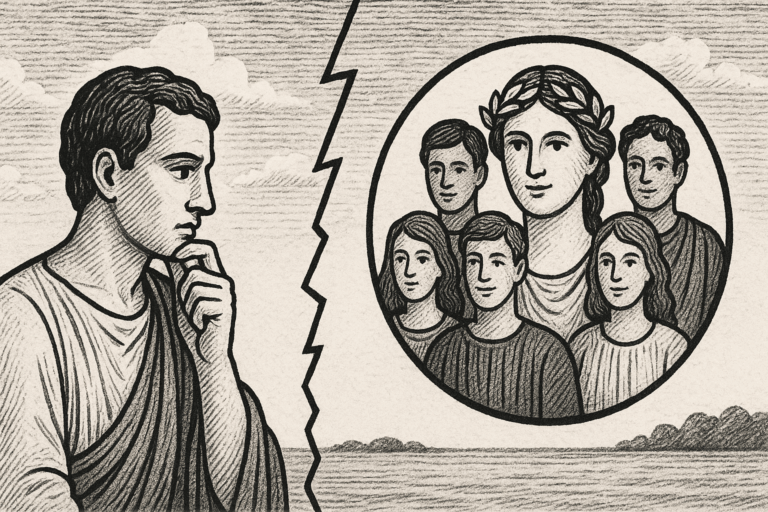
Drawing by Nathanaël Schmid for Le Regard Libre
These two seemingly unrelated tragedies, on different scales, reveal the same mechanism: each political camp selects the facts that confirm its beliefs - an old reflex. What should worry us is the disappearance of confrontation between these opinions.
Two very different events. A drama and a tragedy. Two sets of reactions to seemingly unrelated themes, yet both saying the same thing about our times. The landslide of ice and rock that swept away the village of Blatten in the Upper Valais unleashed a flood of hasty, acidic and caricatured reactions, furiously reminiscent of the one-sided indignation surrounding the horrors of the Middle East.
Environmentalists were quick to seize upon the catastrophe, framing it in the logic of «ecocide». The mountain collapsed because of global warming, and therefore because of man. The opposing camp, led by the UDC, only retained from the words of the head of the cantonal Natural Hazards Service, Raphaël Mayoraz, the nuanced and cautious statement that it could not be said at this stage that the event had been directly caused by climate change. Landslides are the very history of the Alps.
These contrasting interpretations have been echoed by media on the left (i.e. almost all) and the right (look at the German-speaking part of Switzerland). Each of them undoubtedly takes only part of the reality into account. The fact that erosion is a normal phenomenon in mountains - which are themselves forged by erosion - is compatible with the fact that global warming is accelerating ice melt. Similarly, the fact that CO2 create climate disruption does not mean that all climatic phenomena are attributable to them, nor that mankind is responsible for all CO2...
In fact, each of the two camps retains from the facts only those elements that corroborate its preconceived discourse. The horror, pain and complexity of reality are sifted through an ideological sieve. The phenomenon is well known, and even has a name in cognitive science: confirmation bias. We're no longer looking for the truth, but for confirmation of what we already believe.
This bias is nothing new. Ideologies have always shaped our perception of reality. And this bias is not in itself reprehensible. As essayist Samuel Fitoussi explains in his new essay Pourquoi les intellectuels se trompent («Why intellectuals get it wrong») (see the interview we published), confirmation bias is not a brain bug. It's a function of the human mind, shaped by biological evolution to reinforce group cohesion. When two individuals in a tribe disagreed about which course of action to take, each would accumulate as many arguments as possible in favor of his or her idea. The tribe would then make its choice after listening to the debate (and, incidentally, punishing the loser). What's problematic today is the disappearance of adversarial debate.
The fact that everyone accumulates arguments in favor of their preferred thesis is a relatively normal trait. Of course, the ideal is to choose one's ideas based on the study of the various arguments, and not the other way around. In practice, however, the ideal is rarely attainable. Digging deeper often leads to a a priori basic. And it's good enough to improve the way you defend your own cause, as long as you're challenged.
We don't need to dream of a neutral, all-knowing individual, but of spaces - political, academic, media - in which opinions can be confronted and enriched. The gravity of Gaza and Blatten should compel us to defend the existence of these safe spaces.
Every month, a member of the editorial team takes a stand on a subject related to the issues addressed in Le Regard Libre.
You have just read an open-access editorial from our print edition (Le Regard Libre N°118). Debates, analyses, cultural news: subscribe to support us and access all our content.

You'll also like
 French
  German
  English
Leave a comment