




Meeting with Elisa Shua Dusapin, a mixed-race revelation in French-language literature
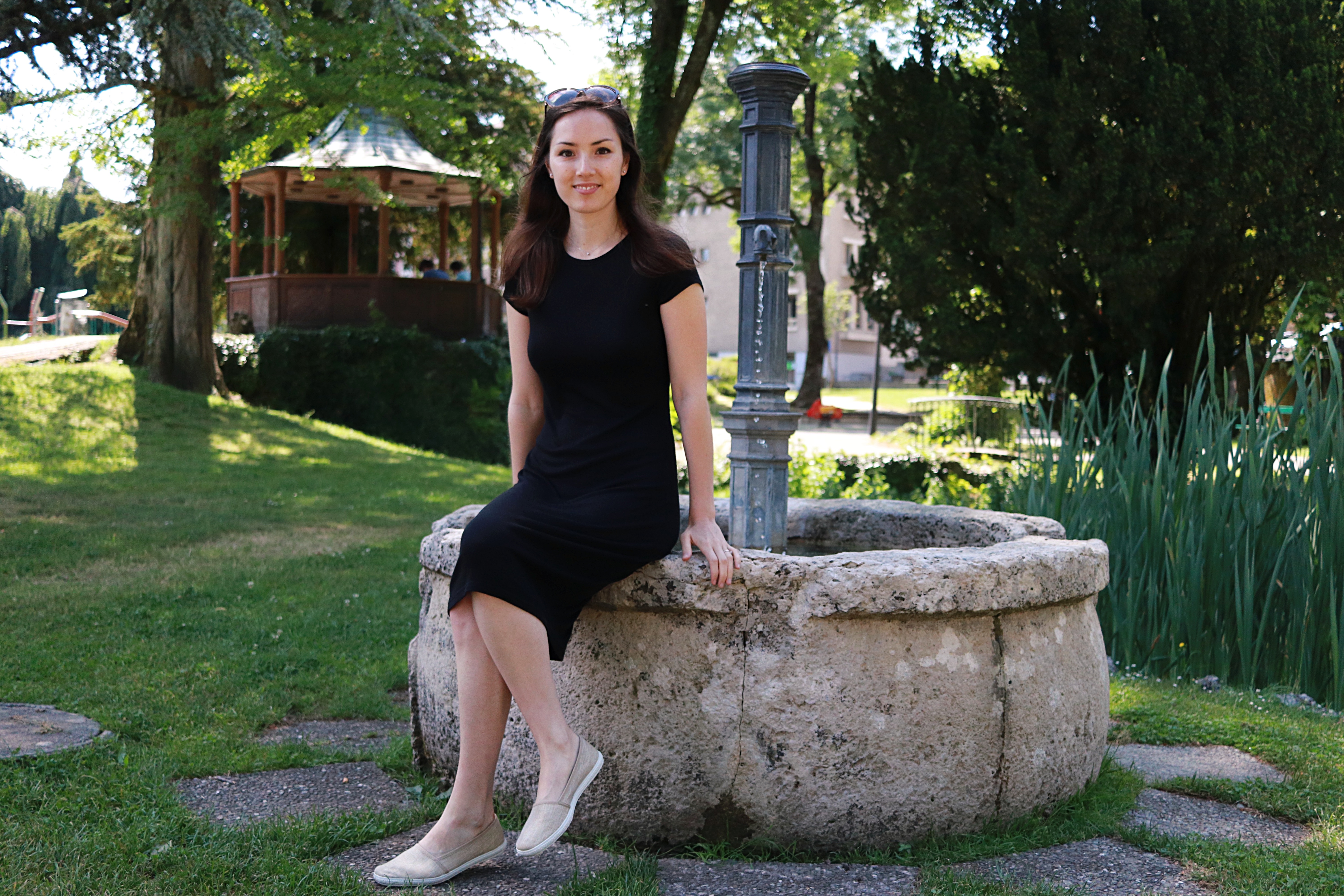
As well as being young and charming, Elisa Shua Dusapin is emerging on the French-language literary scene as a spellbinding revelation, for her delicate pen and her sense of métissage. With a Korean mother and French father, the writer grew up on the border between these two cultures. This gave a multicultural tone to her first novel, Winter in Sokcho (2016). It tells the story of a meeting between an unnamed French-Korean narrator and Kerrand, a comic book artist from Normandy. She works in a seedy boarding house to finance her studies; he becomes her host in search of inspiration. A bond of anguish and sensuality, weariness and modesty is forged between these two people, whom everything seems to separate. This simple, hard-hitting work is a real success, and has recently won numerous awards.
Le Regard LibreYour family origins are not unrelated to the novel. What kind of happy mix are you?
Elisa S. Dusapin: From the outset, I consider it fundamental to establish that’Winter in Sokcho is not an autobiography. The only thing the narrator and I have in common is our Franco-Korean origins. My mother is Korean and my father French. I was born in France, but most of my life was spent here, in Porrentruy. My protagonist, on the other hand, was born in Korea and knows France only through literature.
How did you come to write this book?
It all started in high school. More than just a desire to write, I felt the need to do so. I needed to talk about my relationship with mixed race and multiculturalism. Intimidated, however, by the weight of my literary masters, I didn't dare set to work. The trigger came when I had to choose a subject for my mature thesis. It was now or never to write, for the simple reason that there would be a deadline to meet and the judgment of teachers to guide me. And then, revelation. I knew from that moment on how important writing would be in my life. What's more, I had the real good fortune to hear about the Swiss Literary Institute in Biel just a day before I was due to submit my work. Without giving it much thought, I signed up.
What have you learned from the Literary Institute?
Mainly, the professional relationship with writing. In the solitude it implies, in its rigor. Writing isn't just about putting your emotions down on paper. It's an authentic craft.
A craft?
Yes, absolutely. Such a consideration desacralizes writing. At school, we tend to place literature so high that it seems inaccessible. There are certainly Rimbauds and Baudelaires whom everyone admires, but the work of a novelist today, as in the past, consists in writing, deleting, reading, rereading, criticizing, removing entire passages and adding new ones. And exchanging ideas with other writers.
Noëlle Revaz, in particular.
In this case, since she was my mentor at the Literary Institute. But also with my fellow students. After all, it's not with everyone that you can discuss the problems encountered in a text in progress. Their opinion is very important, if not essential.
Your entire novel is set in Sokcho. Why did you choose this seaside town in South Korea?
To tell the truth, I had originally set the story in Pusan, the country's second-largest city and a major international fishing port. Above all, I wanted the sea to be present in my story. As the writing progressed, I realized that I wasn't at ease with Pusan, even though I know it well. Intimately, I didn't feel close to the place. Then I remembered another place: Sokcho. I was there by chance with my family in 2011. It's not a beautiful town, but it did resonate with me. In its nostalgia, in its heartbreak, since it's forty kilometers from North Korea. Its inhabitants are constantly waiting for the serenity of summer, with its more livable climate and tourists. And even in high season, the seaside resort still suffers from the presence of the military and barbed wire. It's strange, because joy and life coexist with the omnipresence of death. With its alternating emptiness and overflow, and its scarred geographical location, Sokcho is an extension of the narrator.
In a dialogue between the narrator and Kerrand, you write: «My Normandy is no longer Maupassant's Normandy. - Maybe it isn't. But it's like Sokcho.» What is the deep connection between Sokcho and Normandy?
The only link I really wanted to show between these two lands was the fantasy of difference. The girl in the novel has never been to France. But Maupassant gives her an idea of Normandy. Kerrand, on the other hand, seems to be alone under Sokcho's spell.
With a detour into history, the narrator tells us about the Korean War: «Your beaches, the war has passed over them, they bear the scars, but life goes on. The beaches here are waiting for the end of a war that's been going on for so long that we end up believing it's over, so we build hotels and put up garlands, but it's all a lie [...]». What is false?
As the author, I'm making no personal judgement here. What's wrong is in the character's eyes. She's perpetually frustrated by living in this city of Sokcho, when she'd love to leave, if only to stay close to her mother. What's more, she must be overwhelmed with jealousy of the tourists who come during the summer boom, only to leave again, leaving a nostalgic void. They know only the make-up of the place, its tinsel and pomp. The illusion of a war over, of happiness regained. My grandparents themselves, who lived through the country's tearing apart, are still hoping for a reunification of the two Koreas.
You speak of frustration and jealousy; isn't it in fact a tragedy that takes shape through the intimate history of each of the characters, from the narrator to her boyfriend, to her mother and Kerrand?
There's certainly tragedy in all these characters. But beyond the tragedy, I would emphasize the state of affairs. A fatality revealing a reality against which we can do nothing. For the narrator, this is true of her relationship with her body. She doesn't feel good about it, and would like to change it, while rebelling against the dictates of appearance. Nevertheless, I tried to avoid tackling this theme head-on, so as not to fall into cliché or pathos. I absolutely wanted to avoid the two pitfalls of a flat romance or a psychologizing drama. At the same time, the ambient tragedy and nostalgia of’Winter in Sokcho are very representative of the Korean people. A bit like the Portuguese, whose emblematic song is the Fado. It's been said that Koreans are the Latins of the Far East; they express sadness through the beauty of art. In folk songs and tales, there's always the idea of the occupation and cultural hegemony of Mongolia, China or Japan. In reality, I think it's a feeling of confinement that's being expressed.
Isn't it the paradox of people living by the ocean that they feel enclosed?
The sea and the ocean represent birth, life and absence, the distant at once. Looking at the sea is ultimately looking at a line. So how do we relate to the coastline? What does it inspire in us? A barrier, freedom? That's the paradox of beaches.
In other interviews, you've been systematically asked about the place given to food in this novel. Let's talk about alcohol this time, which is also very present. Does it help facilitate the relationship between the narrator and Kerrand, or does it block it?
Koreans drink a lot, it's a cultural thing. As for the narrator, she finds her spirit of control altered by alcohol. She, who usually wants to control everything, doesn't let go of anything. In any case, whether or not drinking really relaxes the relationship between the two, it certainly brings her a discreet sensuality.
Basically, what's blocking the relationship between your main protagonist and Kerrand?
It's so hard to really meet someone. That's the case in general, but even more so when there's a cultural barrier between people. Differences in language, gender and so on make it difficult to make contact. Kerrand and the narrator stand at these boundaries, although they also have things in common, including loneliness. Perhaps they understand each other in their loneliness. Dealing with this similarity between the two allowed me to ask myself the question of the status of an author, who lives terribly alone, facing his paper, to write a text without knowing its destiny. Like Kerrand, I ask myself why I write. What is this will or need?
The unease of both gives rise to a sensual desire to be embalmed with modesty. But why not cross the line into eroticism?
It was the characters who forced me to maintain constant modesty. In the first drafts of the novel, there were many more scenes of nudity or direct eroticism, especially through the description of Kerrand's drawings. I cut most of these passages because I didn't want Kerrand to be seen as an erotic comic book writer. I had to say as little as possible about sensuality to give the reader greater freedom of imagination. I also wanted to avoid the easy way out of sex, which is certainly pleasurable but doesn't add much to the story. What's more, given the coldness of both of them, there's much more eroticism in the touch of a hand than in any other kind of touching.
Finally, what are your literary projects? Will they remain in Korea?
At the moment, I'm working on two parallel projects: a second novel, which is already well advanced, and a musical theater for young audiences based on Debussy. I can tell you that, in the novel, Korea will indeed be present, and there will be links with Japan and Switzerland. Overall, I'll be taking up the idea of the national symbol, with its reappropriation and reinterpretation on the other side of the world. The relationship with language will also play an important role. But I won't tell you any more, to leave you with a bit of a surprise.
You'll also like




 French
  German
  English
1 comment
[...] readers discovered Elisa Shua Dusapin through her first book, «Hiver à Sokcho». We reported on this encounter in issue 29. In the meantime, the book has become a real success, [...].
Leave a comment